
Hallway Rug Planning
A hallway runner should be sized from the hallway itself, then checked against every moving part around it. Width is only one decision. The usable length, end borders, door swings, stairs, thresholds, rug thickness and the way people actually move through the space all affect whether a runner feels deliberate or awkward.
Use this order: measure the finished hall → mark doors, stairs and transitions → decide the visible floor borders → calculate a working rug width and length → tape the footprint → check the pad and finished thickness.
1. Measure the narrowest finished width
Measure the corridor wall to wall at several points. Older hallways can taper, baseboards can project and trim can make one section narrower than the rest. Use the narrowest real passage as the controlling dimension rather than an average.
Mark any console, radiator, shoe cabinet or other fixed projection at the same time. A runner that looks centered in an empty hallway can become visually off-center once furniture reduces the usable path.
2. Decide how much floor should remain visible
A consistent strip of flooring on both sides usually makes a runner look intentional and keeps the edges away from the wall. Instead of starting with a standard rug width, decide what side border feels balanced and work backward from the hallway width.
If a standard size lands between two good options, mock up both widths with painter’s tape. The wider choice can feel richer in a generous hall, while the narrower choice may preserve better circulation in a tight passage.
3. Treat doors as moving zones
Open every door that enters the hallway and watch where the bottom edge travels. The rug and pad should not make a door drag, fold the rug edge or stop short of its normal opening position.
Pay particular attention to doors at the ends of the runner. A rug that technically fits the hallway length may still be too long if it sits under a frequently used door or crosses a raised threshold.

4. Stop before stairs and level changes
A loose runner should not crowd the first stair tread, step-down or landing edge. Leave a clear visual and physical break where people change level so the floor transition remains easy to read.
The same principle applies where the hallway meets another floor material. Let the runner belong to the hallway rather than extending uncertainly into the next room.
5. Check the whole length, not only the ends
Long hallways often have several doorways and cross routes. Walk the entire proposed runner path and notice where feet naturally cut corners, where people turn into rooms and where the edges receive the most traffic.
If the available standard lengths leave a very large empty zone, a made-to-length runner may produce a cleaner result than forcing two separate rugs into one traffic route.
6. Include pile and pad thickness
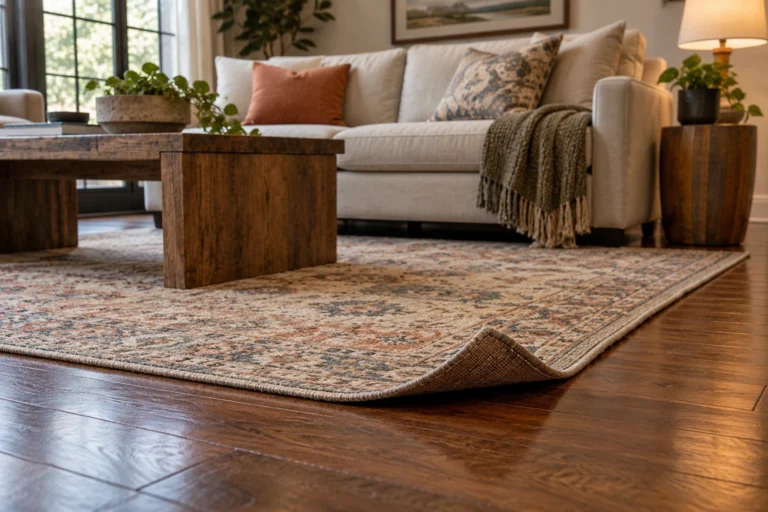
Door clearance and trip risk depend on the finished stack, not the rug alone. A substantial pad can improve grip and feel, but it also raises the surface near doors and thresholds.
Choose a pad that is compatible with the floor finish and trim it so it stays fully inside the runner edge. If a door has minimal clearance, test the combined thickness before ordering.
7. Let pattern support the hallway
Bold stripes and geometric repeats can make a crooked corridor or slightly off-center rug more obvious. Organic motifs and smaller repeats are often more forgiving in older homes.
For a custom runner, ask how the pattern repeat will be centered and where it will end after binding. The cut can matter as much as the nominal length.
8. Tape the footprint and live with it
Mark the proposed rug outline with painter’s tape and leave it in place for a day. Carry a laundry basket through the hall, open every door and walk the route at night.
This simple test reveals whether the runner is visually centered, whether the exposed borders feel balanced and whether the ends sit in the wrong place for the way the hall is actually used.
Hallway runner worksheet
| Check | Record | Why it matters |
|---|---|---|
| Narrowest hallway width | _____ | Sets the maximum practical rug width |
| Desired side border | _____ per side | Controls visual balance and edge clearance |
| Usable uninterrupted length | _____ | Defines the longest sensible runner |
| Door or threshold conflicts | Yes / No | May shorten or reposition the rug |
| Rug + pad thickness | _____ | Affects door clearance and transitions |
Before you buy or install
- Measure the hallway in more than one place.
- Open every nearby door fully.
- Keep the runner clear of stairs and level changes.
- Mock up width and length with tape.
- Check rug-pad compatibility with the floor.
- Confirm return and custom-cut policies before ordering.
Related Dwelanor guides
This guide calculates both runner width and overall fit. If the width is already settled and the problem is where the rug should end relative to doorways, thresholds and stairs, use the hallway runner length and end-border guide.
- Entryway & Hallway Design Guide
- Hallway Runner Width Guide
- How to Choose an Area Rug
- Rug Pad Guide
- Safer Hallway Runner Guide
- Narrow Hallway Guide
FAQ
Should a hallway runner touch the walls?
Usually no. Visible floor along the sides helps the runner read as a distinct layer and keeps the rug edge away from the baseboards.
Can a runner go under a door?
Only if the door clears the rug and pad comfortably through its full swing. If clearance is tight, stop the runner outside the swing zone.
What if no standard length fits?
A custom-cut runner or bound carpet runner can make sense in a long or unusually proportioned hall, especially when two separate rugs would create awkward edges.
Bottom line
Measure the hall as a traffic system, not an empty rectangle. Balanced floor borders, clean stopping points and uninterrupted door and stair clearances matter more than matching a generic standard size.