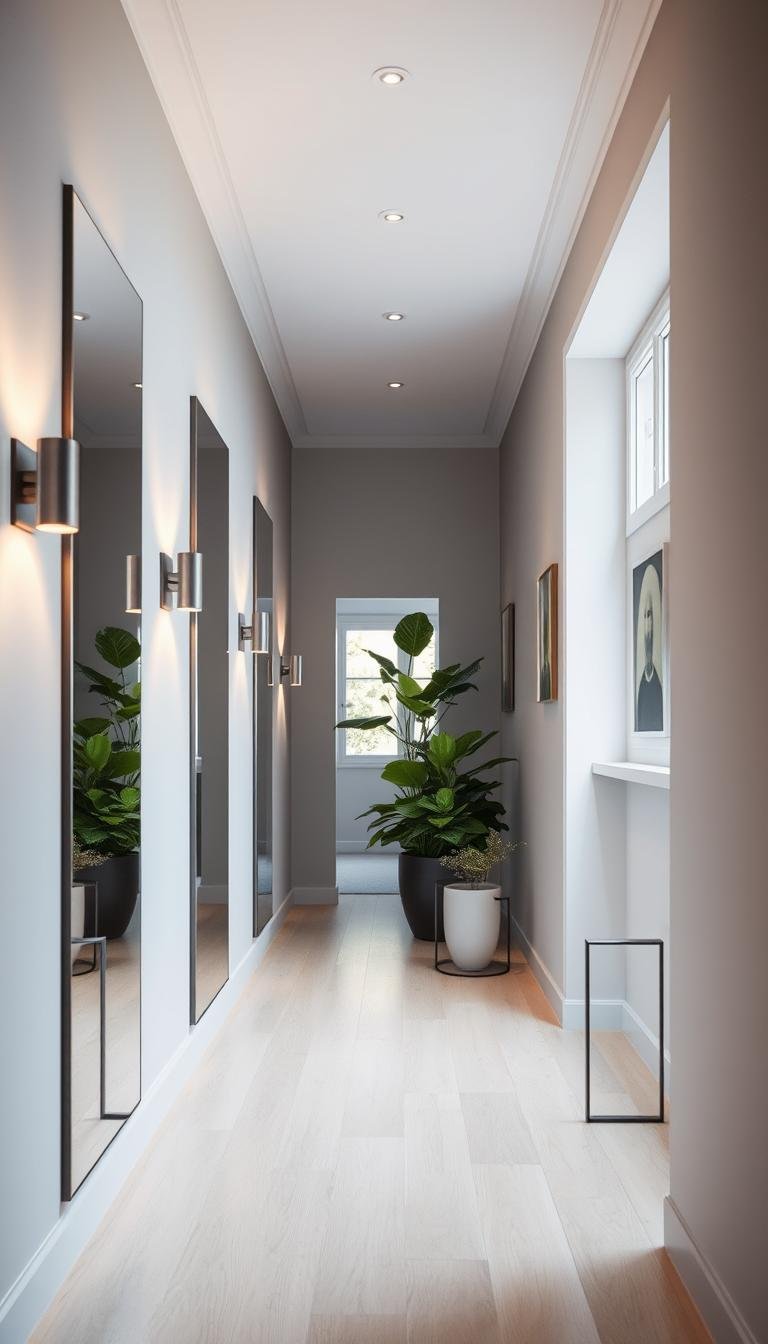
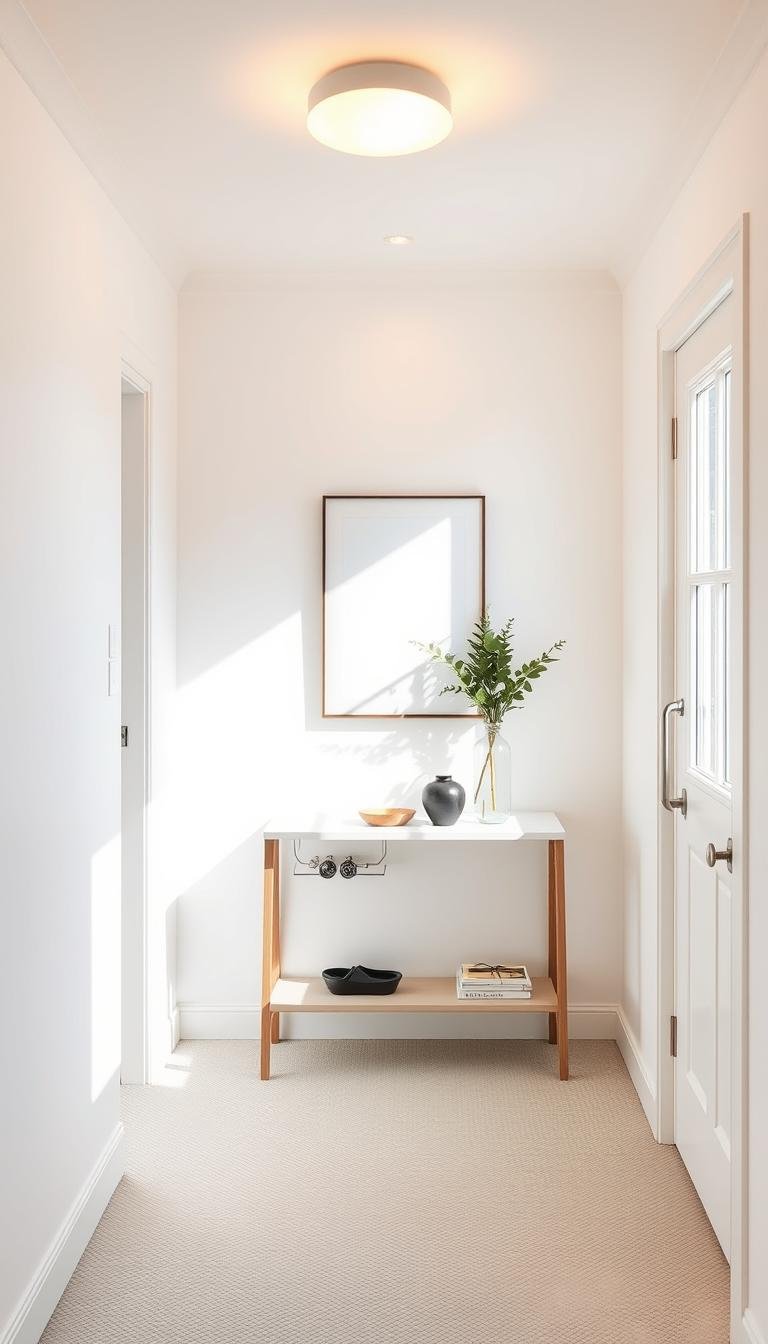
An entryway should make arriving and leaving easier, while a hallway should move people through the home without becoming wasted or cluttered space. Start with circulation and the objects that naturally collect there, then add storage, lighting, mirrors, rugs and wall decor.
The useful sequence is movement → arrival habits → storage → furniture depth → lighting → runner or floor → mirror → wall decor → finishing details.
1. Start with the walking route
Entries and halls often feel cramped because furniture projects into the path. Mark the main route from the door to the rest of the home and keep it visually and physically clear.
Open the front door, nearby cupboards and interior doors while testing any console, bench or shoe cabinet footprint.
2. Build the drop zone around real habits
Keys, mail, bags, shoes and coats tend to land where people naturally stop. Put storage close to that point rather than creating a beautiful but inconvenient station somewhere else.
A shallow tray, hook rail, drawer or small cabinet can be enough. The goal is not maximum storage; it is a fast reset.
3. Choose shallow furniture in tight entries
A console table can provide a landing surface without consuming much floor area. In very narrow passages, wall-mounted shelves or hooks may work better than freestanding furniture.
Use our slim console table guide when every inch matters.
4. Add seating only when it helps
A bench is useful where people remove shoes, manage children or set down bags. If it narrows the path, a smaller stool or no seating may be better.
Storage benches can combine two jobs, but check that lids, drawers or baskets remain easy to access once the entry is busy.
5. Use mirrors for a useful view
An entry mirror can support a final check before leaving and can reflect light into a darker area. Place it where the reflected view is attractive and where people can stand at a natural distance.
Use the Mirror Guide and full-length entry mirror guide for more detailed placement.
6. Light hallways in layers where possible
Long passages can feel flat when they rely only on one ceiling fixture. Ceiling lights, wall lights and picture lights can create rhythm when they are appropriate to the architecture.
Where hardwiring is not available, a well-placed rechargeable light can provide a temporary solution. Use the Home Lighting Guide for the broader strategy.
7. Runner rugs should support the passage
A runner can soften a hallway and create visual direction, but it needs stable placement, appropriate pile height and enough exposed floor at the sides to feel intentional.
See hallway runner width and runner safety for older adults. The Rug Pad Guide covers floor compatibility and grip.
8. Treat a narrow hallway as one long composition
Too many unrelated objects make a corridor feel narrower. Repeating frame styles, lighting, color or a single material can create rhythm without visual clutter.
If the hallway already feels tight, use how to make a narrow hallway feel wider for the focused problem-solving guide.
9. Gallery walls work particularly well in passages
Hallways naturally support linear or collected art because people move past them rather than sitting directly in front. Keep projection low and frame depth practical in narrow routes.
Use the Gallery Wall Guide and family photo hallway ideas.
10. Coordinate the entry with the first room people see
The entry does not need to match the living room exactly, but repeating one or two colors, materials or finishes creates continuity. A timber console, brass-tone mirror or rug color can bridge the spaces.
11. Keep the floor easy to maintain
Entries deal with dirt and moisture from outdoors. Choose rugs, mats and floor treatments around the actual climate and cleaning routine, and avoid loose edges in the main walking path.
Entry and hallway checklist
- The main route remains clear.
- Daily arrival objects have a nearby home.
- Furniture depth suits the passage.
- Lighting supports movement and atmosphere.
- Runner rugs are stable and appropriately scaled.
- Mirrors reflect something useful or attractive.
- Wall decor creates rhythm rather than clutter.
Next: explore the Storage & Organization Guide, Gallery Wall Guide and Entry & Hallways library.