Rug Planning
The most useful dining-room rug calculation starts with the table, then adds the distance your chairs actually travel. That produces a better result than choosing a rug from the room dimensions alone.
The sequence is table size → chair pull-back → table leaves → required rug footprint → standard rug size → room perimeter → doors and furniture → pad thickness.
Dining rug size formula
For a rectangular table, start with:
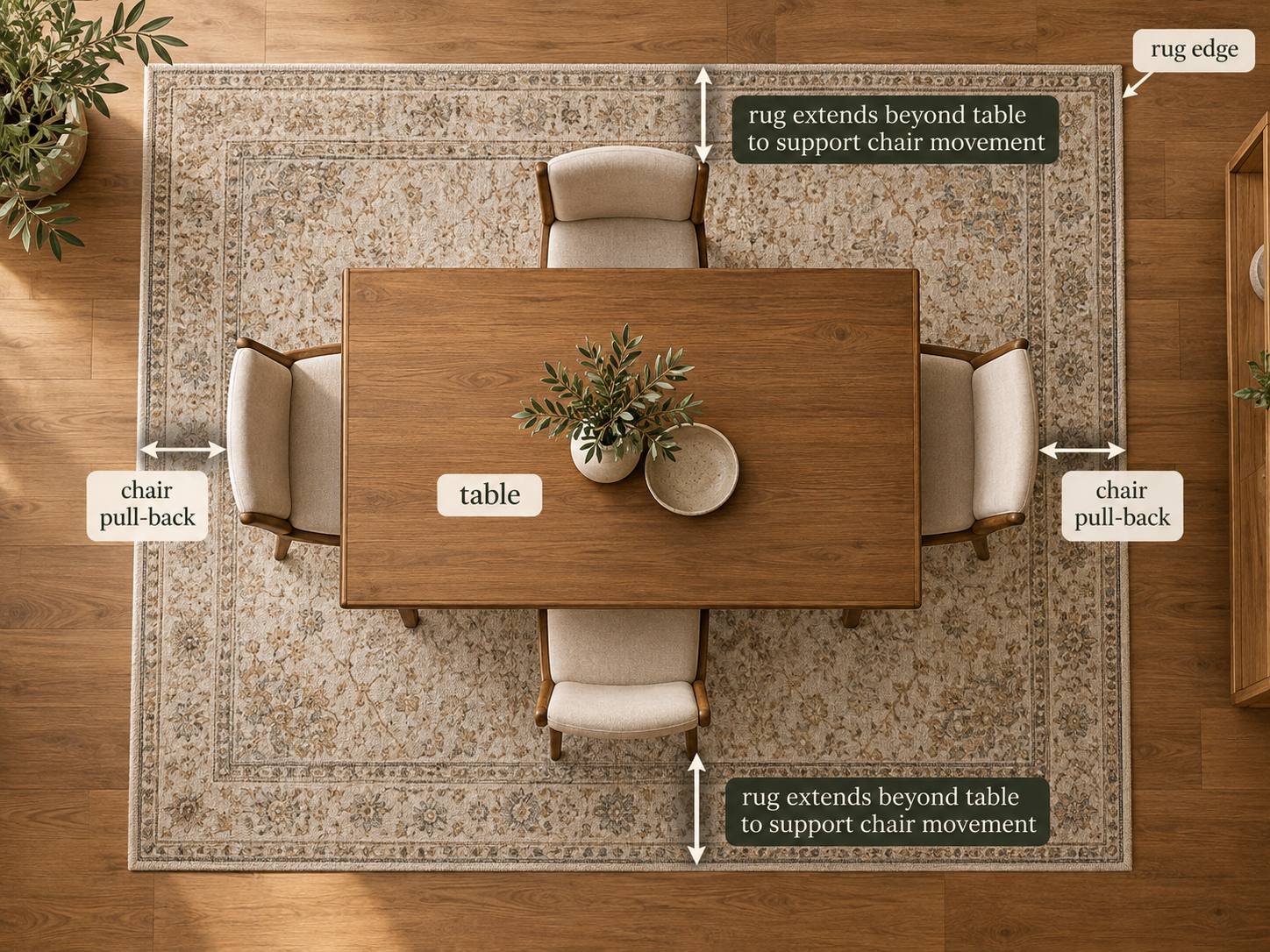
Required rug length = table length + (2 × tested chair pull-back)
Required rug width = table width + (2 × tested chair pull-back)
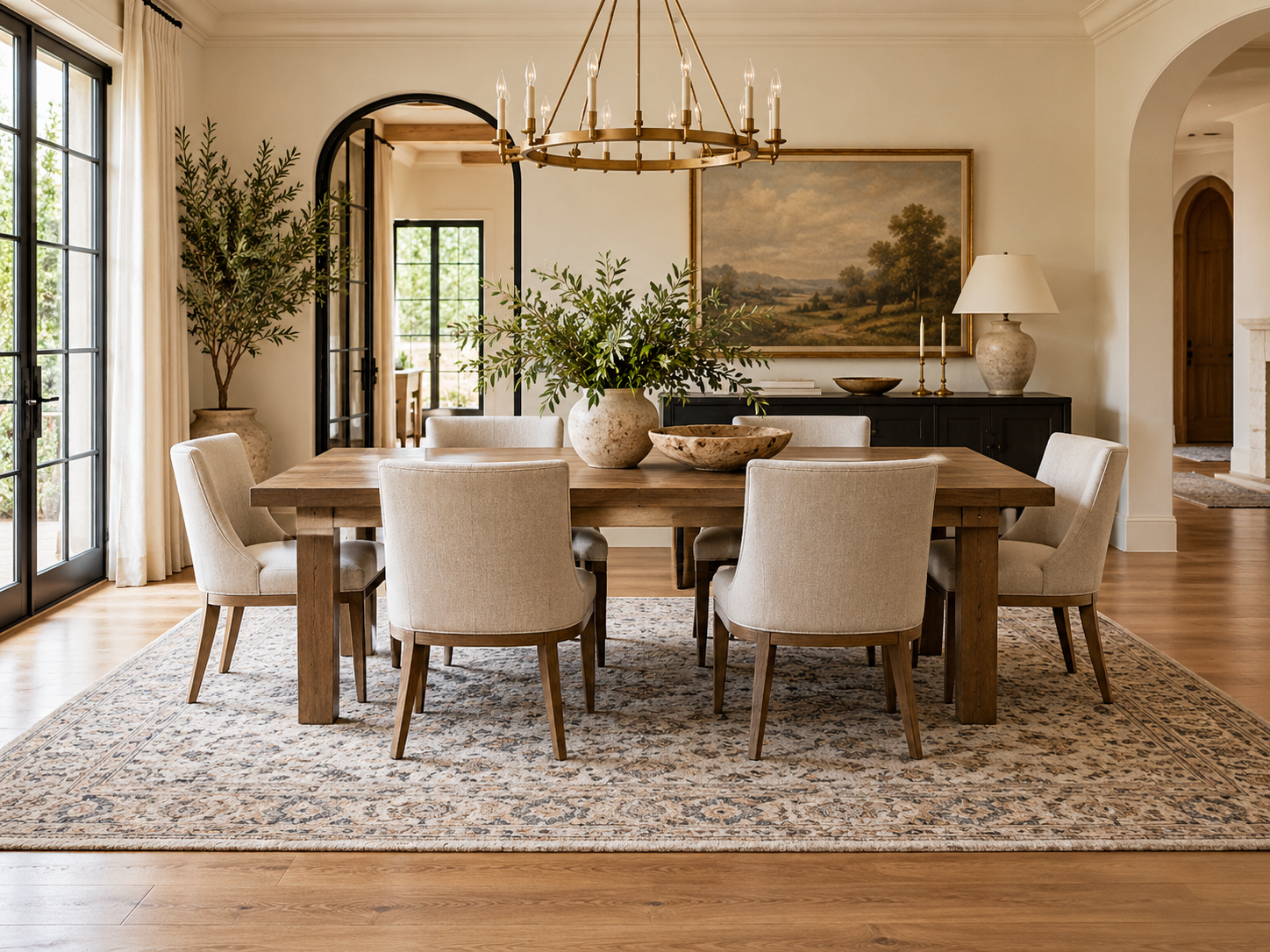
A common starting test is roughly 24 to 30 inches beyond the tabletop on each side, but deeper dining chairs or people passing behind them may need more. A widely used starting range is about 24 to 30 inches beyond the tabletop on each side. Crate & Barrel’s current rug guide recommends 24 to 30 inches so dining chairs remain on the rug when pulled out. The important step is still to test your own chair travel rather than treating the number as universal. See the Crate & Barrel rug-size guide.
1. Measure the table at its real working size
Measure the tabletop at the widest points. If extension leaves are used regularly, decide whether the rug should support the extended table too.
A rug sized only for the closed table may become visibly short when extra chairs are added at the ends.
2. Measure chair pull-back instead of guessing
Place a chair at the table as it is normally used. Pull it back far enough for a person to stand comfortably. Measure from the table edge to the rear-most chair leg.
Repeat with the deepest or largest chair, especially if end chairs have arms.
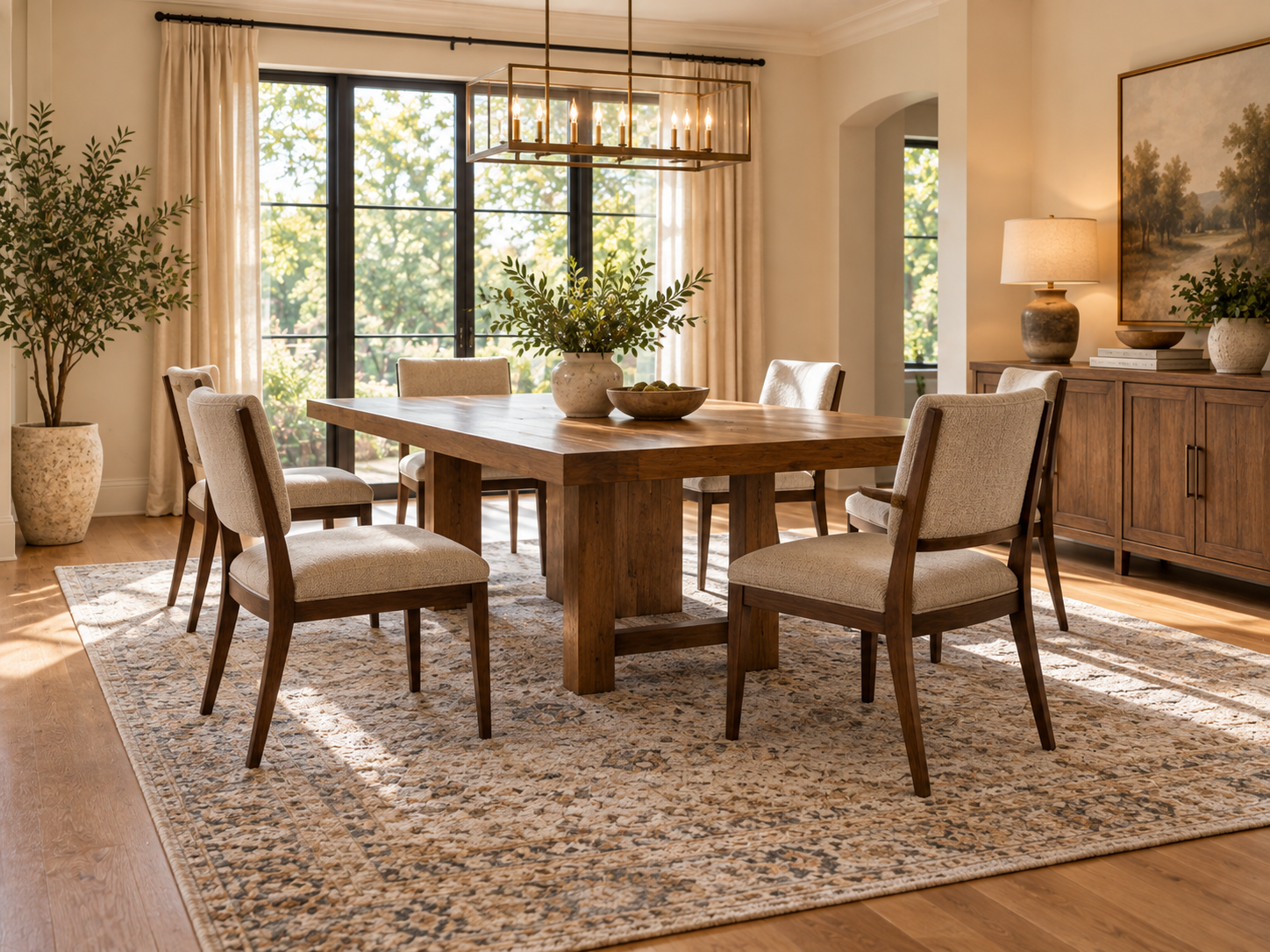
3. Round up to a practical rug size
Your calculated footprint may not match a standard rug exactly. Round up rather than down when the smaller option would put chair legs close to the edge.
| Table example | Tested pull-back per side | Calculated minimum footprint |
|---|---|---|
| 36 × 60 in | 24 in | 84 × 108 in |
| 40 × 72 in | 24 in | 88 × 120 in |
| 42 × 84 in | 30 in | 102 × 144 in |
| 48 in round | 24 in | 96 in diameter starting footprint |
These examples illustrate the arithmetic only. Your chair movement and room still decide the result.
4. Check the room perimeter
A rug can satisfy the table calculation and still be too large for the room. Check nearby walls, sideboards, door swings, floor registers and transitions.
The rug should look deliberate rather than squeezed against every wall or trapping a door.
5. Include the rug pad
Pad thickness affects the finished edge. A thick pad can make a dining chair catch the rug edge more easily than a lower-profile system.
Use the Rug Pad Guide to compare material, thickness and floor compatibility.
6. Round tables still use chair movement
For a round table, add the tested chair pull-back to the radius on every side. The resulting minimum diameter is table diameter + (2 × chair pull-back).
A round rug can reinforce a round table visually, but a square or rectangular rug may work if the room architecture supports it.
7. Open-plan dining zones need two checks
In an open-plan room, the rug should define the dining group without colliding visually or physically with the living-room rug. Check the gap between zones and the route people use to move between them.
See the complete Rug Size Guide for living-room, bedroom and hallway sizing, and the Kitchen & Dining Design Guide for the full room relationship.
Common dining rug mistakes
- Sizing only from the tabletop.
- Ignoring extension leaves.
- Testing chairs while tucked in.
- Rounding down to the smaller standard rug.
- Ignoring doors, sideboards and the room perimeter.
- Choosing a thick pad without checking chair movement.
Worked examples
72 × 40-inch rectangular table
If your deepest chair needs 26 inches of pull-back from the table edge, the calculated starting footprint is 124 × 92 inches. A standard rug that is smaller than that may still work if your actual chair movement is shorter, but you should not round down without testing the chairs.
48-inch round table
If the chair pull-back test is 24 inches, the starting rug diameter is 96 inches. That points toward an 8-foot round rug before room-perimeter constraints are checked.
Chair design changes the calculation
Upholstered dining chairs, armchairs and chairs with angled rear legs can require more usable rug area than compact armless chairs. Use the chair with the greatest rearward travel for the calculation, not the smallest chair in the set.
Rug construction matters too
Low-pile rugs usually allow dining chairs to move more easily than thick high-pile rugs. The rug pad also changes finished edge height. A technically large-enough rug can still be frustrating if the chair catches the edge every time it moves.
The Rug Pad Guide covers pad thickness and floor compatibility, while How to Choose an Area Rug covers construction and material.
Frequently asked questions
Should the rug match the table shape?
It can, but it does not have to. A round table on a round rug creates an obvious relationship; a round table on a square rug can also work when the room itself is square and the chair movement is fully supported.
What if the calculated rug nearly touches the walls?
Reassess the whole room. The table may be too large for the space, the chair pull-back may be unusually deep, or a rug may not be the best choice for that dining zone.
Do I calculate from the table base?
No. Use the tabletop edge as the starting line for chair movement, then verify that the table base does not interfere with chair placement.
Bottom line
Measure the table, test the actual chair pull-back, add that distance to every relevant side, then round up to a practical rug size that still fits the room. The chair movement is the real calculator.