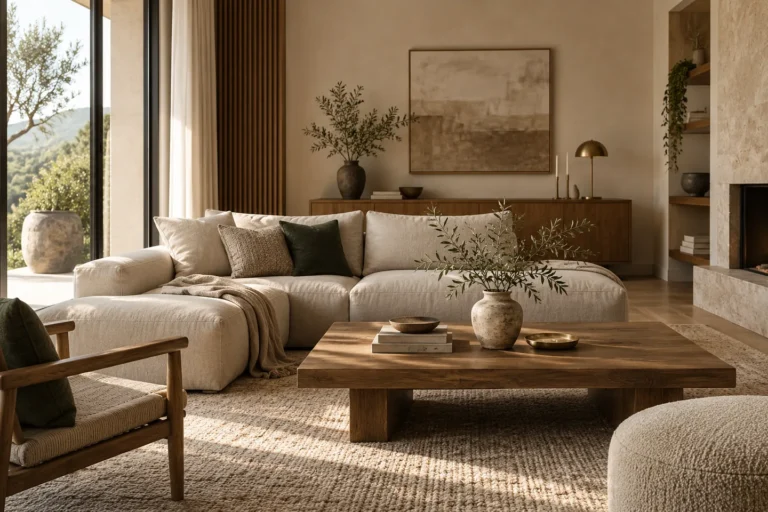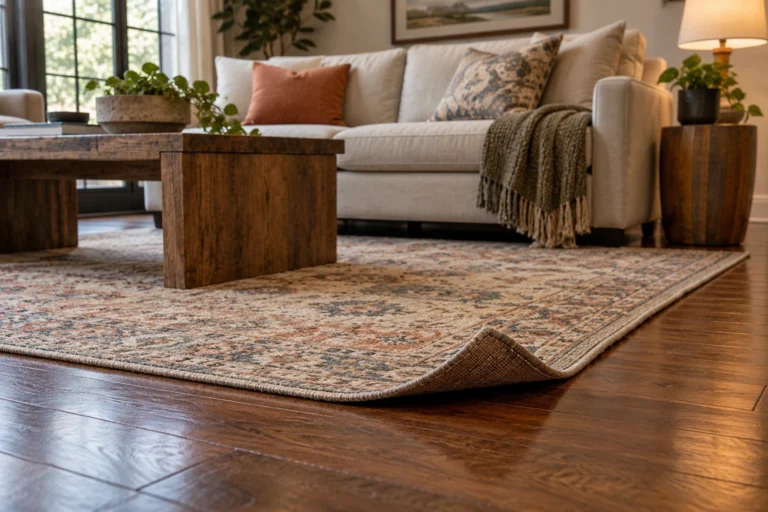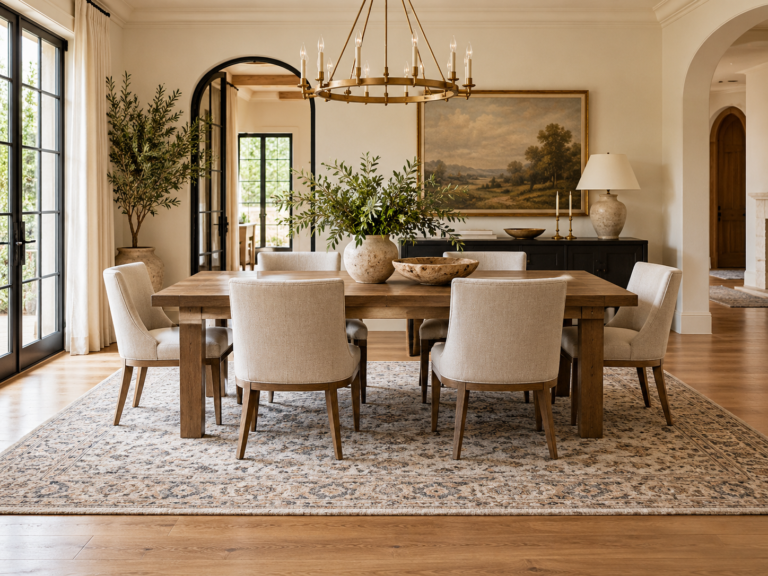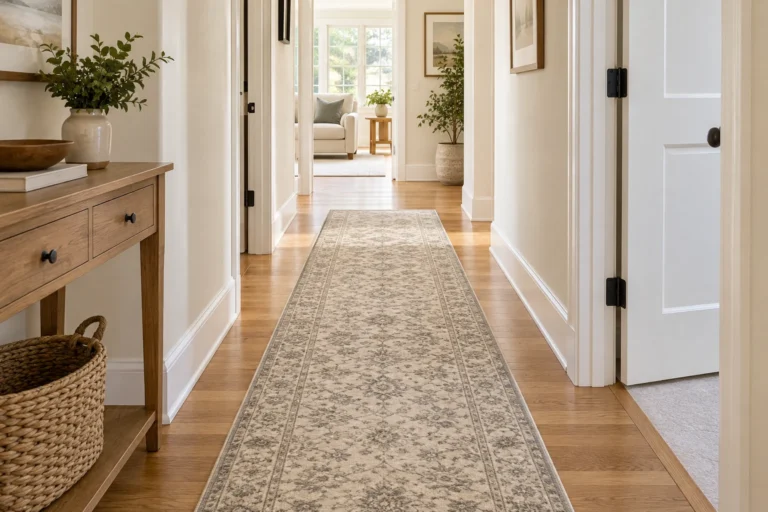
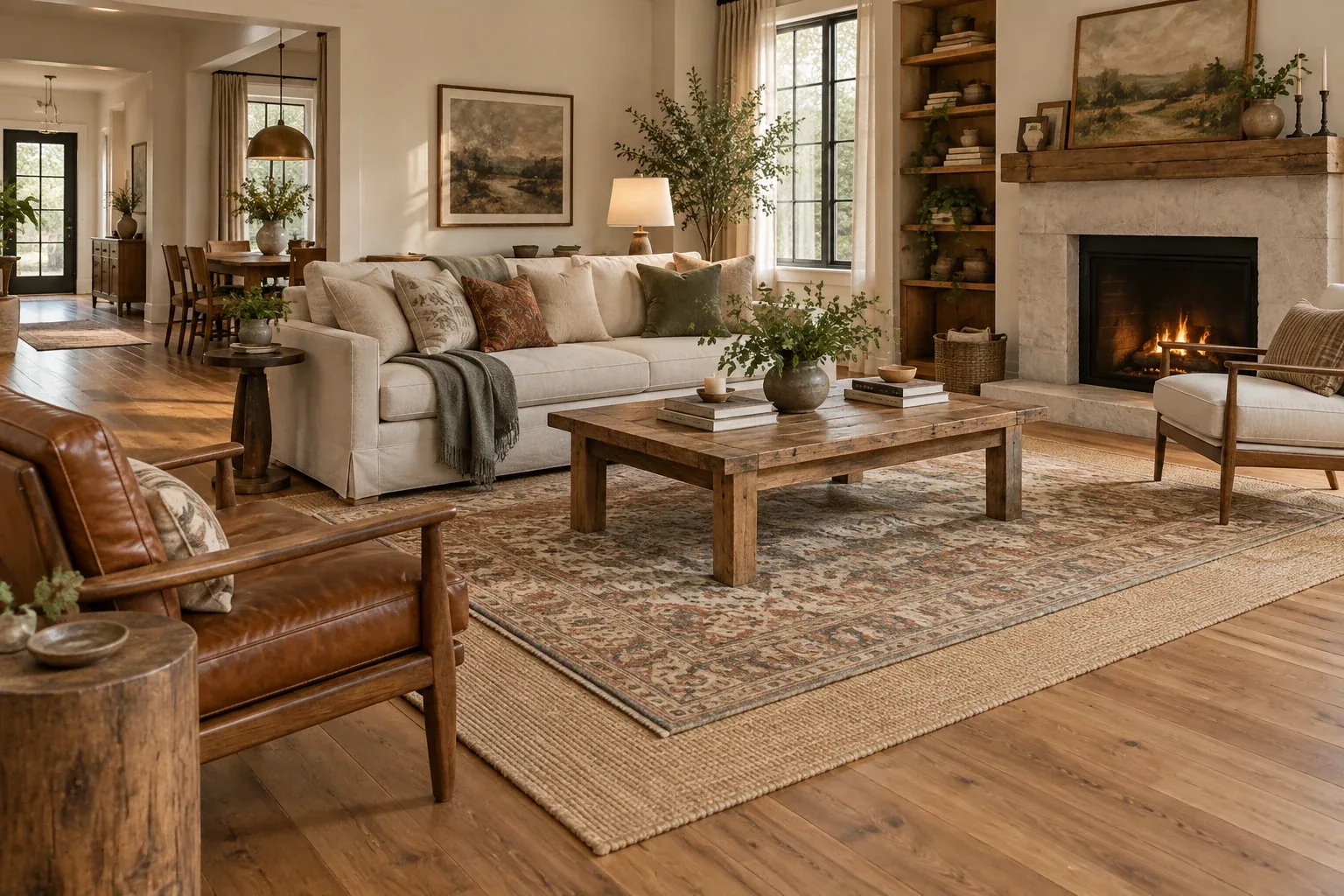
Layering rugs in a high-traffic room works best when the bottom rug creates a stable, low-profile foundation and the top rug adds color, softness or pattern without creating a trip edge. Start with floor compatibility and movement control, then make the visual decisions.
The useful relationship is floor surface → base rug → rug pad → top rug → total thickness → furniture placement → traffic path → cleaning routine.
Why layer rugs at all?
Rug layering can solve several design problems at once:
- add a smaller patterned or vintage rug without requiring it to fill the whole seating zone;
- introduce softness over a durable flatwoven base;
- define a conversation area in an open room;
- change color or pattern seasonally without replacing the large base rug;
- give a small special rug more visual presence.
Those benefits only matter if the two rugs remain stable and the stack is comfortable to walk across.
The base rug does the structural work
The lower rug should usually be the calmer and more stable layer. Flatwoven, low-pile and tightly constructed rugs are often easier to layer than a deep shag or thick sculptural rug.
Choose the base rug by the room’s wear, cleanability and floor system rather than assuming one fiber such as jute, sisal or wool is always best.
For example, a natural-fiber rug may provide useful texture but can have specific moisture, staining and cleaning limitations. A synthetic flatweave may suit another household better. Check the exact product rather than the category name alone.
The top rug should add something the base does not
A second rug earns its place when it contributes:
- a stronger pattern;
- a softer texture;
- a special vintage or handmade piece;
- a different shape;
- a clear color story;
- a smaller zone within a larger room.
If both rugs are equally busy, equally thick and equally dominant, the arrangement can look accidental and become harder to keep flat.
Use scale, not a fixed “one or two sizes smaller” rule
There is no required size jump between the base and top rug. The useful question is whether enough of the base remains visible for the layering to read intentionally.
Use painter’s tape to mark the proposed top-rug footprint. Check the composition from:
- the room entrance;
- the main sofa;
- adjacent rooms;
- the normal walking path.
A small top rug can work as a focal accent. A larger top rug can almost function like a second zone. The furniture and room geometry determine which is better.
Centering is not mandatory
A centered top rug creates a formal, balanced composition. An offset top rug can work when it relates to a chaise, reading chair, coffee table or other secondary zone.
Angling a rug can add movement, but it also creates more exposed corners. In a high-traffic room, use an angle only when the edges stay out of walking paths.
Furniture placement can stabilize the composition
Furniture may help hold a layered rug system in place, but do not use heavy furniture to force a wrinkled or distorted rug flat.
Check that furniture legs do not sit partly on one layer and partly on another in a way that creates wobble.
For living-room layouts, it often helps when the base rug clearly relates to the main seating group while the top rug reads as an accent rather than a random island.
Total thickness matters
A rug pad plus base rug plus top rug can become surprisingly thick.
Check:
- door clearance;
- transition strips;
- coffee-table stability;
- chair legs;
- robot-vacuum clearance;
- trip risk at exposed corners.
A low-profile stack is usually easier to live with in a busy room than two thick rugs layered together.
Choose the rug pad for the floor, not the visual style
The pad beneath the base rug should be compatible with the actual flooring surface and finish. A pad designed for hardwood is not automatically right for carpet, vinyl or radiant-heated flooring.
See our Rug Pad Guide for floor compatibility, material and thickness. Heated floors need extra product-specific checking against the flooring, heating-system, rug and pad manufacturers’ requirements.
Do you need a pad between the two rugs?
Sometimes the top rug stays stable because of its construction and furniture placement. In other cases, a purpose-made rug-to-rug grip layer may help.
Do not insert generic shelf liner or unknown rubber mesh between valuable textiles. If a grip layer is needed, choose one intended for that use and confirm that it is compatible with both rugs.
High-traffic areas need controlled edges
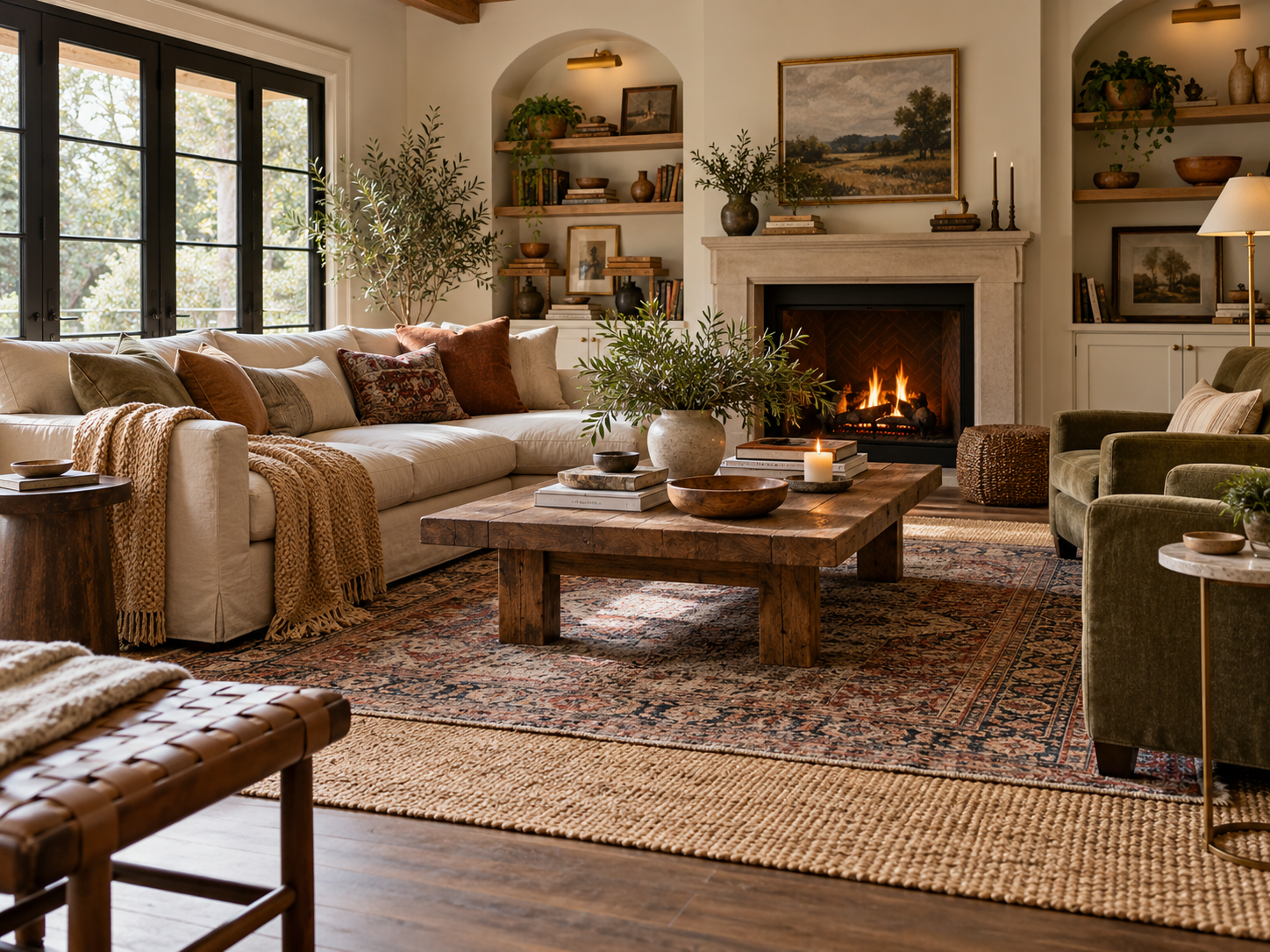
The most important part of a layered arrangement is often the exposed edge of the top rug.
Keep that edge:
- away from the narrowest walking line where possible;
- flat and free of curling;
- visible enough that people can read the change in level;
- clear of doors that sweep across it.
If an edge keeps curling, address the rug itself rather than adding more layers. See our rug-corner guide.
Pattern: let one rug lead
A reliable visual strategy is to let one rug carry the strongest pattern while the other provides quieter texture or color.
That does not mean one must be plain. Two patterns can work when they differ in scale and share at least part of the room’s palette.
Use the sofa, artwork and curtains as context. The rugs should support the room rather than requiring every other object to coordinate with them.
Texture: contrast deliberately
Layering becomes more interesting when the surfaces feel different.
Examples include:
- flatwoven base with a softer wool top rug;
- quiet woven base with a low-pile vintage rug;
- smooth tonal base with a more tactile patterned accent.
Keep the upper layer stable enough that the texture does not become a snag or trip issue.
What about jute and sisal?
Natural-fiber rugs can make attractive neutral bases, but they are not universally low-maintenance. Some dislike moisture, stain readily or shed fiber.
Check the exact rug’s care requirements and backing. If the room sees frequent spills, pets or wet shoes, another material may be easier to maintain.
What about washable rugs?
A washable top rug can be practical in a family room, but confirm that its backing and washing system remain compatible with the base rug beneath it.
Do not assume a two-piece washable rug system can be separated from its intended base and placed on another rug without affecting performance.
Dining rooms need chair movement to stay predictable
Layering rugs under a dining table can work, but chair legs repeatedly cross the rug surface. Multiple exposed edges can catch chairs or shift the top rug.
Before layering in a dining area, mock up the full chair movement from tucked-in to pulled-out positions. If the top rug edge sits directly beneath that travel path, simplify the arrangement.
Entryways and halls need extra restraint
Layering can add character to a wide entry, but narrow halls and tight door zones often benefit from a single stable rug instead.
Do not add a second layer simply for visual interest when it makes an already narrow passage less predictable.
Cleaning two rugs requires a plan
Layered rugs collect dust between surfaces. Periodically lift the top rug and clean both textiles and the exposed base according to their care instructions.
Make sure each rug is fully dry before re-layering. Trapping dampness between textiles can create odor and material problems.
A practical layering sequence
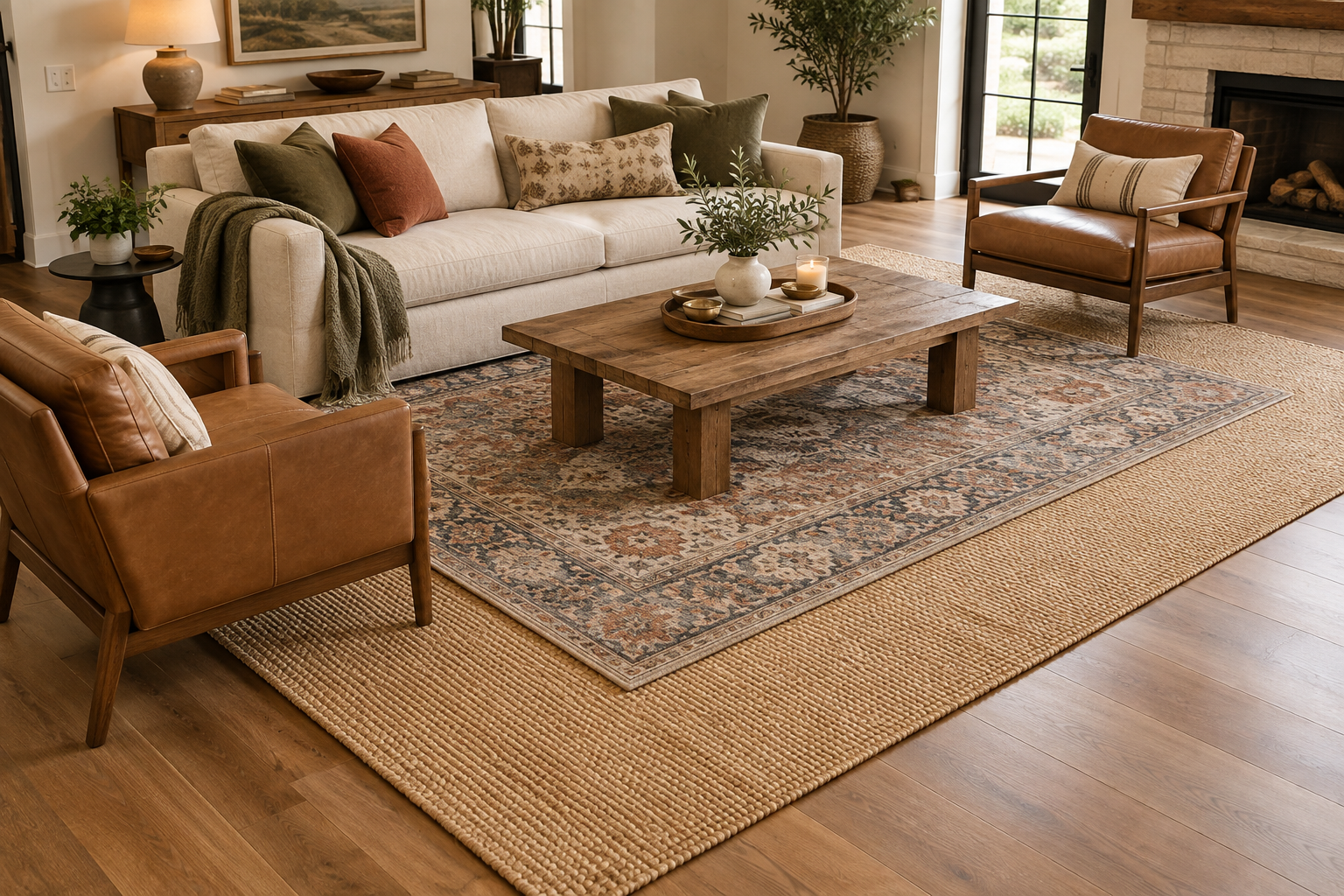
- Choose the base rug for the floor and room function.
- Add the correct floor-compatible pad.
- Mock up the top rug with tape.
- Check exposed edges and total thickness.
- Place furniture and test normal circulation.
- Adjust the top rug until the visual hierarchy feels clear.
- Recheck the stack after several days of normal use.
Continue with our Rug Pad Guide, Rug Size Guide, rug-corner guide, and the Area Rug Guide.