
Living rooms · Sofas & fit
Small Sectional Sofas for Smaller Living Rooms
Choose a sectional by its real footprint, chaise orientation, delivery path and the amount of circulation your room needs.
Dwelanor Editorial · Buying & room-planning guide
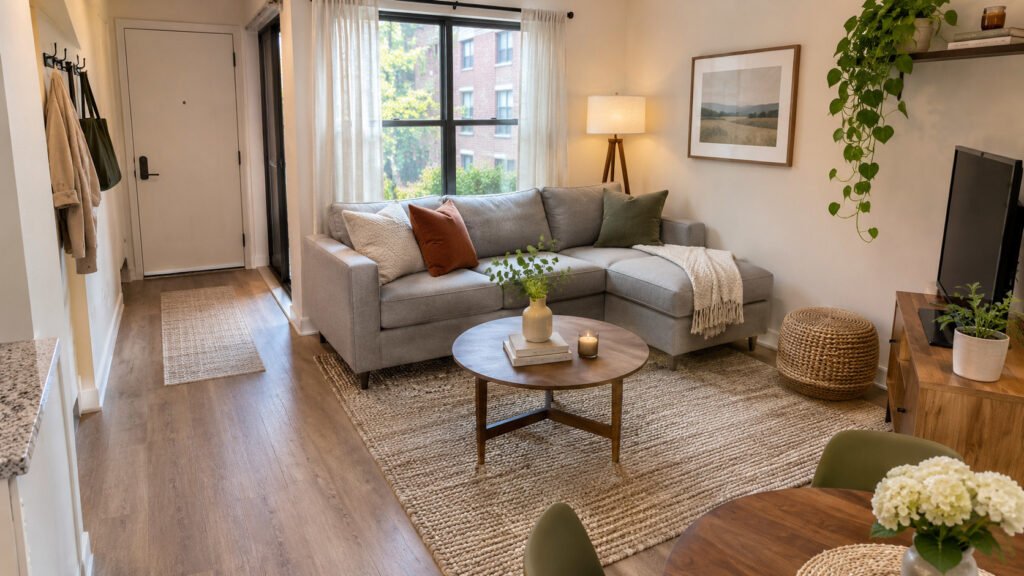
The best small sectional is not necessarily the sofa advertised as “apartment-size.” It is the one that fits your actual seating area, leaves a usable walkway, can pass through every delivery doorway and has a chaise on the right side for the room. A modular sofa may solve a narrow stair problem, but not if its assembled footprint is too wide.
Use a three-test buying method: assembled room footprint → full delivery route → comfort and return terms. This guide is based on actual furniture measuring guidance, not a claim that Dwelanor tested particular sofas.
Choose a sofa format that solves the right problem
| Sofa format | Main strength | Important question | Trade-off |
|---|---|---|---|
| Reversible-chaise compact sectional | Change the chaise side when rearranging | Is the exact model truly reversible without a new component? | Chaise is not always deep enough to lounge |
| Modular sectional in separate pieces | May simplify delivery and future moves | Largest individual box size, joiners and module weights | More seams and components |
| Fixed left- or right-chaise sectional | Simple fixed layout | Is “left” defined while facing or sitting on the sofa? | Wrong handedness is costly |
| Compact sleeper sectional | Additional guest bed | Whole bed-open projection, mattress constraints and route | Heavier construction and more complexity |
| Reclining small sectional | Adjustable lounging | Fully extended footrest, rear clearance and power | Closed sofa dimensions are not enough |
A two-piece chaise sofa may be practical even if it isn’t a fully modular system. Conversely, a large modular collection is not automatically suitable for a studio. Compare specific configurations.
1. Tape the entire sofa footprint onto the floor
Measure the room and mark doorways, circulation paths, other seating and the coffee table. Then use the manufacturer’s overall assembled width and depth to mark the sofa outline with painter’s tape. Put a second rectangle on the floor for the chaise extension if it is not included clearly in the advertised dimensions.
A common buying mistake is measuring only the room’s longest wall. A sofa can fit there and still prevent the door from opening, crowd the coffee table or block the normal route to the dining area. Our Living Room Design Guide shows how the conversation area works as a whole, and the Sofa Depth Guide explains why overall depth differs from the actual sitting depth.
Wayfair’s sectional measuring guide advises checking the room’s complete dimensions, traffic routes and doorway openings rather than relying on the headline sofa size.
2. Keep a usable route around the chaise
A chaise can project much further into the room than the standard sofa seat, especially at the corner where people walk toward the kitchen or bedroom. Tape the full extension, then walk the proposed route carrying a laundry basket or typical shopping bag. Test the room with the coffee table and any accent chair in place.
Wayfair suggests roughly 30–36 inches as a common clear walking-path starting point in its guide, but that is not a universal legal accessibility rule. Actual access needs, local building constraints and furniture placement vary. For some narrow rooms, a straight sofa with a separate ottoman may be a better fit than a fixed sectional that permanently blocks the route.
Use our Coffee Table Clearance Guide to work out table placement without guessing.
3. Left-facing or right-facing chaise: verify the seller’s convention
Stores do not always express “left” and “right” from the same perspective. Confirm whether the term means the person looking toward the sofa or a person sitting on it. Better still, inspect a plan drawing of the actual model and ask the seller to confirm the delivered configuration in writing.
If the room is likely to change, a genuine reversible chaise may be worth extra consideration. But not every chaise design can switch sides: seat cushions, hardware, armrest or connector orientation may make the option model-specific.
Plan where the TV, patio door, hallway and desk will remain after any rearrangement. A sofa that works only while blocking one entrance is not flexible.
4. Delivery fit is separate from room fit
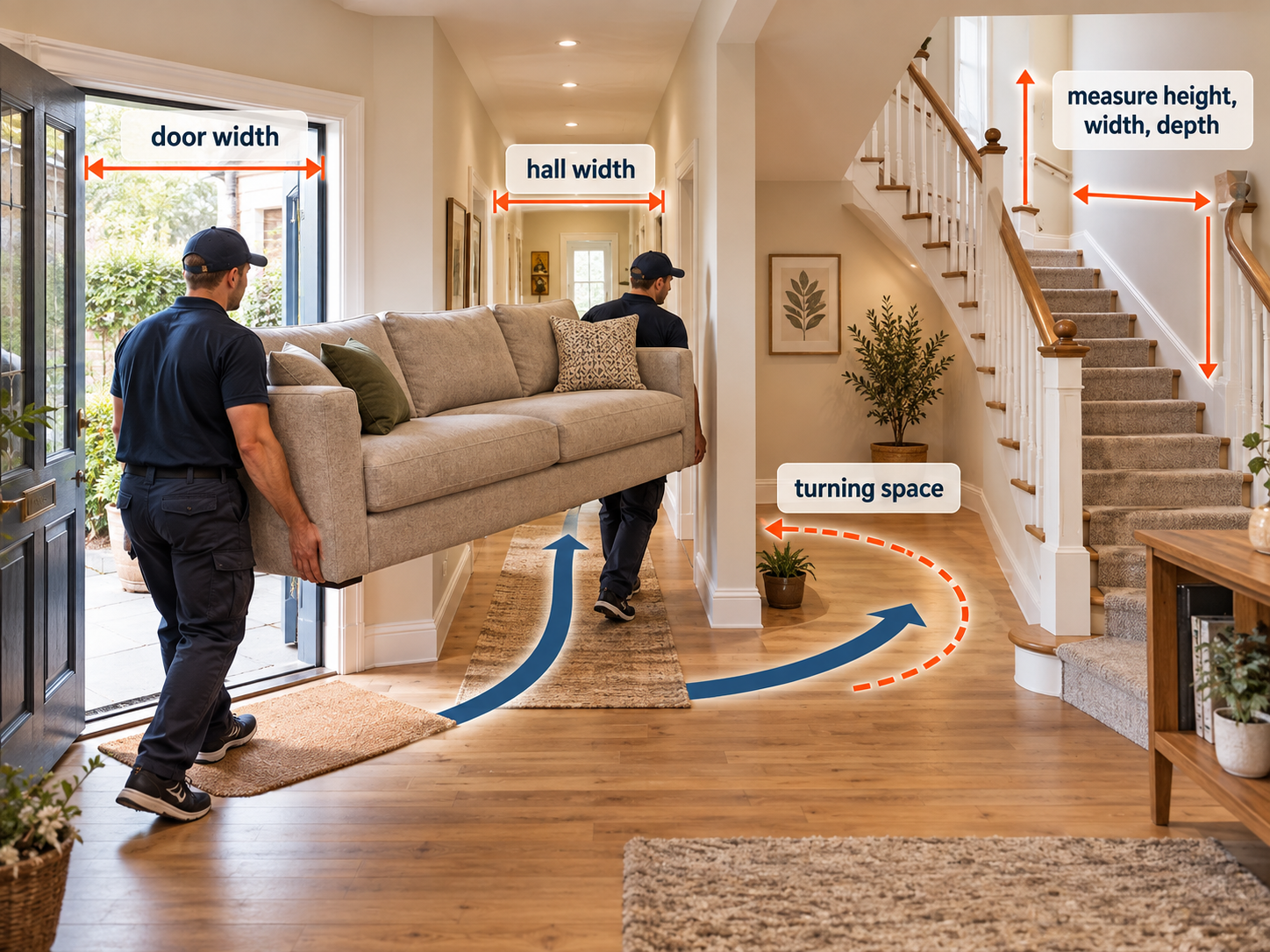
The assembled sectional can fit your living room and still fail to enter your apartment. Check the largest carton or assembled module, not just the size of the whole sofa. A sofa sold as multiple boxes can make a narrow route easier, but stair turns and elevator doors remain the critical points.
West Elm’s delivery measuring guidance instructs buyers to check room dimensions, doorways, diagonal depth, corridors, stairs, turns and elevators. CB2’s guide also emphasizes diagonal depth and comparing the furniture’s delivery path with actual entryways.
Record the smallest real clearance along the complete route from building entrance to destination. Include bannisters, low ceiling points, wall sconces and tight turns; a door opening width alone does not establish whether a long sofa can rotate through the turn.
5. The carton test: a repeatable worksheet
| What to measure | Your value | Ask the seller |
|---|---|---|
| Total assembled width | _____ in | Does width include the arms? |
| Overall sofa depth | _____ in | Does depth include back cushions? |
| Full chaise projection | _____ in | Measured from which reference line? |
| Largest delivery carton | _____ × _____ × _____ | Can legs/panels be safely removed? |
| Narrowest door opening | _____ in | Can your delivery team carry at the required angle? |
| Tightest hallway turn | _____ × _____ in | What diagonal clearance is needed? |
| Stairs or elevator | _____ in | Is scheduled carry-in included? |
| Intended coffee-table clearance | _____ in | Any moving seat or footrest? |
Example, not a size recommendation: Suppose an apartment has a 100-inch usable sofa wall and a narrow hallway. A 92-inch sectional might fit the wall after accounting for furniture, but a 93-inch single carton could still be impossible to maneuver through a tight landing. A model shipped in shorter modules could solve the delivery problem; it would not solve any overlap with the room’s walkways. These are illustrative numbers, not fit guarantees.
Ask the vendor for actual carton dimensions, packed weights, delivery method and return policy. Avoid a high-priced special-order sofa when those critical figures are missing.
6. Seat depth matters as much as overall width

Two sectionals can have similar exterior widths but feel different because of seat depth, cushion thickness, arm width, backrest pitch and seating height. A deep lounging sofa can be wonderful for some households but uncomfortable for someone who prefers upright seating without extra lumbar cushions.
If you cannot try the product in a showroom, compare the published seat depth and height to a chair or sofa already comfortable for you. Check whether decorative pillows are included in depth measurements or are only styling.
Our Sofa Depth Guide explains why nominal “deep seat” claims should be translated into actual body and room use.
7. Fabric and cushion construction: match maintenance to use
Consider how often people eat on the sofa, whether pets use it, whether children will make spills, and how easy the cushions are to remove. A removable cover is useful only if the label permits the cleaning method you plan to use. “Performance fabric” has no universal agreed meaning across brands; inspect the maker’s specific cleaning instructions and warranty language.
When comparing foam, down alternatives or spring arrangements, do not treat high-end marketing language as proof of greater longevity. Compare materials disclosed by the manufacturer, construction, supported weight, warranty exclusions and return handling.
Choose a design and color that you would still like when the room evolves; a $1,000+ purchase deserves more thought than a throw pillow.
8. Reclining and sleeper versions require a second footprint
A reclining sectional may need floor space at the footrest and clearance behind the back. A pull-out sleeper needs space for the bed mechanism, a walking route around the open mattress and storage for moved coffee tables. Do not infer these dimensions from the sofa’s closed photograph.
If you also need a guest bed, consider whether a separate sleeper sofa would serve the room better; Dwelanor’s Guest Room + Home Office Layout Guide provides context for multifunctional rooms.
For a small sectional with a power recliner, check outlet placement and avoid pinching cords against moving furniture.
9. Know what “white glove delivery” actually includes
Delivery terms vary. One retailer may leave boxes at the curb; another may include bringing modules indoors, assembling them, positioning them and removing packaging. Ask who verifies access and what happens if the furniture does not fit.
For example, West Elm’s measuring guide distinguishes standard delivery from its White Glove service. That is specific to the service offered at the time, not a promise that all sofa retailers provide the same scope.
Read what a failed delivery or return could cost, particularly for oversized or made-to-order furniture. Confirm who handles old furniture removal and whether the delivery team can navigate building rules.
10. Compare the right shopping categories
Disclosure: As an Amazon Associate I earn from qualifying purchases. The following links are paid Amazon search-result links; they are not furniture products Dwelanor has independently purchased or tested. Confirm real dimensions, model details, seller and freight terms before buying.
- Compare compact sectional sofas for small spaces on Amazon (paid link) — prioritize footprint, chaise orientation and box sizes.
- Browse modular apartment sectional sofas on Amazon (paid link) — ask for each shipping module’s dimensions and connectors.
- Compare reversible chaise sectionals on Amazon (paid link) — check actual reversible construction and installation instructions.
See Dwelanor’s full affiliate disclosure. Amazon’s product listings and prices change; never substitute the search snippet for the detailed model documentation.
11. Four mistakes that lead to expensive returns
- Measuring only the sofa wall. Tape out the chaise, coffee table and main walking route.
- Ignoring the delivery route. Compare the actual largest module with every doorway, elevator and turn.
- Assuming “reversible” and “modular” mean the same thing. They refer to different design capabilities.
- Comparing headline prices without freight and return costs. Confirm the full delivered price and what happens when a configuration does not fit.
Questions about small-space sectionals
Is an L-shaped sofa better than a straight sofa in a small room?
Not universally. An L-shape may consolidate seating around one corner, but a straight sofa plus movable ottoman can preserve more flexible circulation. Measure both footprints.
Can a modular sectional fit through a narrow doorway?
It might if the largest individual module and its turning route fit; “modular” alone does not guarantee access. Request carton sizes.
What counts as a small sectional?
Retailers use different names and measurement thresholds. Decide based on actual assembled width, chaise projection and circulation rather than a marketing category.
What if I need a sleeper sofa too?
Add the full bed-open footprint and a realistic route to the hallway and bathroom. The closed sectional dimensions cannot answer that.
Should I choose a sectional with a reversible chaise?
It can help if your room layout might change, but verify that the chosen model genuinely supports both orientations and that the parts are included.
Bottom line
Buy the sectional that fits three different realities: your room, your route into the room, and your everyday seating needs. Paying more for a stylish sofa makes sense only when those checks pass. Prioritize dimensioned drawings, actual carton data and clear delivery terms over generic “small apartment” labels.
Research and measurement sources
- West Elm: measuring furniture for delivery
- Wayfair: how to measure for a sectional sofa
- CB2: how to measure large furniture
- Ashley: small sectional buying considerations, updated July 2026
Editorial quality note: manufacturer/retailer guidance is attributed; hypothetical sizes are labeled; no in-house product testing or specific model warranty is claimed. Check product specs, link availability, and image placement again before release.