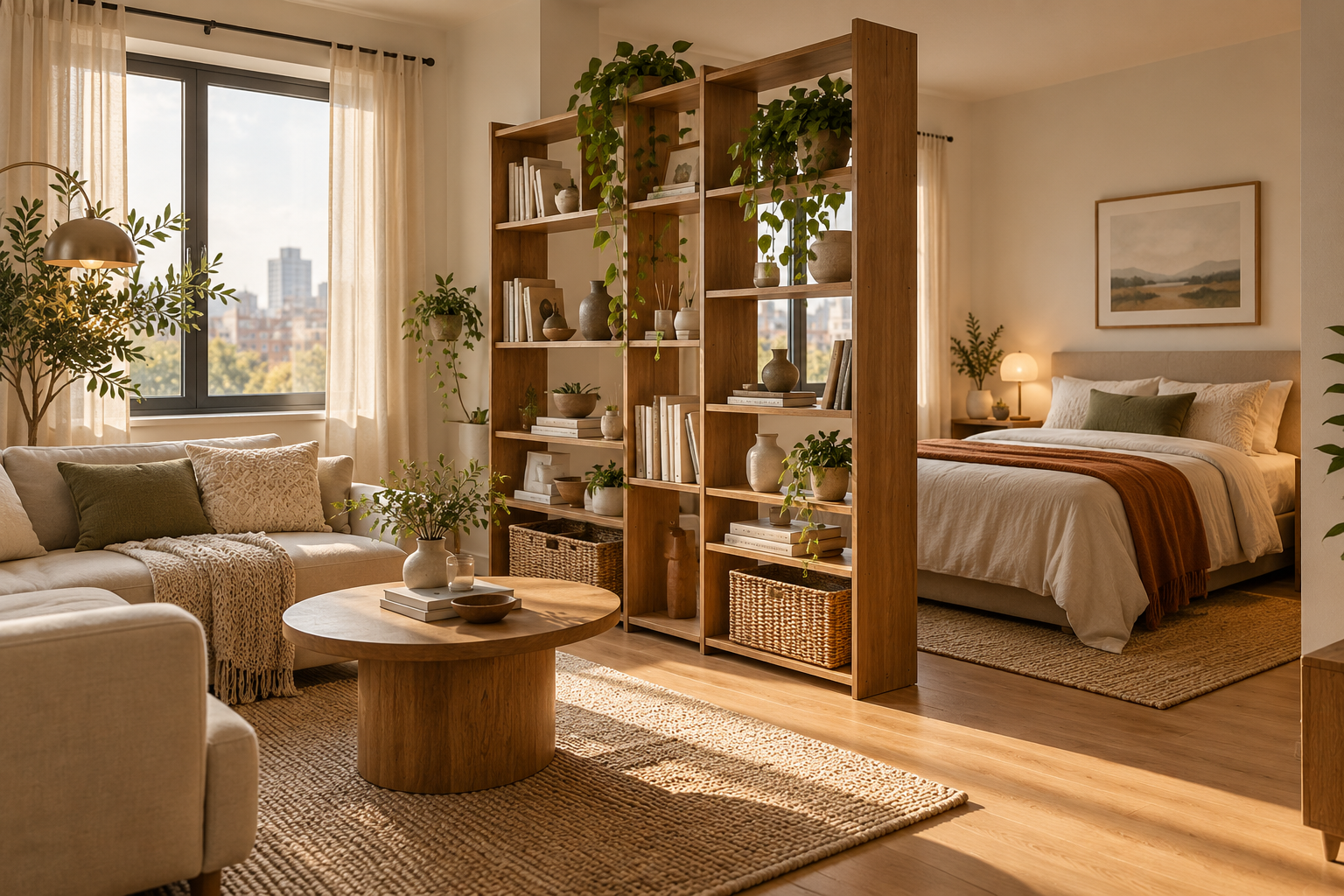
Rental Space Planning
The best renter-friendly room divider creates the amount of privacy you need without pretending to be a permanent wall. Freestanding screens, open shelving, curtains and tall furniture each divide space differently. Choose by privacy, light, stability, circulation and lease restrictions.
Define privacy need → mark circulation → protect windows and vents → compare divider types → test stability → check lease/fire-safety constraints → mock up height and width.
1. Define what needs privacy
A sleeping zone may need visual screening, while a desk may only need a psychological boundary. Do not use a floor-to-ceiling solution when a lower open divider solves the actual problem.
Write down whether the goal is visual privacy, acoustic softening, storage, backdrop or simply zoning.
2. Map the main route first
Mark the path from entry to kitchen, bathroom, windows and balcony. Keep the divider out of that route before choosing its style.
A beautiful folding screen becomes frustrating if it must be moved every time someone walks across the apartment.
3. Use freestanding screens for flexibility
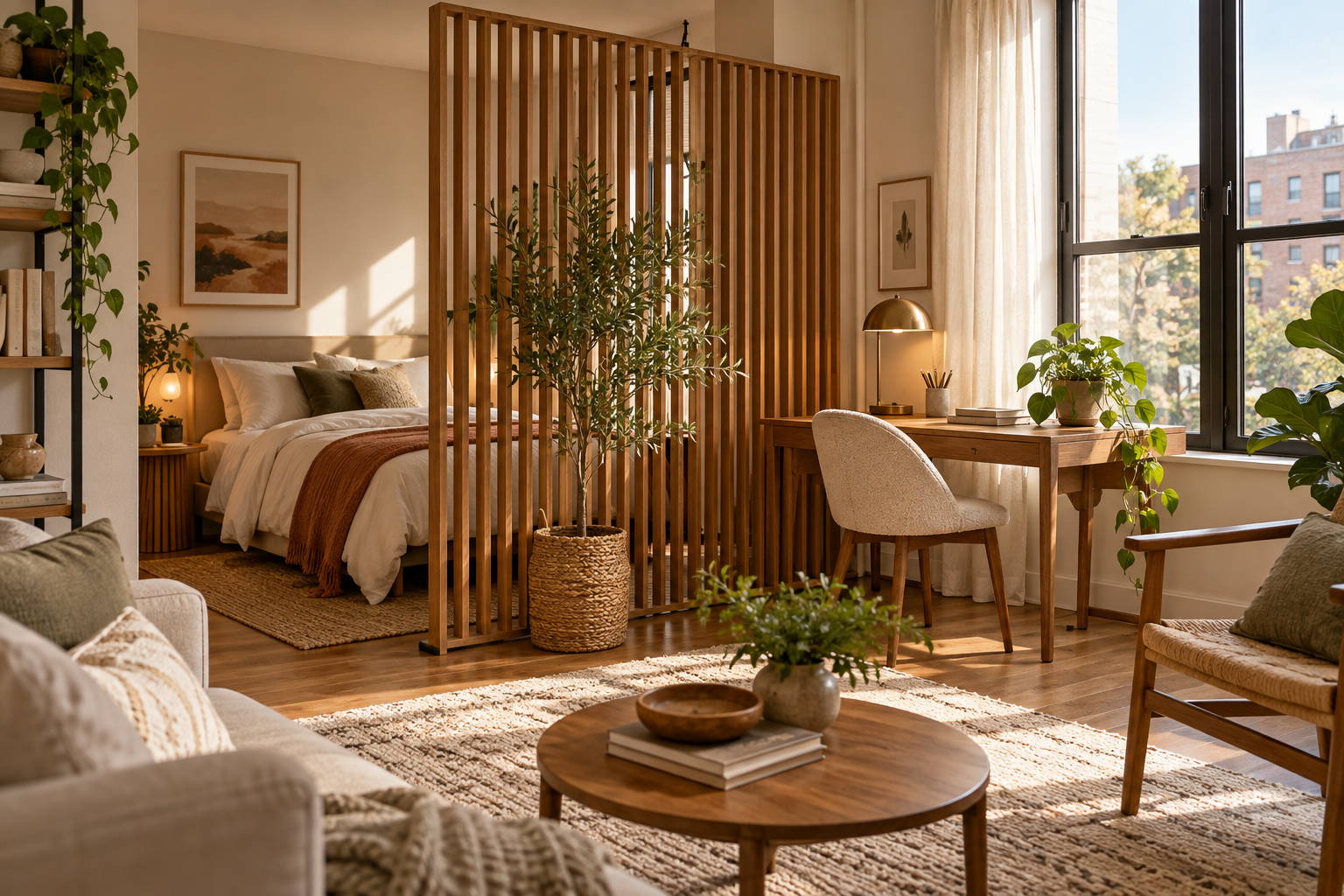
Folding screens are easy to reposition and usually require no wall work. Their stability depends on footprint, hinge angle and exposure to pets, children or drafts.
Do not place a tall lightweight screen where it can easily tip into a passage.
4. Use open shelving when storage is also needed
A bookcase can divide two zones while storing objects, but deep or fully packed shelves can block light and make the apartment feel boxed in.
Anchor or stabilize tall furniture according to the product instructions and lease conditions; freestanding does not automatically mean tip-safe.
5. Use curtains for soft separation
A curtain can create strong visual privacy with minimal floor footprint. Tension systems or other no-drill methods may be suitable in some rentals if used within their load and surface limits.
Keep fabric away from heat sources and do not block required egress or ventilation.
6. Use plants as partial screening
Tall plants can soften a view between zones without becoming a wall. They work best where privacy can be partial rather than complete.
Choose containers and species appropriate to the available light, and keep watering away from vulnerable rental flooring.
7. Preserve daylight and air movement
Stand in the darker side of the proposed divider and check how much window light remains. Open, slatted or translucent systems can separate zones without cutting the room in half visually.
Do not cover HVAC returns, radiators or other building systems.
8. Mock up with sheets or boxes
Hang a temporary sheet or stack boxes to the proposed height and width. Live with the layout for a day and notice light, routes and sightlines.
If the apartment immediately feels cramped, shorten, narrow or open the divider rather than assuming decoration will fix it.
Planning table
| Check | What to test | Why it matters |
|---|---|---|
| Privacy need | Full, partial or visual only | Sets divider opacity |
| Route | Entry and daily circulation | Protects movement |
| Light | Window-to-room path | Prevents dark zones |
| Stability | Height, base and tip risk | Supports safe use |
| Lease limits | Drilling, anchoring and surfaces | Controls installation method |
Related Dwelanor guides
- Rental Decorating Guide — choose reversible changes
- Small Space Design Guide — zone compact homes
- Small Apartment Storage Map — combine division with storage
- Multifunctional Furniture Guide — use furniture for more than one job
- Home Lighting Guide — keep both zones lit
- Furniture Sizing Guide — protect circulation
Bottom line
A renter-friendly divider should make the apartment easier to live in, not simply create another wall. Choose the lightest solution that provides the needed privacy while preserving daylight, stability and circulation.