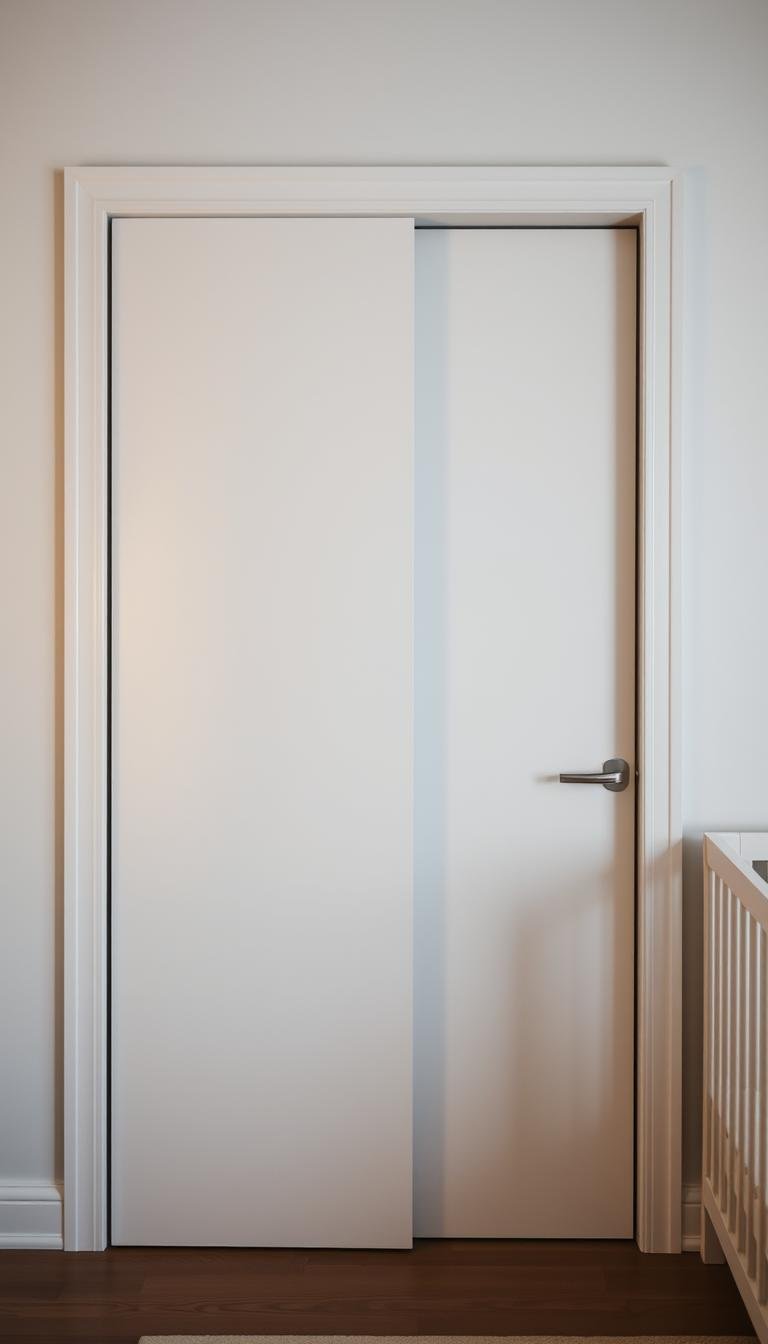
For a nursery closet, the quietest door is usually the one with the smoothest hardware, the fewest rattling parts, and a closing system that prevents impact. If sound isolation matters too, a well-fitted solid-core swing door generally performs better than sliding or bifold formats because it can seal more tightly around the opening.
The right choice depends on the room: available swing clearance, closet width, wall space, renter restrictions, and whether your priority is reducing operating noise or reducing sound transmission through the doorway.

Separate two different noise problems
Door-operation noise
This is the click, rattle, squeak or slam produced when the closet is opened or closed. Better rollers, aligned tracks, lubricated hinges where the manufacturer permits, bumpers and soft-close hardware can reduce it.
Sound passing through the doorway
This depends more on panel mass and air gaps. A solid-core hinged door with a good perimeter fit usually blocks more sound than a barn, bypass or bifold door because sliding systems inherently leave larger gaps.
Closet-door types compared
| Door type | Operating noise potential | Sound isolation | Space requirement |
|---|---|---|---|
| Solid-core swing | Low with adjusted hinges and latch | Usually best of these options | Needs swing clearance |
| Sliding bypass | Low with good rollers and soft-close | Moderate to low because of overlap gaps | Saves floor space |
| Bifold | More hinges and pivots can create noise | Usually lower | Compact opening |
| Barn-style | Can glide quietly with good hardware | Usually poor because the panel sits off the wall | Needs clear wall beside opening |
Best choice when quiet operation matters most
If you already have a sliding or bifold closet, replacing the entire door may not be necessary. First inspect the existing hardware. Loose fasteners, dirty tracks, worn rollers, misaligned pivots and missing bumpers can make an otherwise serviceable door noisy.
Where available for the exact door system, a manufacturer-approved soft-close accessory can reduce impact at the end of travel. Do not improvise dampers or modify tracks in ways the manufacturer does not permit.
Best choice when sound blocking matters most
A solid-core swing door is usually the stronger starting point because its added mass and tighter perimeter can reduce sound leakage. The result still depends on the frame, undercut and latch alignment.
If adding weatherstripping or a sweep, make sure it does not prevent the door from closing or create a trip or pinch hazard. Use products intended for interior doors and follow their installation instructions.
Features worth checking before you buy
- Soft-close compatibility: verify that the exact track or hinge system supports it.
- Roller quality: look for replaceable rollers and adjustment instructions.
- Anti-jump or retention hardware: important on sliding systems so panels stay safely on track.
- Finger-clearance design: especially relevant for bifold doors and homes with young children.
- Panel weight and hardware rating: the track and fasteners must be rated for the actual door.
- Serviceability: choose hardware that can be adjusted or replaced rather than sealed inside trim.
What to avoid in a nursery
Avoid treating decorative soundproofing materials as a substitute for proper door hardware. Mass-loaded vinyl, improvised panels and heavy add-ons can change the load on hinges or tracks and may create new hazards if they are not part of an engineered system.
Also avoid relying on arbitrary noise numbers for white-noise machines or other nursery devices. Follow the device manufacturer’s placement and volume guidance and any advice from your pediatric care provider.
Renter-friendly options
If you cannot replace or drill into the door system, focus on reversible maintenance and room-level changes:
- clean the track according to the manufacturer’s instructions;
- tighten accessible hardware that is designed to be user-adjustable;
- replace worn manufacturer-compatible rollers or bumpers;
- use a rug outside the closet if footfall noise is the real problem;
- ask the landlord before changing the door, track or frame.
A practical decision guide
- If the door rattles, service the hardware first.
- If it slams, look for compatible soft-close hardware.
- If it squeaks, inspect hinges or pivots and follow the manufacturer’s maintenance guidance.
- If outside sound passes through the closet opening, a better-sealing solid-core swing door may be the more effective upgrade.
- If the room is too tight for a swing door, prioritize smooth sliding hardware and accept that sound isolation will usually be lower.
The short answer
For the best combination of quiet operation and sound reduction, use a properly fitted solid-core swing door where space allows. For tight rooms, a high-quality sliding bypass system with aligned rollers and compatible soft-close hardware is usually the more practical choice.
For more nursery and bedroom planning ideas, browse the Dwelanor Room Guides.