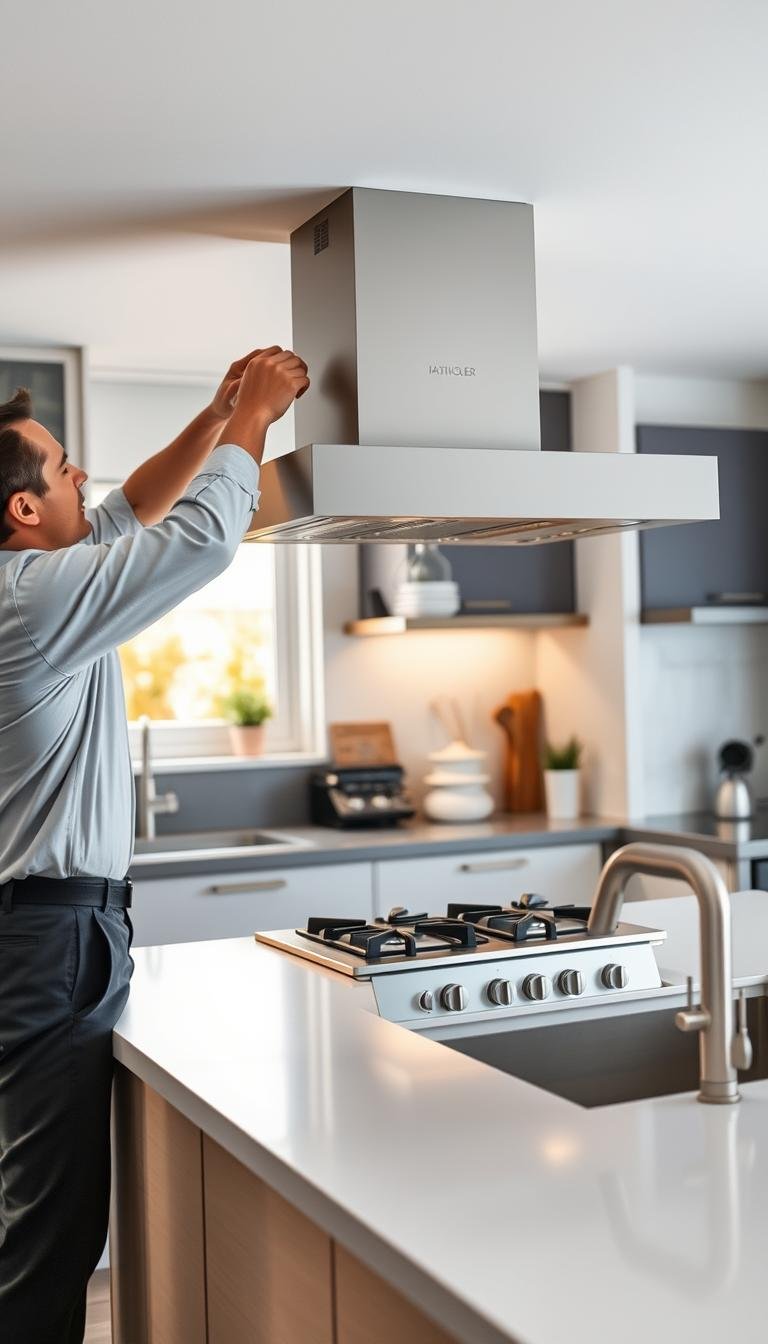
The quietest range hood is usually not the model with the lowest number in a marketing headline; it is the hood that can capture cooking fumes at a useful airflow without forcing you to run the blower at full speed. For a ducted hood, compare verified sound and airflow data, then make sure the hood dimensions, duct route and installation match the kitchen.
If you want a quiet ventilation hood that exhausts outdoors, start with three filters: ducted rather than recirculating, independently published performance data where available, and enough capture area for the actual cooktop. The Home Ventilating Institute (HVI) publishes certified airflow and sone ratings for many residential range hoods, which makes its directory a useful comparison source.
HVI Certified Products Directory
What makes a range hood quiet?
Range-hood noise comes from several sources at once: the blower, air moving through filters and ductwork, vibration in the hood or cabinetry, and turbulence created by restrictive ducting. That is why a premium motor alone does not guarantee a quiet kitchen.
Sound rating
Range-hood sound is often published in sones. HVI explains that sones are intended to correspond more closely to perceived loudness than raw decibel figures. Lower sone values indicate quieter operation, but only compare ratings measured at comparable operating conditions.
A low-speed sone number from one hood should not be compared with another hood’s maximum-speed rating. When possible, compare sound and airflow together at the speeds you expect to use.
Blower speed
A hood with several useful speed settings can be quieter in daily life because light cooking does not require maximum airflow. Low-end control matters: a hood that can run effectively at a modest setting for simmering or reheating may feel much quieter than one that must jump immediately to a high fan speed.
Duct resistance
Undersized ducting, excessive equivalent length, abrupt turns and poorly executed transitions can increase resistance. That can reduce delivered airflow and make the system sound harsher. Use the duct size, fittings and maximum equivalent length specified by the hood manufacturer rather than applying a universal duct rule.
Vibration and mounting
Loose fasteners, vibrating duct sections, poorly supported cabinetry and rattling filter panels can all add noise. A hood that was quiet when installed but develops a new buzz or rattle should be inspected rather than simply operated at a different speed.
What should you look for in the quietest luxury range hood?
“Luxury” should mean more than decorative metal and a high price. For a premium ducted hood, compare the engineering details that affect everyday use:
- Published airflow and sound data: preferably from a recognized certification program such as HVI where the model is listed.
- Useful low and medium speeds: so routine cooking does not require maximum output.
- Capture area: the hood needs to suit the cooktop and the manufacturer’s installation requirements.
- Duct requirements: the planned route must accommodate the required duct size and fittings.
- Controls: easy speed changes, delayed shutoff or automatic modes can improve daily use, but they do not replace good capture and duct design.
- Serviceability: filters, lights, controls and blower components should remain accessible for cleaning and replacement.
- Warranty and parts support: especially important when a hood uses proprietary electronics or remote blowers.
Ducted vs. recirculating: which is better for ventilation?
A ducted hood moves captured air outdoors. A recirculating hood passes air through filters and returns it to the room. They solve different problems, so do not assume a recirculating product provides the same removal of moisture and cooking pollutants as an outdoor-exhaust system.
For this guide, the focus is ducted range hoods that vent outside. If outdoor ducting is not possible, follow the appliance manufacturer’s guidance and local requirements for the available ventilation options.
How to compare sone ratings correctly
HVI’s certified ratings program exists to make airflow and sound comparisons more consistent. Its FAQ confirms that range hoods can carry sone ratings, and its directory includes kitchen range hoods among the certified product categories.
When comparing two hoods, record:
- the airflow associated with the published sound number;
- the fan speed or test point;
- whether the figure is manufacturer-only or independently certified;
- the duct requirements used by the tested configuration;
- whether the model uses an internal, inline or remote blower.
A hood that posts a very low sone value at its minimum speed may still be loud at the airflow needed for high-heat cooking. The meaningful comparison is noise at a useful airflow.
Internal, inline and remote blowers
| Blower arrangement | Potential advantage | What to verify |
|---|---|---|
| Internal blower | Simple, self-contained installation | Sound at working speeds and cabinet/wall vibration |
| Inline blower | Moves the blower away from the hood body | Approved duct layout, service access and installation requirements |
| Remote exterior blower | Can move a major noise source farther from the kitchen | Compatibility, weather exposure, service access and total system design |
A remote blower is not automatically silent. Air noise at the hood opening and noise created by duct resistance can still be noticeable. Treat blower location as one part of the system rather than a guaranteed cure.
Under-cabinet, wall-mounted or island?
Under-cabinet hoods
These can work well when cabinetry already defines the ventilation zone. Compare the depth of the hood, cabinet clearances, duct route and published sound data. Do not assume compact automatically means quiet.
Wall-mounted hoods
Wall-mounted chimney hoods are available across a wide range of airflow and sound specifications. Their visual size can be generous, but capture performance still depends on the exact hood geometry, mounting height and duct design.
Island hoods
Island hoods do not have a rear wall helping contain the cooking plume. Follow the exact manufacturer’s capture-area and mounting guidance, and pay particular attention to ceiling support and duct routing.
Mounting height: use the actual instructions
There is no single universal range-hood height that is correct for every cooktop and hood. HVI advises using the hood manufacturer’s recommended mounting height, and the cooking appliance can have its own clearance requirements.
Check both sets of instructions and applicable local requirements before installation. Mounting too high can reduce capture; mounting outside the approved range can also create safety or warranty problems.
Why duct design can make a quiet hood noisy
Think of the hood and duct as one ventilation system. A strong blower pushing through a restrictive path may create more air noise and deliver less useful airflow than expected.
Before buying, check:
- required duct diameter or dimensions;
- permitted duct material;
- maximum equivalent duct length;
- how elbows and transitions are counted;
- the specified exterior termination;
- whether backdraft protection is built in or required separately.
If the planned route cannot meet the product instructions, choose a different hood or redesign the route rather than reducing duct size simply to make it fit.
Filters and maintenance
Filter design affects grease capture and airflow, but broad claims that one filter type is always quieter than another are not reliable enough for a buying decision. Use the filter system supplied for the exact hood and clean or replace it on the schedule the manufacturer specifies.
A loaded or incorrectly installed filter can restrict airflow or cause vibration. If a previously quiet hood develops new noise, check filters, removable panels and obvious external vibration before assuming the blower has failed.
What about automatic and “quiet” modes?
Automatic ventilation, delayed shutoff and branded quiet modes can be convenient. Verify what the feature actually changes. Some modes simply cap the fan speed; others react to temperature or cooking conditions.
These features are worth considering only after the core system is right: capture, ducting, airflow and published sound performance.
A practical buying checklist
- Confirm the hood is designed for outdoor ducted exhaust if that is your goal.
- Check the cooktop and hood installation instructions together.
- Compare HVI-certified airflow and sone data where available.
- Compare sound at useful airflow, not only the lowest published number.
- Verify duct size, equivalent-length limits and termination requirements before ordering.
- Choose enough speed control for both quiet everyday use and heavier cooking.
- Check filter access, replacement parts and warranty support.
- Plan electrical, duct and structural work before the hood arrives.
So what is the quietest range hood that actually vents outside?
There is no single permanent winner because model lines, sizes and installations differ. The best quiet ducted hood is the one that fits the cooktop, works with the available duct route, has credible sound and airflow data, and can handle routine cooking at a moderate fan speed.
For a premium or luxury purchase, prioritize verified performance and system design over decorative finish. A beautiful hood that needs maximum speed because of poor capture or restrictive ducting will not feel luxurious in daily use.
For related kitchen planning, see our quiet garbage-disposal guide, under-cabinet lighting guide, and the Dwelanor Room Guides.