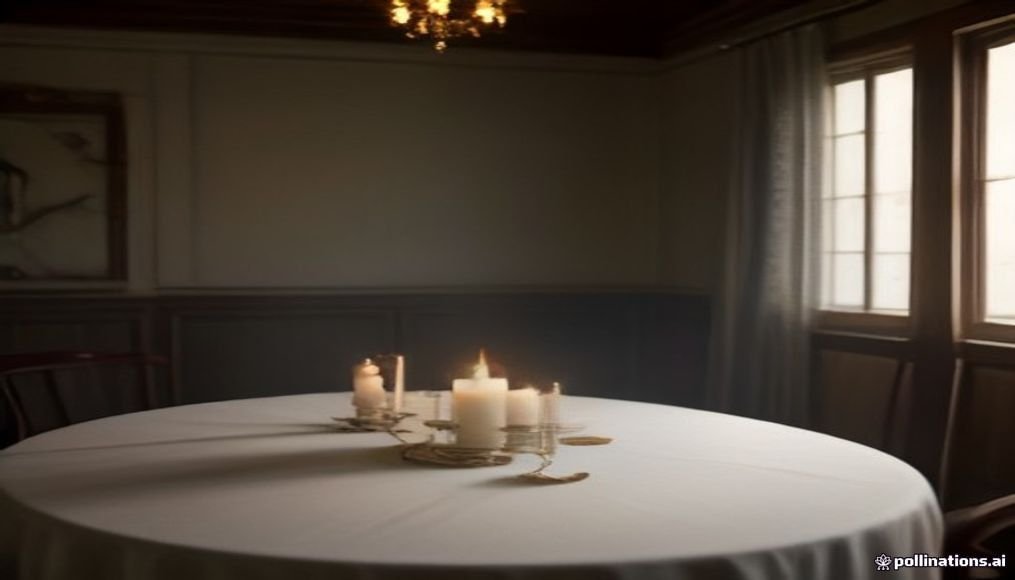
For a dinner party, candlelight should support conversation and the meal without turning the table into a fire hazard. The best arrangement is usually low enough to preserve sightlines, sparse enough to leave room for serving, and positioned so every flame has a clear safety zone around it.
The useful relationship is table size → serving plan → sightlines → candle type → holder stability → combustible clearance → ambient lighting.
Keep open flames at least 12 inches from anything combustible
The U.S. Fire Administration recommends keeping lit candles at least 12 inches from anything that can burn, using sturdy holders and extinguishing candles whenever you leave the room. Its current guidance also recommends considering battery-operated flameless candles as a safer alternative. See the U.S. Fire Administration candle safety guidance.
That means a dinner table with flowing linen, paper place cards, dried leaves, low branches or fabric napkins needs more open space around a real flame than a photograph may suggest.
Choose the candle type by the role it needs to play
| Candle type | Useful role | Main concern |
|---|---|---|
| Taper | Vertical rhythm and formal table settings | Needs a stable holder and enough clearance from faces and décor |
| Votive or tealight in a holder | Low pools of light between place settings | Holder can become hot; keep away from fabrics and clutter |
| Pillar | Stronger visual anchor on a sideboard or large table | Needs a broad, stable, noncombustible base |
| Flameless candle | Tables with children, pets, dense greenery or tighter clearances | Check battery access and timer behavior |
There is no requirement to mix every format. Repeating one or two candle types usually creates a calmer table than a collection of unrelated heights and holders.
Preserve sightlines across the table
The center of a dining table is shared visual space. If guests have to lean around a taper, vase or candelabra to see one another, the arrangement is too visually dominant.
Two common approaches work well:
- Low line: small enclosed votives or flameless candles distributed along the center.
- Sparse vertical rhythm: a few tapers placed far enough apart that faces remain visible between them.
Mock up the table from seated eye level before guests arrive. A centerpiece can look elegant from above and still feel obstructive once everyone sits down.
Leave space for food and serving
Decide whether dishes will be plated in the kitchen or served from the table. Family-style service needs a wider open center than plated service.
If serving bowls, bread, water and condiments will sit on the table, candlelight may work better in a few small clusters rather than a continuous centerpiece.
Another option is to move most candlelight to a nearby sideboard, console or mantel and keep only one restrained group on the dining table.
Use stable holders on a stable surface
Open-flame candles should sit in sturdy holders that do not tip easily. The surface beneath them should also be steady and uncluttered.
A holder that rocks on a textured tray, a taper that fits loosely in its socket, or a pillar balanced on loose filler material is not a good dinner-table setup. Do not use dried beans, rice, leaves, moss, pinecones or other combustible decorative material as a stabilizing medium around a lit candle.
If you want texture around the centerpiece, keep combustible décor well outside the flame clearance zone or use flameless candles instead.
Do not rely on mirrors or glass to make an unsafe arrangement acceptable
Mirrored trays and glass surfaces can multiply reflections and make a small amount of light feel richer, but they do not change fire-safety requirements.
Use them only when the candle holder itself is stable and the surrounding area remains clear. Avoid placing a real flame inside an improvised glass container that was not designed for candle use.
Keep strong fragrance away from the meal
For the dining table, unscented candles are usually the simplest choice because they do not compete with food aromas.
If fragrance is part of the room, place a lightly scented candle away from the dining surface and extinguish it if the scent starts to dominate. A candle chosen for aroma does not need to be the same candle chosen for table illumination.
Layer candlelight with the room lighting
Candles should add warmth, not be expected to provide all the functional light in the room.
A practical dinner-party lighting stack can include:
- dimmable ceiling or pendant lighting at a comfortable low level;
- one or two table lamps or sconces for room-wide ambient light;
- candlelight as the final decorative layer.
This keeps plates, steps and serving areas visible while still creating a softer atmosphere at the table. If open flames are not a good fit, cordless table lamps for a warm dinner table can provide a similarly low, controlled layer of light without adding another candle.
Arrange candles around the table shape
Rectangular table
A narrow centerline works well. Keep the candle grouping broken into several small moments rather than creating an uninterrupted wall of objects.
Round table
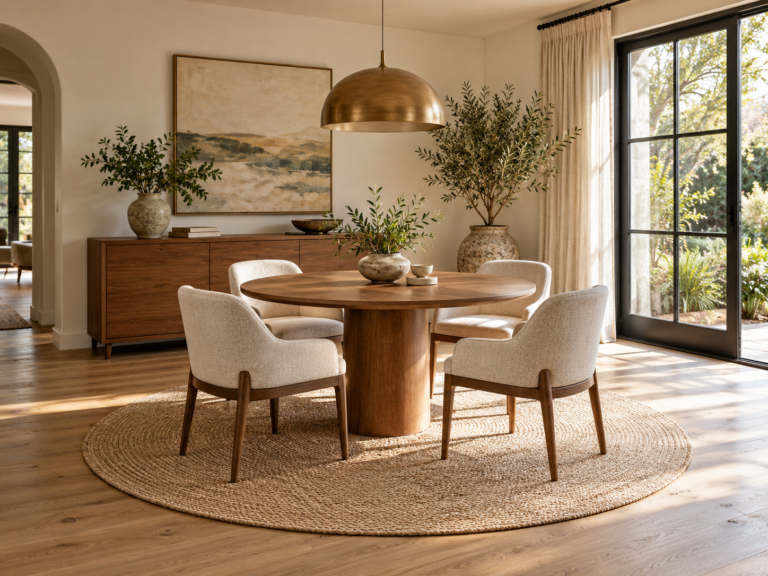
A compact central cluster can work, provided it stays low enough for conversation and leaves enough space for serving.
Oval table
Follow the long axis with a soft, elongated arrangement. Repeating small low lights often complements the curve better than one large centerpiece.
Small table
One or two flameless candles or a single stable low holder may be enough. Do not sacrifice plate and glass space just to create a centerpiece.
Children and pets change the safest choice
NFPA advises keeping candles out of the reach of children and pets and never leaving a child alone in a room with a burning candle. For active family gatherings, flameless candles can provide much of the same visual effect without an open flame. See the NFPA candle safety tips.
Do not place open flames where a pet’s tail, a child’s sleeve, or a guest reaching across the table can contact them.
Greenery and seasonal décor need extra restraint
Fresh flowers can be part of a safe centerpiece when stems and leaves remain well away from flames. Dried greenery, paper decorations, ribbons, pinecones and similar materials are much less forgiving because they can ignite readily.
For dense holiday or seasonal arrangements, use flameless candles rather than trying to hide real flames inside the display.
What to avoid
- Leaving a candle burning after guests move to another room.
- Placing flames near curtains, paper menus, napkins or dry greenery.
- Using an unstable decorative container as a candle holder.
- Putting real flames inside crowded floral arrangements.
- Moving a candle while wax is liquid.
- Using candles as emergency lighting during a power outage.
- Putting candles where they can be knocked over by children, pets or passing guests.
A practical dinner-party sequence
- Set the table with plates, glasses and serving pieces.
- Decide how much of the center must stay clear for food.
- Choose low candles, sparse tapers or flameless candles.
- Confirm every real flame has at least 12 inches of clearance from combustible material.
- Test sightlines from each seat.
- Dim the room lighting only enough to make candlelight noticeable.
- Light candles shortly before guests sit.
- Extinguish every flame when the room is no longer continuously occupied.