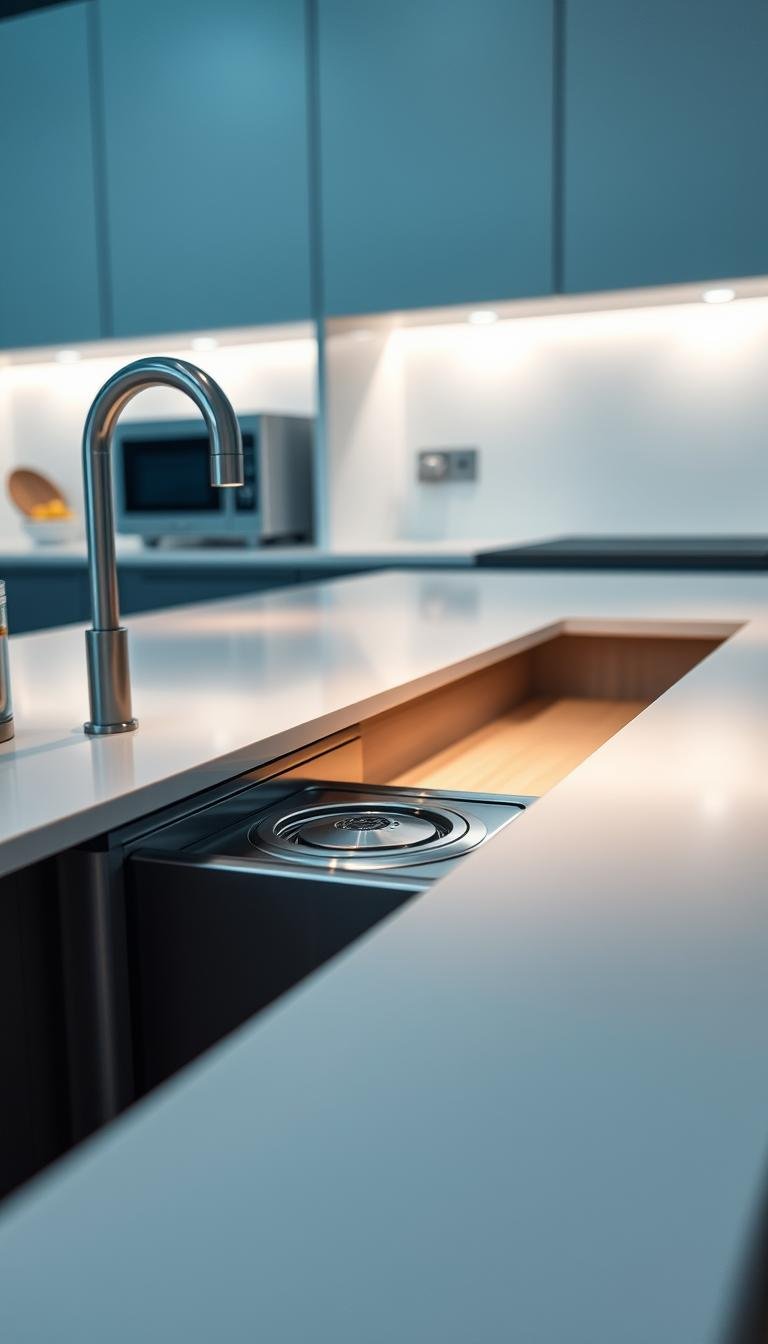
The quietest garbage disposal is usually the one with the best combination of insulation, vibration control, secure mounting and enough motor capacity for the way you actually use the sink. A universal decibel ranking is not very useful because the sink, countertop, cabinet, plumbing and installation all change how loud a unit sounds in the room.
Instead of chasing one permanent “quietest” winner, compare the features that consistently matter: sound insulation, mounting system, motor size, feed style, dimensions, warranty and independent owner feedback.
What actually makes a garbage disposal quieter?
Sound insulation
Insulated housings help absorb the higher-pitched sound that escapes from the motor and grinding chamber. Premium units often devote more physical space to insulation, which is one reason quieter models can be larger.
Vibration control
A disposal can sound loud even when the motor itself is reasonably smooth if vibration is being transferred into a stainless-steel sink, stone countertop or loose plumbing. A secure mount and well-aligned drain connection matter.
Motor capacity
An undersized motor can sound harsher when it struggles with normal food waste. More horsepower does not automatically mean quieter operation, but enough capacity can reduce strain and shorten run time.
Grinding design
Balanced internal components and multi-stage grinding can help a unit process food more smoothly. The useful question is not how aggressively a model can be “stress tested,” but whether it handles the foods the manufacturer permits without repeated jams or long run times.
Continuous feed vs. batch feed
Continuous-feed disposals run from a switch and are the most common style. They are convenient for everyday cleanup and available across a wide range of sizes and prices.
Batch-feed disposals operate only when the stopper is engaged. That changes the workflow and can reduce some sound escaping through the sink opening while also limiting accidental access during operation.
Choose based on how you use the kitchen rather than assuming one format is always quieter in every installation.
How much horsepower do you need?
| Motor size | Typical fit | What to consider |
|---|---|---|
| 1/2 HP | Light, occasional use | Compact and lower cost, but easier to overload |
| 3/4 HP | Most everyday kitchens | Good balance of size and capacity |
| 1 HP+ | Frequent cooking or larger households | More capacity, usually a larger body |
The right size depends on household use and what the manufacturer says the unit can process. Do not use bones, fibrous waste or other difficult scraps as a generic test unless the manual explicitly permits them.
Measure the cabinet before buying
Quiet models can be physically larger because of their insulation. Measure the available height and diameter beneath the sink, then check:
- drain and trap position;
- dishwasher connection;
- electrical outlet or hardwiring arrangement;
- cabinet shelves or pull-outs;
- space needed for future service.
What is the best quiet garbage disposal for most homes?
There is no single model that is objectively quietest in every kitchen, because the sink, countertop, cabinet, plumbing and installation all change the sound you hear. For many households, the best quiet garbage disposal is a properly sized 3/4 or 1 HP unit with substantial sound insulation, vibration control, a secure mounting system and enough cabinet clearance that it does not press against plumbing or shelving.
Use that as a shortlist filter, then compare current models by verified specifications, warranty terms and recurring owner feedback.
Why garbage-disposal decibel ratings are hard to compare
Shoppers often look for the quietest garbage-disposal decibel level, but manufacturers do not publish sound data under one standardized household installation. A disposal measured on one sink and countertop can sound different on another, and cabinet construction or vibrating drain pipes can amplify noise.
When a manufacturer publishes a sound-control system or test result, treat it as one piece of evidence rather than a universal room-level decibel guarantee.
What to compare when shopping
For a genuinely useful product comparison, verify current specifications instead of relying on old “best overall” labels.
- Sound-control features: insulation, anti-vibration mounting or manufacturer-specific noise-control systems.
- Motor size: enough capacity for normal use without unnecessary bulk.
- Feed style: continuous or batch feed.
- Dimensions: especially total height and diameter.
- Power setup: whether a cord is included and whether the installation is plug-in or hardwired.
- Warranty: length, parts coverage and whether in-home service is included.
- Independent feedback: recurring complaints about vibration, leaks, jams or unusually harsh sound.
This is also the right place for future affiliate links: a replaceable comparison module with current verified specifications, not a permanent ranking that becomes stale.
Installation can make a quiet unit noisy
A loose mount, misaligned drain or vibrating pipe can amplify sound dramatically. If you are replacing a unit with the same mounting system and an existing switched outlet, the job may be straightforward for an experienced DIYer.
If the work involves new wiring, a new switch, changing the electrical box, difficult plumbing changes or uncertain local-code requirements, use a qualified electrician or plumber.
Simple habits that reduce noise and jams
- Run cold water before and during operation.
- Feed food waste gradually instead of forcing a large amount in at once.
- Follow the manufacturer’s list of acceptable food waste.
- Keep the splash guard clean.
- Stop the unit if it develops a new rattle, scrape or repeated reset problem.
For a jam, disconnect power before following the manufacturer’s clearing procedure. Never reach into the disposal by hand.
How to think about price
Higher-priced models often add more insulation, heavier housings, longer warranties and more elaborate grinding systems. That does not mean every premium unit is worth the extra cost in every kitchen.
Compare total cost, including installation. A moderately priced model installed securely can be a better real-world choice than an expensive disposal squeezed into a cabinet where it vibrates against pipes or shelving.
The simplest way to choose
For most homes, start with a properly sized 3/4 or 1 HP model that has clearly described sound-control features, fits the cabinet comfortably and has a solid warranty. Then compare verified current models inside that group.
The goal is not silence; it is a smoother, shorter, less intrusive cleanup cycle.
For more practical kitchen upgrades, see our guides to under-cabinet lighting, adding a breakfast bar in a tight kitchen, and the Dwelanor Room Guides.