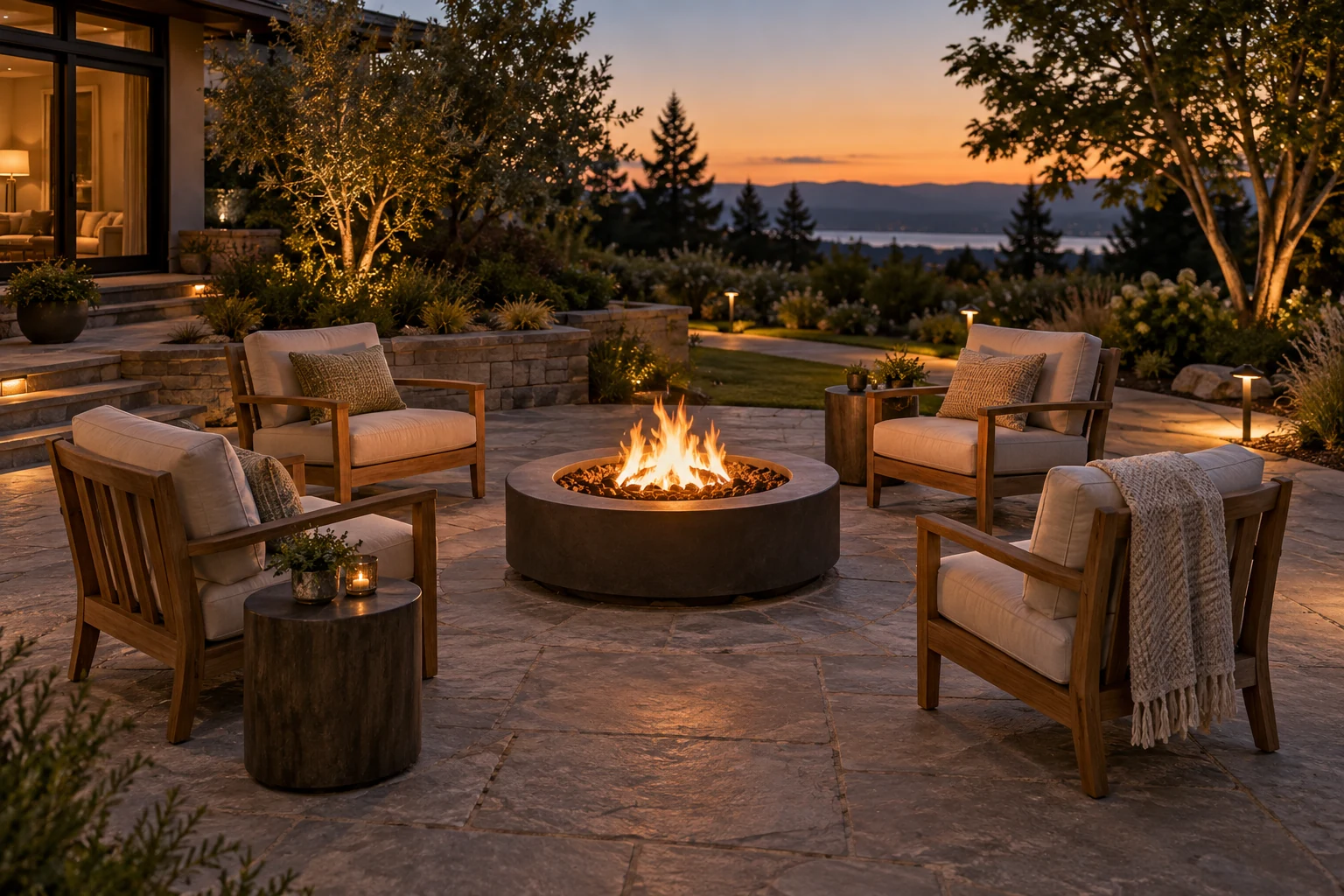
A backyard fire-pit area should be planned around the fire feature’s approved location and clearances first, then seating, lighting, surfaces and decor can be added around that safe zone. The exact requirements depend on the fire-pit type, fuel, manufacturer instructions, local fire rules, nearby structures, overhead conditions and weather.
The useful sequence is fire-pit type → local rules → manufacturer clearances → noncombustible base → seating zone → circulation → lighting → storage → plants and decor.
1. Start with the fire feature, not the furniture
Before arranging chairs or adding string lights, identify the exact fire-pit type and read its installation and operating instructions. For a general public-safety baseline, the U.S. Fire Administration’s outdoor fire-safety guidance also emphasizes keeping fire pits away from combustible materials, supervising children and fully extinguishing the fire before leaving. The exact appliance instructions and local rules still take priority.
Check:
- approved surface or base;
- required distance from combustible materials;
- overhead-clearance restrictions;
- whether the unit is portable or permanently installed;
- fuel-storage requirements;
- wind and weather restrictions;
- whether a cover, cooking grate or accessory is approved;
- local burn restrictions or permit requirements.
A decorative layout should adapt to those constraints rather than moving the fire feature into a visually convenient but unsuitable location.
2. Use a suitable noncombustible or manufacturer-approved base
Many fire features require a noncombustible surface or another specific base. Follow the product instructions for the exact unit.
Materials such as concrete, pavers, compatible masonry or gravel may be appropriate in some installations, but their suitability depends on the appliance, heat exposure, substrate and local requirements.
Do not assume every stone, paver, tile or concrete product is designed for direct high-heat exposure.
3. Keep the seating outside the required fire zone
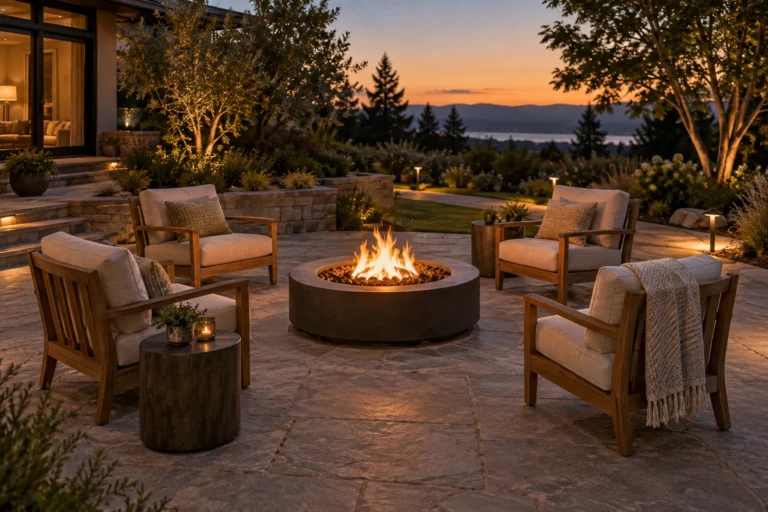
Once the fire feature’s clearances are known, position seating outside that zone while keeping the conversation comfortable.
A loose circle or open U-shaped arrangement often works because people can see one another without forcing chairs into the fire’s immediate heat zone.
Check the layout with the chairs occupied, not empty. Reclined backs, extended footrests and people moving behind chairs all change the real footprint.
4. Leave a clear route in and out
Guests should be able to reach and leave the seating area without stepping close to the flame, crossing fuel equipment or squeezing behind hot surfaces.
Keep primary circulation routes:
- easy to identify after dark;
- free of loose cords and hoses;
- clear of unstable stools or side tables;
- away from fuel-storage areas;
- wide enough for the household’s normal use.
5. Choose seating materials for the actual environment
Outdoor chairs and cushions should be suitable for weather exposure and positioned according to the fire feature’s clearance requirements.
Do not treat the words “outdoor furniture” as proof that a material can sit close to open flame or high radiant heat. Synthetic wicker, plastics, fabrics, foam and wood can all have heat limitations.
Where cushions are removable, store them away from the fire feature when not in use and keep them dry according to their care instructions.
6. Add side tables without crowding the fire
Small side tables can keep drinks and phones off the ground, but they should not push seating closer to the flame or become obstacles in the exit path.
Choose stable tables that suit the outdoor surface. Avoid lightweight pieces that can tip into the fire area in strong wind.
7. Treat overhead lighting as a separate safety system
String lights, pergolas and overhead decor should never be positioned using a generic height rule over a fire pit.
Instead:
- check the fire-pit manufacturer’s overhead-clearance requirements;
- keep combustible lighting cords, shades and structures outside prohibited zones;
- use outdoor-rated lighting and electrical equipment;
- keep connections protected and installed according to their listing and instructions;
- avoid routing cords across walking paths.
If the fire-pit instructions prohibit overhead structures or the required clearance cannot be achieved, light the area from the perimeter instead.
8. Use path lighting to support movement
Low-level path and step lighting can be more useful than decorative light directly above the flame because it helps people see changes in level and the route back to the house.
Keep fixtures outside traffic pinch points and choose outdoor-rated products suited to the installation location.
For low-level perimeter lighting, the Solar Path Lights guide explains panel exposure, runtime, beam direction and when solar should remain supplemental rather than the only safety light. For the broader exterior-lighting plan, use the Outdoor Living Design Guide.
9. Keep lanterns and candles secondary
Decorative lanterns can add atmosphere, but open-flame candles create another ignition source. Battery or rechargeable lanterns are simpler where additional flame is unnecessary.
If real candles are used, follow the candle and lantern manufacturer’s instructions and keep them stable, supervised and well away from combustible materials.
10. Planting should frame the area without entering the fire zone
Plants can soften a gravel or paver seating area, but leaves, dry grasses, mulch and branches should not encroach on the clearances required by the fire feature.
Keep containers stable and away from the main walking route. Regularly remove dry plant material that accumulates near the fire area.
11. Choose materials that connect to the house
Once safety constraints are resolved, repeat one or two materials already used on the patio or exterior. This creates a coherent outdoor room without requiring a large amount of decoration.
Useful relationships include:
- paver or stone tone repeated in side tables;
- metal finish echoed in lighting or furniture frames;
- cushion colors connected to exterior paint or planting;
- wood tones repeated in a nearby deck or fence.
The fire itself is already a strong focal point, so the surrounding palette can stay restrained.
12. Use rugs only when the fire-pit system allows them
An outdoor rug can visually define seating, but do not place one within a fire-pit zone unless the fire-pit manufacturer and rug material are appropriate for that use.
Loose textiles, synthetic fibers and rug edges can be vulnerable to sparks, heat or movement. A hardscape surface may be the better choice around a wood-burning feature.
13. Treat covers as product-specific accessories
A cover can protect a fire pit when it is completely cool and the manufacturer approves the cover. Some products also offer purpose-designed hard covers that create a temporary surface.
Do not place an improvised wood or decorative cover over a warm appliance, fuel controls or vents. Use only covers and conversion tops designed for the exact fire feature.
14. Cooking attachments need explicit approval
A fire pit is not automatically a grill. Use cooking grates, swing arms or other food accessories only when the manufacturer approves them for the appliance.
Gas and propane decorative fire features in particular may have media, burner and ventilation systems that are not intended for cooking.
15. Keep fuel and service access clear
Propane cylinders, gas valves, electrical controls and shutoffs need appropriate placement and access. Do not hide them behind decorative baskets, cushions or built-in seating.
Follow the fuel-system manufacturer’s storage, ventilation and service instructions.
16. Wind changes how the area should be used
Wind can move smoke, sparks and heat beyond the usual comfort zone. Follow the fire-pit instructions for wind limits and shut the fire down when conditions make operation unsafe.
Do not use decorative screens, walls or plants as improvised wind barriers unless they are part of an approved installation. They can redirect heat or create new combustible surfaces.
17. Make extinguishing or shutoff equipment easy to reach
Know how the specific appliance is shut down before lighting it. Keep any required fire-control equipment accessible and appropriate for the fuel type and local guidance.
Never leave an operating fire feature unattended, and make sure it is fully extinguished or shut down according to its instructions before leaving the area.
18. A practical seating and decor sequence
- Confirm the fire-pit type and operating instructions.
- Check local fire restrictions and permit requirements.
- Establish the approved base and clearance zone.
- Mark the no-furniture area on the ground.
- Place seating outside that boundary.
- Walk the entry and exit routes.
- Add stable side tables.
- Plan perimeter and path lighting.
- Add planting outside the required fire zone.
- Add only the textiles and accessories that do not compromise safety.
Style directions that work without crowding the flame
| Style | Useful materials | Keep restrained |
|---|---|---|
| Warm rustic | Stone, weathered wood, woven outdoor textiles | Loose dry decor near the fire |
| Modern | Concrete, dark metal, simple upholstery | Extra objects on the hardscape |
| Garden-focused | Planters, natural stone, softer colors | Plant material inside required clearances |
| Minimal | One seating material, low path lights, simple hardscape | Overhead decoration |
For broader patio planning, continue with the Outdoor Living Design Guide and our guide to preventing mildew under outdoor rugs.