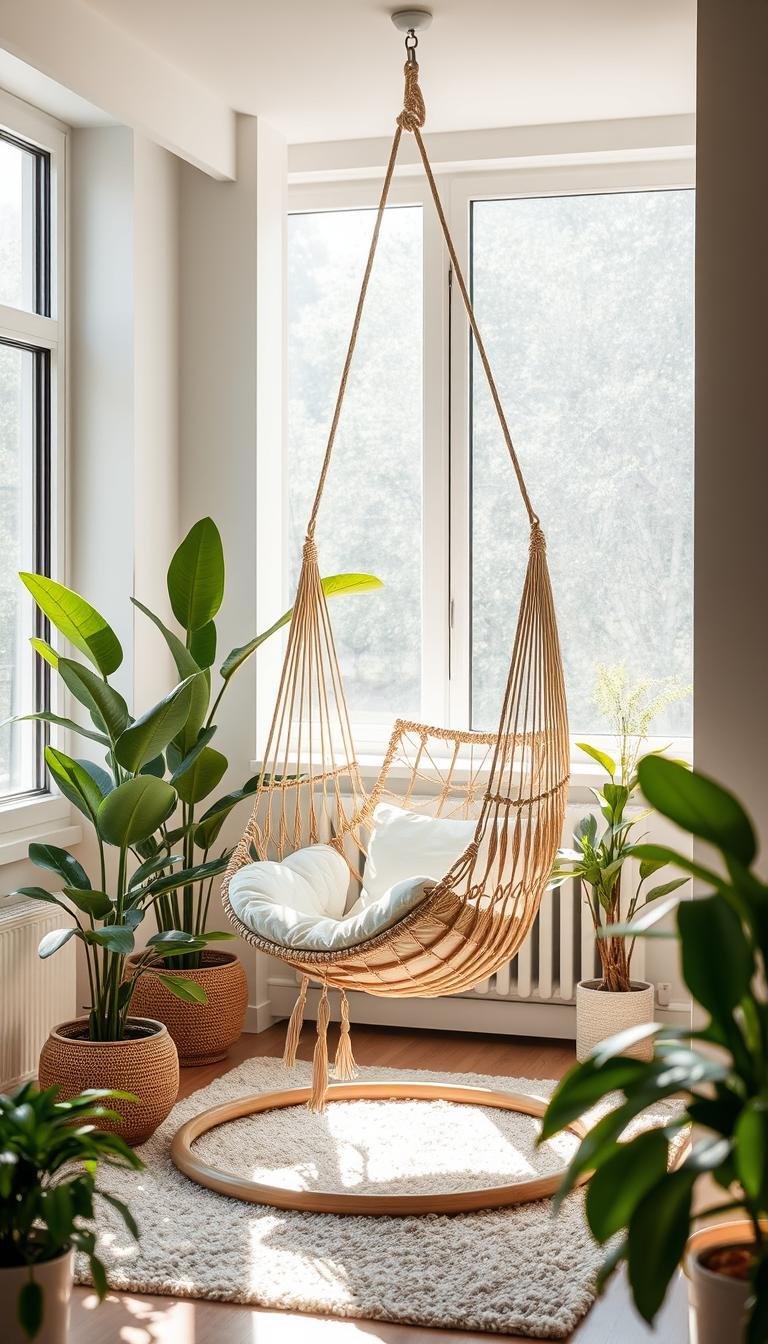

An indoor hammock is not just decor: the suspension points have to support dynamic human loads. If you cannot positively identify a suitable structural attachment and follow the hammock manufacturer’s mounting requirements, use a compatible freestanding stand or hire a qualified installer.
Do not rely on drywall, plaster, decorative trim, or a stud finder alone to prove that a ceiling or wall point is suitable.

Start with the hammock manufacturer’s instructions
Check the exact hammock or chair model for:
- approved mounting methods;
- required anchor spacing and height;
- compatible hardware;
- published load rating;
- minimum clearance around the hammock;
- whether the product is intended for single-point or two-point suspension.
A generic eye-bolt size, thread length or suspension angle should not replace those instructions because the required hardware depends on the product and the structure.
Freestanding stands are the simplest rental option
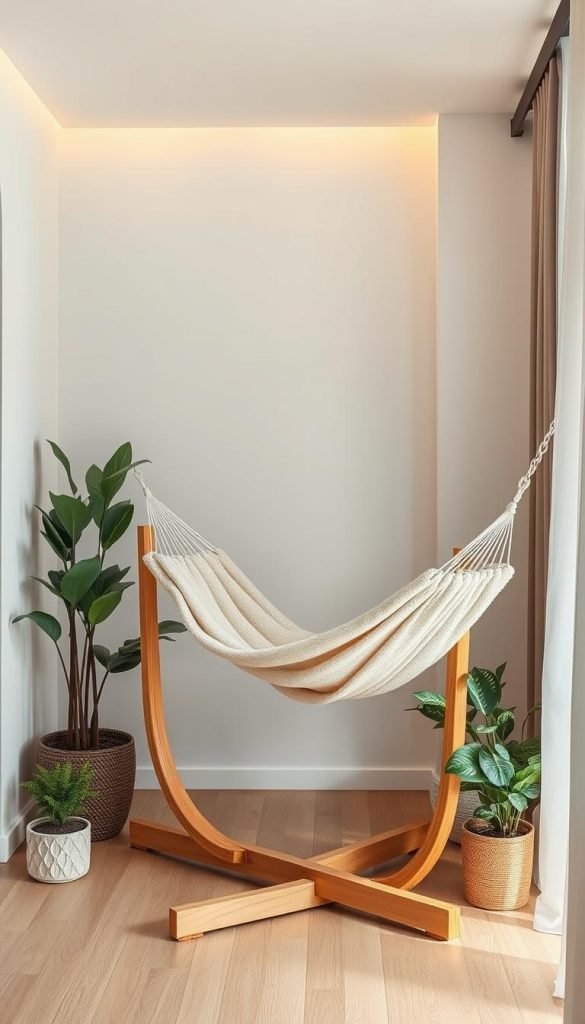
If drilling is not allowed, choose a stand designed for the hammock type and size. Verify the stand’s published load rating, footprint, connector compatibility and floor-surface requirements.
Set the entire base on a stable, level floor and keep the movement path clear of walls, glass, lighting, shelving and sharp furniture edges.
If you want a ceiling- or wall-hung hammock
Treat the installation as structural work. The correct attachment depends on framing material, member size and condition, anchor geometry, expected movement and the hammock maker’s requirements.
Do not assume that hitting wood with a pilot hole proves the member is suitable. Ceiling joists, trusses, engineered framing and wall studs can have restrictions on drilling or concentrated loads. If there is any uncertainty, have the location evaluated by someone qualified to assess the structure.
Do not improvise connectors
Use hardware specified or approved by the hammock manufacturer. Decorative carabiners, general-purpose hooks, unknown rope, and hardware without a relevant load rating are not appropriate substitutes.
All components in the load path matter: the weakest connector, knot, strap, anchor or structural point can govern the safety of the system.
Plan the movement envelope
Measure more than the hammock at rest. Leave space for entry, exit and gentle movement. Keep the hammock away from:
- windows and glass doors;
- ceiling fans, pendants and wall lights;
- sprinkler heads and detectors;
- bookcases and sharp furniture corners;
- heaters, fireplaces and hot surfaces;
- stairs and changes in floor level.
Hammock chairs need the same structural care
A single-point hanging chair can place a concentrated dynamic load on one location. Do not assume that one point is simpler or safer than a two-point hammock. Follow the chair manufacturer’s exact mounting method and clearance requirements.
Comfort comes after secure installation
Once the support system is resolved, adjust height and sag within the product’s stated guidance so the hammock is easy to enter and does not bottom out on the floor. Avoid universal seat-height or angle targets unless they are part of the manufacturer’s instructions for your model.

Inspection and maintenance
Follow the manufacturer’s inspection schedule. Stop using the hammock if you notice movement at an anchor, cracking around the mounting point, bent hardware, corrosion, frayed rope or straps, torn fabric, or unusual sounds.
Replace damaged parts only with compatible components. Do not keep tightening an anchor that appears to be loosening in the structure; stop using it and have the cause checked.
Apartment checklist
- Check the lease before drilling.
- Confirm whether a freestanding stand solves the problem.
- If mounting to the building, verify the structure rather than the finish.
- Use manufacturer-approved hardware.
- Keep the movement path clear.
- Inspect the system regularly and stop at the first sign of damage.
The simplest recommendation
For most renters, a manufacturer-matched freestanding stand is the lowest-risk route because it avoids unknown building structure and permanent alterations. For a mounted hammock, use the exact product instructions and qualified structural judgment rather than generic DIY bolt sizes or internet load formulas.
For another apartment seating option, see our guide to choosing an indoor swing chair, plus the Dwelanor Room Guides.