Bedroom · Bedding buying guide
How to Choose a Mattress Topper: Materials, Certifications & a Luxe Feel
Start with the feel you want, then verify the actual material, thickness, dimensions, certification scope and return terms. Treat broad “non-toxic” wording as a claim to investigate, not a shortcut.
Dwelanor Editorial · Evidence-led buying guide
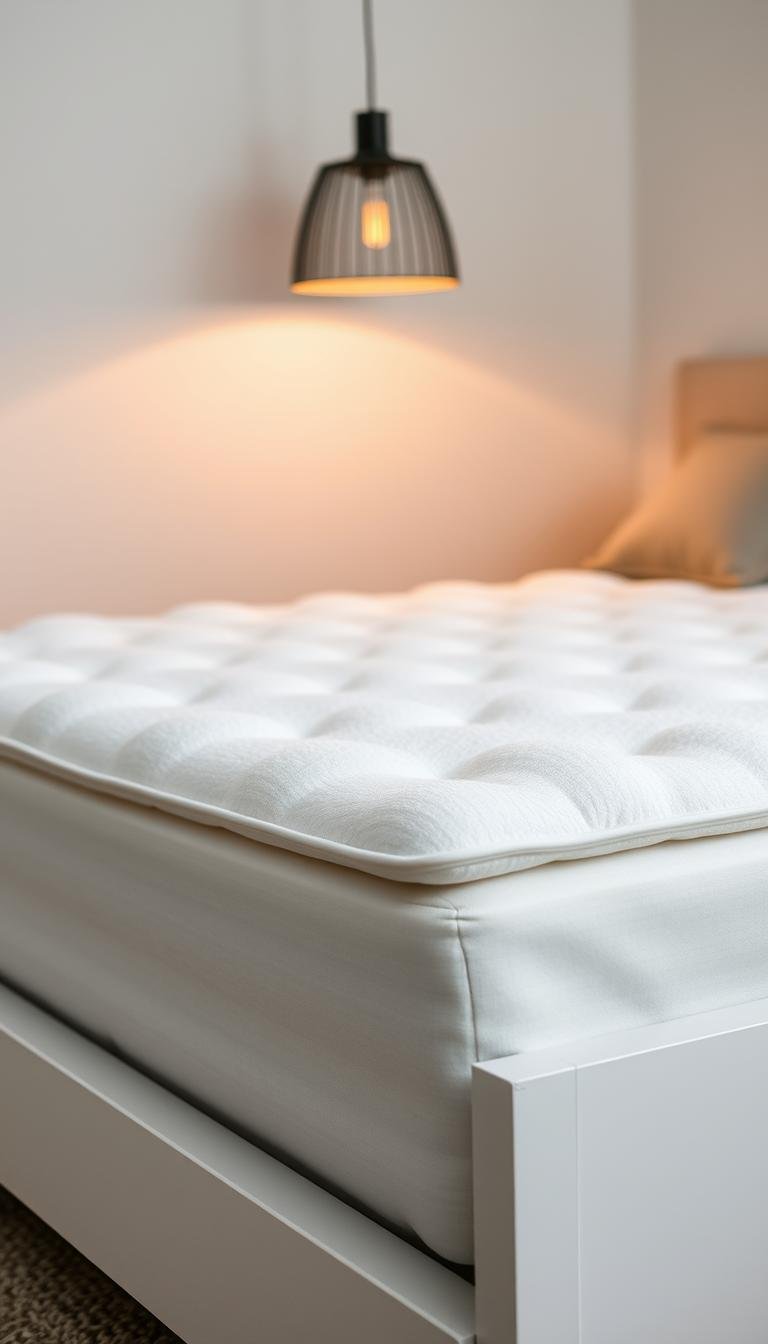
If you are searching for a “non-toxic mattress topper,” the most useful first step is to slow down and translate that broad phrase into things you can actually verify. The U.S. Federal Trade Commission says marketers making a non-toxic claim need competent and reliable scientific evidence that the product is safe for people and the environment. That is a much broader claim than “this textile was tested for specified harmful substances” or “this polyurethane foam meets a particular emissions standard.”
For a practical purchase, compare material → comfort goal → thickness → certification scope → exact dimensions → care → trial/return terms. A credible certification can be useful, but only for what that certification actually covers.
What “non-toxic” can and cannot tell you
“Non-toxic” is not a material specification. It does not tell you whether a topper is wool, latex, polyurethane foam, cotton batting or another construction. It also does not tell you what was tested, which substances were measured, the test limits, whether only one component was tested, or whether the final retail product holds a current certification.
The FTC’s Green Guides summary is especially useful here because it separates broad environmental marketing language from evidence. A better buying question is therefore: What specific property does this seller document, and can I verify it?
| Label or claim | What it can help verify | What it does not automatically prove |
|---|---|---|
| OEKO-TEX STANDARD 100 | Textile articles tested against the program’s harmful-substance criteria; requirements vary with intended skin contact. | That every non-textile internal component has the same certification, unless the certified article explicitly covers it. |
| GOTS | Certified organic textile content and processing under the GOTS standard. GOTS Version 8.0, released in March 2026 and in transition before becoming mandatory on March 1, 2027, uses label grades of at least 95% certified fibre content for “Organic” and at least 70% for “Made with organic materials.” | That an entire multi-material topper is “organic” merely because its cover uses organic cotton. |
| CertiPUR-US | Flexible polyurethane foam tested to the program’s content, emissions and durability criteria by independent accredited laboratories. | The whole topper, non-foam components, or a blanket “non-toxic” claim. CertiPUR-US itself says participants should not describe certified foam as “non-toxic.” |
| “Natural,” “eco,” or “non-toxic” | Nothing specific without supporting details. | A defined testing standard, organic content percentage, low-emission result or product-wide certification. |
Choose the topper material by feel first
A topper works only if it solves the comfort problem you actually have. Material labels are useful, but they should not override how the topper changes the bed.
Wool toppers
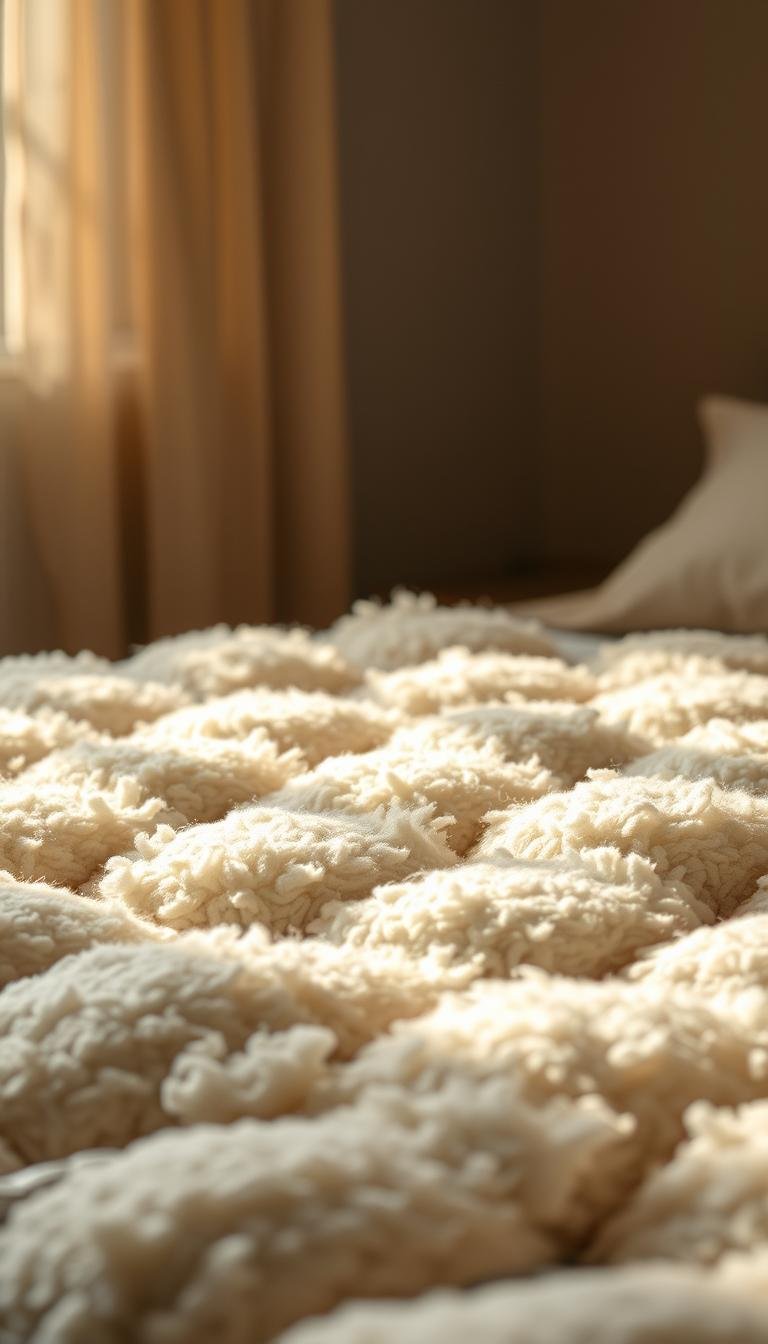
Wool toppers usually add a softer, cushioned surface rather than the deep contouring associated with many foams. If you want a lofty natural-fibre layer, compare the amount and construction of the wool fill, the cover material, overall thickness, care instructions and whether the finished product or only a fabric component carries a certification.
Disclosure: As an Amazon Associate I earn from qualifying purchases. Amazon links on this page are paid affiliate links. Dwelanor does not claim hands-on testing unless explicitly stated.
Compare wool mattress toppers on Amazon (paid link). As an Amazon Associate, Dwelanor earns from qualifying purchases. Check the exact fibre composition, dimensions, care instructions, seller and certification documentation for the listing you choose.
Latex toppers
Latex commonly gives a more buoyant, resilient feel than slow-response memory foam. But “latex,” “natural latex” and “organic latex” are not interchangeable claims. Look for the stated composition and the documentation behind any certification language. Do not assume a cotton cover makes the latex core organic, or that the word “natural” defines a percentage by itself.
For comfort, focus on thickness and the seller’s firmness description, then check whether you can return or exchange the topper if the feel is wrong. A thicker topper changes the mattress more dramatically than a thin comfort layer.
Compare latex mattress toppers on Amazon (paid link). Verify the stated latex content and certification scope on the exact product rather than relying on the search title.
Memory foam and other polyurethane foam toppers
Memory foam is chosen primarily for contouring and pressure-distributing feel. If you prefer that feel but want documented emissions/content criteria for the foam, a current CertiPUR-US claim can be one useful checkpoint. The program says certified flexible polyurethane foam is independently tested against its content, emissions and durability criteria, including a low-VOC emissions limit specified by the program.
That certification applies to qualifying foam. It does not convert the entire finished topper into a generally “safe,” “chemical-free” or “non-toxic” product, and CertiPUR-US explicitly restricts those broader descriptions in its own program rules.
Compare memory-foam topper listings that mention CertiPUR-US (paid link), then verify the brand/company in the program directory rather than trusting the marketplace text alone.
Fibre-fill and quilted toppers
Polyester or other fibre-fill toppers can create a plush, pillow-top feel without behaving like foam. They can be useful if the goal is surface softness rather than major contouring. Read the fibre composition carefully, because “down alternative” describes a style of fill, not a single material. Check washability, fill distribution, attachment method and how much loft the topper retains after use.
How thick should a topper be?
Thickness should follow the job. A modest comfort layer can soften the surface without substantially changing how high you sit in the bed. A much thicker topper can change the feel more dramatically and may affect fitted-sheet depth, bed height, edge feel and how easily you get in and out.
Before ordering, measure the mattress width and length rather than relying only on “queen” or “king.” Then add the topper thickness to your mattress depth and compare that combined depth with your fitted-sheet pocket. If the mattress already sits high on the frame, consider the resulting bed height too.
What makes a topper feel “luxe”?
A luxurious feel is not a certification. In practice, it comes from a combination of comfort, surface finish and how neatly the topper integrates with the rest of the bed.
- Consistent loft or contour: the surface should feel even rather than lumpy or visibly collapsed.
- A cover you actually like touching: if the topper has a removable cover, inspect the textile composition and care requirements.
- Correct fit: an undersized topper that shifts at the edges rarely feels premium.
- Stable placement: check straps, fitted construction or the manufacturer’s recommended anti-shift method where provided.
- Appropriate thickness: more material is not automatically more comfortable.
- A realistic return policy: certifications cannot tell you whether the topper will feel right to you.
How to verify certifications without getting fooled by badges
Do not stop at a logo in a product gallery. Certification programs generally define how their marks may be used, and some provide directories or label-check systems.
- Write down the exact brand and model you are considering.
- Identify which component the seller says is certified: cover, foam, fill or finished product.
- Open the certification body’s own site, not another retailer’s summary.
- Use the directory, certificate number or label check where available.
- Make sure the scope matches the claim you care about.
- If the seller says only “uses certified materials,” do not silently upgrade that to “the whole topper is certified.”
OEKO-TEX describes STANDARD 100 as testing textiles for harmful substances, with stricter requirements for more intensive skin contact. GOTS requires correct labelling for certified retail goods. Version 8.0 was released in March 2026 with a one-year transition period before mandatory use from March 1, 2027, and it distinguishes its organic-content label grades. CertiPUR-US maintains a directory for companies using certified flexible polyurethane foam and advises consumers to verify participating companies there.
A better five-minute shopping checklist
| Check | What to record before buying |
|---|---|
| Comfort goal | Surface softness, buoyancy, contouring, or a modest refresh of a mattress that is otherwise supportive. |
| Material | Exact fill/core and cover composition, not just the marketing family. |
| Dimensions | Actual width, length and thickness. |
| Certification | Program, certified component, certificate/directory verification and current scope. |
| Care | Whether the cover or full topper can be cleaned, and the manufacturer’s instructions. |
| Return/trial | Return window, opened-product rules, return shipping and any restocking conditions. |
| Bed fit | Combined mattress + topper depth, sheet pocket, bed height and shifting risk. |
Bottom line
The strongest mattress-topper purchase is not the one with the most reassuring adjectives. It is the one whose material, comfort role, thickness, dimensions, certification scope and return terms you can verify. If a seller uses “non-toxic,” treat it as a claim requiring evidence, not as a certification category.
For the rest of the bedroom plan, use the Bedroom Design Guide, Duvet Insert Size Guide and Bedroom Rug Size Guide. You can also browse current room-based categories in Shop the Home.
Sources and methodology
This guide separates broad marketing claims from the narrower scope of individual certification programs. It does not rate a specific topper as healthy, safe or “non-toxic,” and it does not treat a component certification as whole-product certification.
- Federal Trade Commission: Environmental Claims, Green Guides summary
- OEKO-TEX STANDARD 100
- Global Organic Textile Standard, Version 8.0 — released March 2026; transition period runs until mandatory use from March 1, 2027.
- CertiPUR-US: About the Certification
- CertiPUR-US Program Rules