A hidden litter box should make the room look better without making the litter box harder for the cat to use. The best setup starts with the cat’s access, box size, cleaning routine, ventilation and escape path, then uses furniture or screening to reduce the visual impact.
The useful relationship is cat → litter box → location → access → enclosure size → ventilation → cleaning → furniture.
Do not begin by cutting a cabinet or squeezing a box into the smallest available cavity. A discreet setup only works if the cat accepts it and the box remains easy to scoop.
Start with the litter-box needs, not the furniture
Current FelineVMA client guidance, from the organization formerly known as the American Association of Feline Practitioners, recommends a convenient, clean and private litter box. It gives the general rule of one box per cat plus one extra and notes that many cats prefer a box about one and a half times their body length. See the current FelineVMA client guidance.
That means a beautiful cabinet is not useful if the interior forces you to use a box that is too small for the cat.
Good hidden-litter locations
The best location is usually somewhere quiet but still easy to reach. AAFP guidance also advises avoiding busy thoroughfares and locations where a cat can be cornered.
Useful room options can include:
- a living-room cabinet designed specifically as litter-box furniture;
- a utility or laundry area away from noisy appliances when the cat is comfortable there;
- a wide hallway alcove that is not a traffic pinch point;
- a bathroom corner with sufficient floor space and ventilation;
- a spare-room or office corner where the cat has reliable access.
Do not choose a location solely because guests cannot see it. A hidden box that is difficult for the cat to access can create a much bigger household problem than a visible one.
Purpose-built litter-box furniture is usually easier than modifying random furniture
Furniture designed for litter-box use has one major advantage: the manufacturer has already planned an entry, internal dimensions and service access.
Before buying, check:
- internal width, depth and height;
- entry size and threshold height;
- door opening for removing the litter tray;
- ventilation openings;
- material and wipe-clean surfaces;
- weight and anti-tip requirements;
- whether your actual litter box fits inside.
A console or sideboard can blend naturally into a living room while giving the top surface another purpose.
When adapting existing furniture makes sense
Adapting an existing cabinet can work, but only when the furniture is large enough and the alteration does not compromise its structure.
Do not cut into electrical components, drawers, load-bearing joints or unknown hidden hardware. If the cabinet is tall or heavy, follow its anti-tip instructions after any modification.
For a rental, changing your own freestanding furniture is usually easier than modifying a built-in vanity or closet door that belongs to the property.
A skirted table is one of the least invasive options
A side table or console with a fabric skirt can visually soften the litter-box area without enclosing it in a rigid cabinet. The box remains easy to remove and airflow is usually better than in a small closed cabinet.
Keep enough open area for the cat to enter comfortably and do not wrap the fabric so tightly around the box that it traps odor or creates a single narrow escape route.
Choose washable fabric that does not drag inside the litter or create a loose cord or loop around the opening.
Open versus enclosed litter-box furniture
Some cats accept covered or furniture-style boxes easily. Others prefer a more open setup. The enclosure should follow the cat’s behavior rather than forcing the cat to follow the design.
| Approach | Visual advantage | Main consideration |
|---|---|---|
| Open box behind a screen | Easy to disguise visually | Preserves airflow and easy access |
| Skirted table | Looks like normal furniture | Keep fabric clear of litter and entry |
| Purpose-built cabinet | Most integrated appearance | Interior size, ventilation and cleaning access |
| Closet or alcove | Removes the box from the main room | Door access and risk of another pet blocking the cat |
Ventilation matters more than fragrance
Do not try to make an enclosed litter box acceptable by adding strong fragrance. Keep the box clean and make sure the enclosure does not trap concentrated odor.
A larger cabinet with ventilation openings is generally easier to manage than a very tight enclosure. Do not install a powered fan, electrical device or filter system inside furniture unless it is specifically designed and safely powered for that use.
Keep cleaning easier than hiding
If the enclosure turns a 30-second scoop into a furniture-disassembly project, the design is working against you.
Look for:
- a full-opening cabinet door;
- a removable litter pan;
- enough headroom to scoop without spilling;
- wipeable interior surfaces;
- a nearby place for scoop and waste bags;
- a washable mat that does not block the entry.
FelineVMA client guidance recommends scooping at least once daily. A design that makes that routine easy is more useful than one that hides the box completely.
Plan for senior cats and mobility changes
A setup that works for a young cat may become difficult later. A senior or painful cat may benefit from a lower-entry box and a location without stairs. FelineVMA materials specifically note the value of easy-to-access boxes for aging or chronically ill cats.
If the cat begins straining, avoiding the box, urinating outside the box or showing other changes in toileting behavior, do not treat that purely as a decor problem. Veterinary guidance recommends ruling out medical causes when elimination behavior changes.
Multi-cat homes need more than one “perfect” hidden cabinet
One beautiful cabinet in the living room may not satisfy a multi-cat household. The common veterinary rule of thumb is one box per cat plus one extra, distributed across the home where practical.
Several boxes placed in one tight enclosure are not the same as multiple accessible resources if one cat can block another from entering or leaving.
Do not put the box beside food and water
A hidden litter cabinet can look convenient next to a feeding station, but cats generally prefer toileting resources separated from food and water.
Use the room plan to create distinct zones rather than forcing all pet supplies into one decorative console.
Track litter without blocking access
A washable mat outside the entrance can help catch litter carried on paws. Keep it flat and large enough to be useful without becoming a trip hazard or forcing the cat through a narrow path.
If the cat avoids textured mats, move or change the mat rather than making the route uncomfortable.
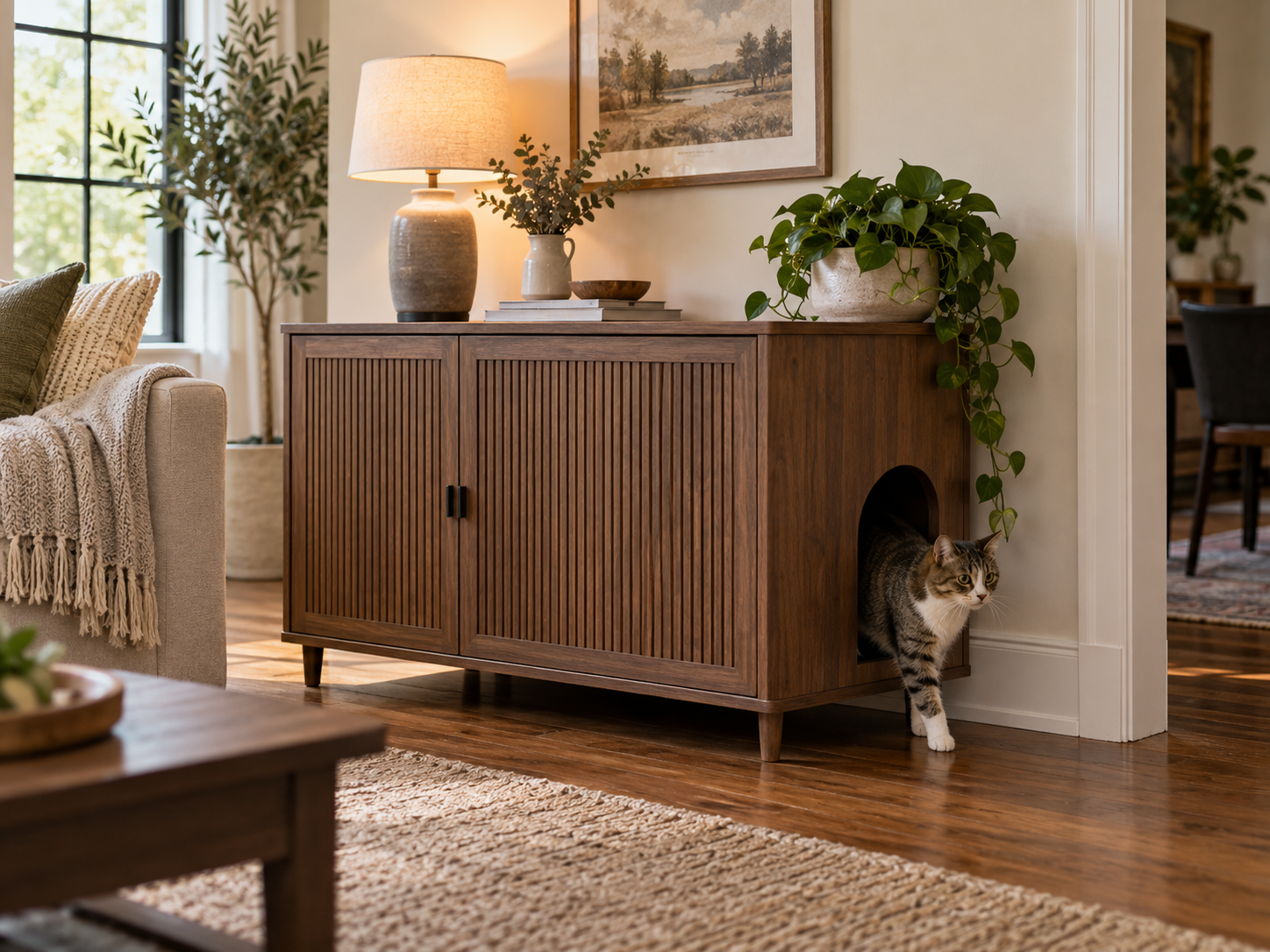
How to make the setup look intentional
Once access and cleaning are resolved, treat the furniture like the rest of the room.
You can coordinate:
- cabinet finish with nearby wood tones;
- hardware with lamps or side tables;
- a tray, lamp or plant on top where safe;
- wall art above the cabinet;
- a low screen or slatted panel that repeats another room material.
The goal is not to disguise the setup with dozens of decorative objects. It is to make the litter-box furniture read as part of the room.
A practical decision sequence
- Choose the correct box size and litter setup for the cat.
- Identify two or more quiet, accessible location options.
- Measure the box before shopping for furniture.
- Choose open screening, a skirt, purpose-built furniture or a properly sized cabinet.
- Check ventilation and escape routes.
- Make sure the entire box can be removed easily.
- Test the setup with the cat before treating the location as permanent.
- Style the furniture only after the cat uses the setup reliably.