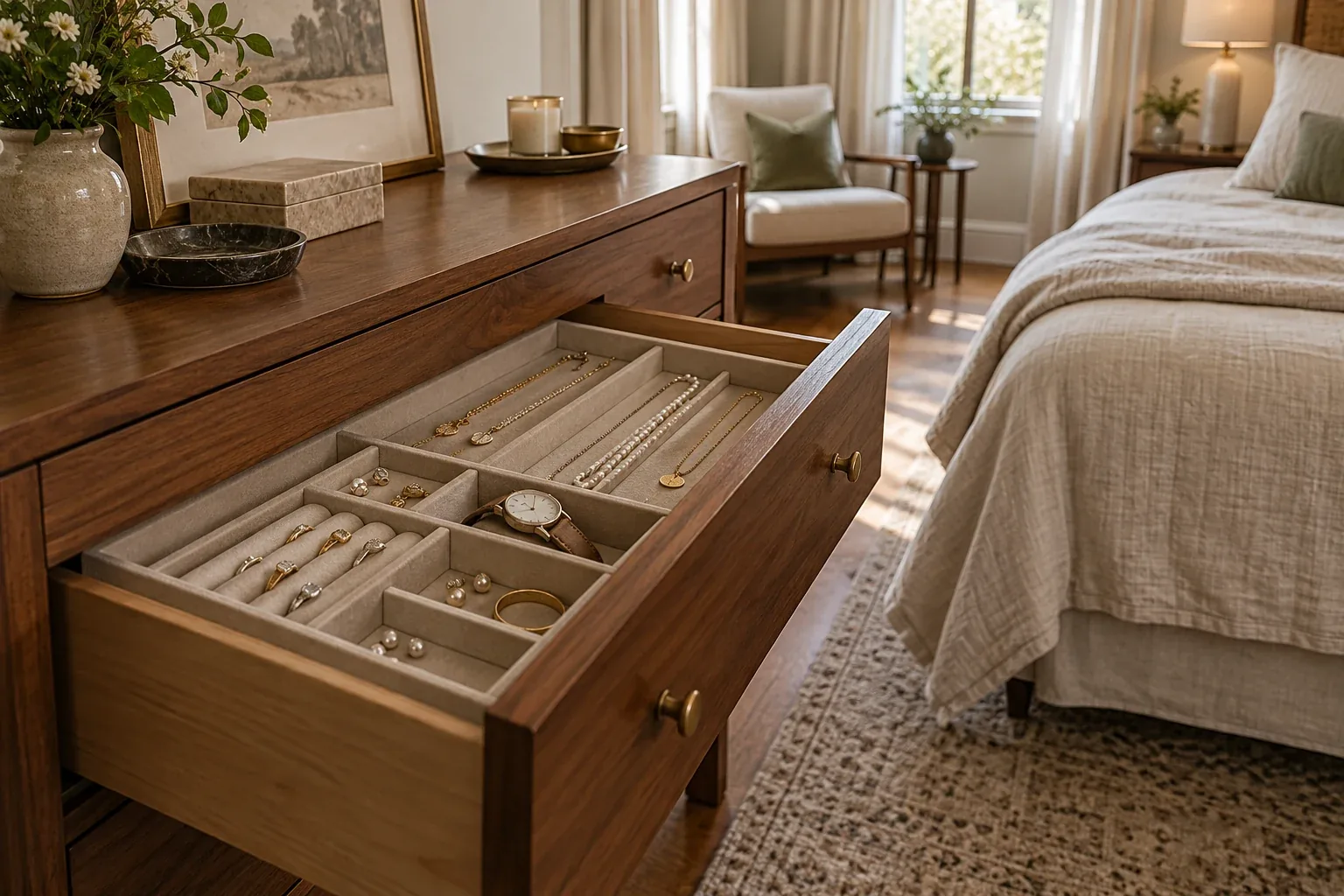
The easiest way to create hidden jewelry storage inside a dresser is usually to add a shallow, removable organizer within an existing drawer rather than rebuild the furniture around a secret compartment. If the drawer is deep enough, a second sliding tray can work, but only when the drawer box, slides, clearances and added weight support it.
The useful relationship is drawer dimensions → jewelry type → organizer depth → drawer-slide clearance → lining material → access → furniture structure.
Start by inventorying what you actually need to store
Jewelry storage works better when the compartments match the collection. Sort items into groups before choosing the organizer:
- rings;
- stud and drop earrings;
- bracelets and watches;
- short necklaces;
- long necklaces;
- brooches or pins;
- larger costume pieces;
- items that need their original boxes.
A shallow tray is excellent for rings and earrings but can be frustrating for bulky cuffs or large watches. Measure the tallest and widest pieces before buying or making an insert.
Measure the usable drawer, not just the drawer front
Open the drawer and measure the actual interior width, depth and clear height. Then check for anything that reduces the usable space:
- side-mounted or undermount drawer slides;
- drawer-stop hardware;
- the drawer above;
- internal rails or braces;
- a shaped or curved drawer front;
- fasteners projecting into the box.
The face of a dresser drawer can be much taller than the storage cavity behind it, so do not design from the front dimension alone.
Choose the simplest organizer format that fits
| Organizer type | Best use | Main advantage |
|---|---|---|
| Removable fitted tray | Most collections | No furniture modification |
| Stacked shallow trays | Deep drawers with occasional-access pieces below | Adds layers without slides |
| Sliding upper tray | Very deep, structurally suitable drawers | Lets upper and lower layers remain accessible |
| Drawer dividers | Larger watches, boxes and costume pieces | Flexible compartment sizes |
For most dressers, a fitted removable tray is the least complicated and easiest to clean or replace later.
Use soft, non-abrasive contact surfaces
Jewelry can scratch when metal pieces rub against each other or against rough organizer materials. Use a smooth lining appropriate to the items you store.
Common options include:
- velvet or velour-style jewelry trays;
- soft microsuede-style liners;
- felt inserts with smooth finished edges;
- purpose-built ring rolls and watch cushions.
Avoid rough exposed fasteners, unfinished wood edges or loose adhesive residue where jewelry will make contact.
Do not assume one liner is ideal for every material
Fine jewelry, costume jewelry, pearls, plated pieces and watches can have different care needs. If an item came with specific storage instructions, follow those first.
Keep pieces dry before putting them away. Do not store jewelry beside cosmetics, perfume, household chemicals or damp textiles simply because those items also live in the bedroom.
When a sliding second tier makes sense
A sliding upper tray can make a deep drawer easier to use because the top layer moves aside to reveal storage below. But it adds weight and hardware to a drawer that was not necessarily designed for that system.
Before adding one, confirm:
- the dresser drawer has enough internal height;
- the tray will not collide with the drawer above;
- the side walls or internal support can accept the chosen hardware;
- the existing drawer slides can handle the total loaded weight;
- the added mechanism does not prevent the main drawer from opening fully;
- the tray cannot tip or fall when pulled to one side.
Use a purpose-built small tray-slide or organizer system with published installation requirements rather than improvising rails from trim, random dowels or generic hardware. Drawer-runner systems are engineered around specific lengths, mounting geometry and load classes. For example, Blum publishes separate MOVENTO load classes and dedicated assembly instructions for its runner system rather than treating drawer slides as interchangeable hardware. See the Blum MOVENTO assembly guidance. If quiet closing is the main goal, our quiet drawer-slide guide explains soft-close hardware, alignment, drawer construction and load checks.
Do not drill into a dresser blindly
Dresser construction varies widely. Solid wood, veneered panels, MDF, particleboard and thin drawer sides do not accept fasteners the same way.
Before drilling:
- identify the drawer material;
- locate existing slide hardware;
- check screw length against the panel thickness;
- avoid fasteners that could project through the visible exterior;
- do not weaken dovetails, corner joints or slide attachment points.
For valuable, antique or heirloom furniture, use a removable insert or consult a furniture professional rather than modifying the drawer.
Keep the storage discreet without calling it secure
A drawer insert can keep jewelry out of immediate view and reduce visual clutter, but it is not a safe or theft-resistant storage system.
Do not describe a false electrical outlet, decorative clock or hidden drawer as “high security.” If theft protection matters, use a properly selected secure storage solution appropriate to the value and insurance requirements of the items.
The dresser organizer should be treated as discreet everyday storage, not as a replacement for a safe.
Plan necklaces differently from rings and earrings
Necklaces are the category most likely to tangle in a shallow tray. If the drawer is wide enough, give each necklace a separate channel or compartment rather than stacking several chains together.
Long pieces may work better on a dedicated hanging organizer elsewhere in the closet, provided the hanging system protects the jewelry and does not expose it to constant dust or sunlight.
Give watches and bracelets enough depth
Watches and rigid bracelets often need more vertical space than rings and studs. Use cushions or wider compartments so clasps are not forced shut at awkward angles.
If a tray has a sliding upper layer, check that watches beneath it do not rub against the bottom of the moving tray.
Keep frequently used pieces near the front
Organize by access frequency rather than simply by jewelry type. Everyday items can sit toward the front or in the upper tray, while occasional pieces can occupy the rear or lower layer.
This reduces daily rummaging and makes the organizer easier to reset.
Label only when it genuinely helps
A jewelry drawer is usually visible enough that extensive labeling is unnecessary. Small labels can help with categories such as heirloom pieces, repair-needed items or travel accessories, but avoid turning a compact organizer into a wall of text.
Visual separation should do most of the work.
Lighting belongs outside the drawer unless the system is designed for it
A nearby bedroom or closet light is usually enough. Avoid hiding loose battery packs, improvised wiring or charging electronics inside a textile-lined jewelry drawer.
If integrated drawer lighting is important, choose a purpose-built furniture-lighting system and follow its installation requirements, including clearance, wiring and service access.
A simple no-build version
- Measure the drawer interior.
- Sort jewelry by size and frequency of use.
- Choose one or more shallow removable trays that fit the drawer.
- Add non-slip material beneath the trays if needed and compatible with the drawer finish.
- Place daily items toward the front.
- Keep bulky or boxed items in the deeper portion of the drawer.
- Remove the entire tray for periodic cleaning.
A more advanced sliding-tray version
- Measure the clear internal height and width.
- Choose a purpose-built sliding organizer system with published dimensions and load requirements.
- Confirm the dresser material and drawer-slide capacity.
- Mock up the tray thickness and movement path before installing hardware.
- Keep fasteners clear of existing joinery and drawer slides.
- Test the empty system through its full movement.
- Add jewelry gradually and confirm the main drawer still operates smoothly.
What to avoid
- Using unknown reclaimed materials that may abrade or stain jewelry.
- Applying strong solvent-based adhesive inside an enclosed drawer without following the product’s use and ventilation instructions.
- Drilling into thin drawer sides without confirming they can accept the hardware.
- Adding enough organizer weight that the original drawer slides bind or sag.
- Calling a hidden drawer burglar-proof or high-security storage.
- Building fake electrical outlets or other deceptive fixtures as storage.
- Placing jewelry beside liquids, cleaners or damp items.
For related bedroom storage, continue with our under-bed storage guide, walk-in closet organization guide, the Storage & Organization Guide, and the Bedroom Design Guide.