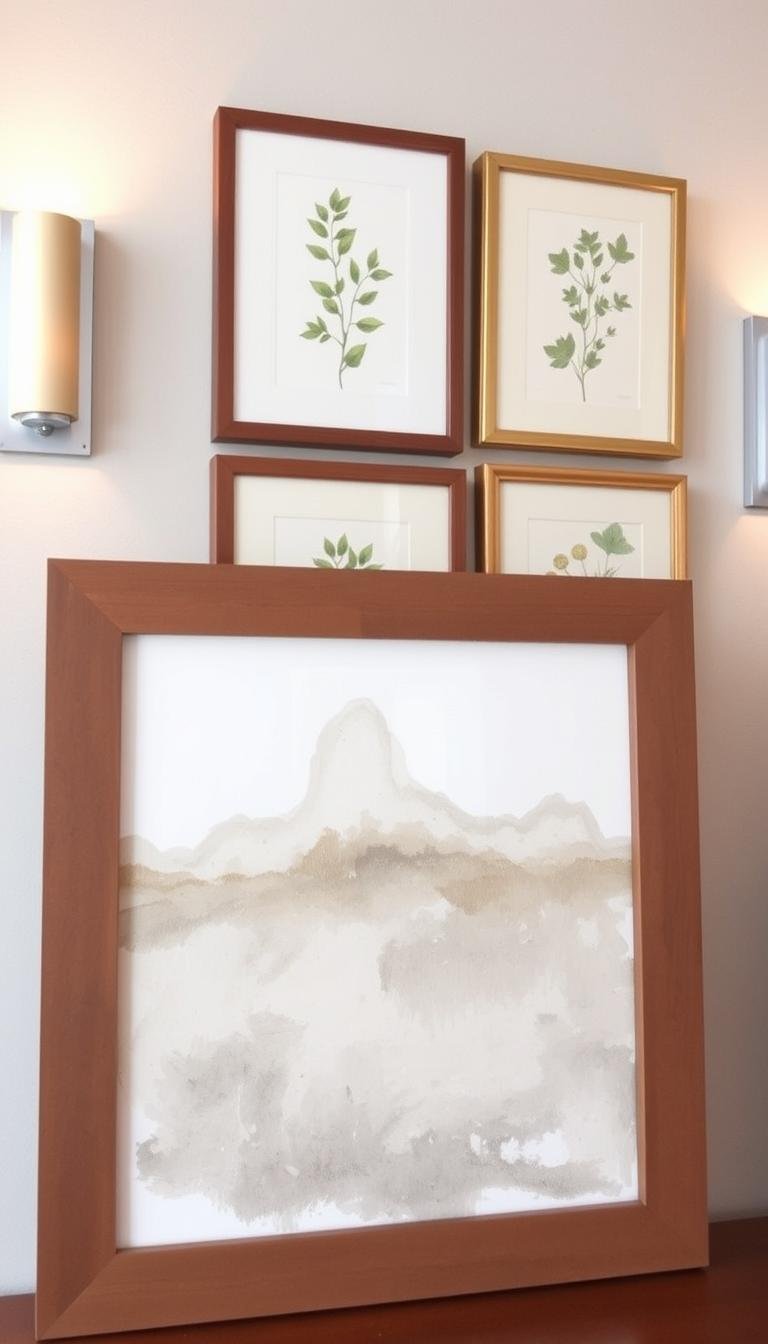

Picture frames usually tilt for one of three reasons: they can pivot around a single hanging point, the hardware on the back lets the frame lean forward, or the lower corners have too little friction against the wall. The fix depends on which movement you are seeing.
For a frame that keeps rotating sideways, stabilize the hanging points and add small soft bumpers at the lower corners. For a frame that leans forward, check the rear hardware, wire slack and the way the frame’s weight sits against the wall before adding more adhesive products.
How do I keep picture frames from tilting on the wall?
Start with the least invasive fixes:
- Level the frame and check the hanger. Make sure the wall hook or picture-hanging system is seated properly and rated for the finished frame weight.
- Add two small bumpers to the lower back corners. Felt, silicone or rubber bumpers can create consistent wall contact and reduce small side-to-side shifts.
- Use two hanging points for wide frames when the hardware allows it. A frame suspended from one central point can pivot more easily than one supported at two correctly positioned points.
- Check the rear wire or D-rings. Loose, uneven or poorly positioned hardware can make the frame sit crooked even when the wall hook is level.
If the frame keeps rotating sideways
Sideways rotation is common when a frame hangs from a single nail or hook and is frequently disturbed by doors, foot traffic, cleaning or vibration.
For a lightweight frame, lower-corner bumpers may provide enough friction to keep it straight. For a wider or heavier frame, use the hanging method specified for the frame and consider two appropriately rated attachment points if the frame hardware is designed for them.
- Is the wall hanger itself level and secure?
- Are the D-rings or other frame attachments installed at matching heights?
- Is the wire centered rather than caught on one side?
- Do the lower corners contact the wall evenly?
- Is a nearby door or piece of furniture repeatedly bumping the frame?
How to stop a picture frame tilting forward
A forward lean is a different problem from sideways rotation. It can happen when the frame is deep or front-heavy, when the hanging wire allows the top to fall away from the wall, or when the rear hardware creates an awkward angle.
Do not assume the answer is simply to make the wire extremely tight. Over-tensioning can put unnecessary stress on the frame and hardware. Instead, inspect the existing hanging system and use the hardware arrangement recommended for the frame’s size and weight.
Check the back of the frame
Look for loose screw eyes, D-rings, wire, sawtooth hangers or other fittings. If the hardware is damaged, undersized or pulling out of the frame, replace it with a system appropriate for the frame rather than trying to stabilize the problem with adhesive alone.
Use lower-corner spacers consistently
Two identical soft bumpers can help a frame sit against the wall at a consistent angle. They also reduce rubbing and can help prevent the dark contact marks covered in our guide to stopping picture frames from marking walls.
Should you use one hook or two?
| Situation | Useful approach |
|---|---|
| Small lightweight frame with centered hardware | One correctly rated hanger may be sufficient |
| Wide frame that keeps rotating | Two rated hanging points can reduce pivoting when the frame hardware supports them |
| Heavy or valuable artwork | Use a hanging method specifically rated for the weight and wall construction |
| Gallery wall that changes often | A picture rail or gallery hanging system can make repeated alignment easier |
Do not double a product’s capacity simply because you use two hooks. Follow the published load and installation guidance for the exact hanging system.
Can adhesive strips stop frames moving?
They can help in some installations, but distinguish between supporting the frame’s weight and stabilizing the lower corners. A small removable product used only to reduce movement is different from asking adhesive strips to carry a heavy frame.
If you want a removable system to support the frame itself, use one whose current manufacturer instructions explicitly cover the finished weight, frame size, wall surface and backing. Our guide to removable hanging systems for heavier frames explains those limits in more detail.
What about gallery walls?
A gallery wall is easier to keep aligned when every frame uses a predictable hanging method. Mixing loose wires, sawtooth hangers, adhesive strips and different hook styles can make small adjustments harder because every piece responds differently.
Before hanging the group:
- lay out the arrangement on the floor or with paper templates;
- measure the hanger location on the back of each frame, not just the frame dimensions;
- use a level or laser line for shared horizontal references;
- add matching lower-corner bumpers after each frame is level;
- keep a record of the layout if you expect to remove frames for cleaning.
If a frame moves every time a door closes
Repeated movement may be caused by vibration or airflow rather than poor leveling. Make sure the frame is not touching a door, curtain or piece of furniture. Two-point support and lower-corner bumpers usually provide more resistance to small disturbances than a loosely hanging single-point setup.
For very light frames, a gallery hanging system or another method designed to reduce pivoting can be easier than repeatedly adjusting individual hooks.
When not to improvise
Large mirrors, heavy glazed artwork and valuable pieces deserve a hanging method chosen for the actual wall construction and finished weight. Plaster, masonry, drywall and timber all require different fasteners and load assumptions.
If the existing hardware is pulling out, the wall is damaged, or the frame will hang above a bed or another location where a fall could cause injury, use appropriate mechanical support rather than treating the problem as a simple leveling issue.
The simplest fix
For an ordinary frame that is merely drifting out of level, start with two soft bumpers at the lower corners and make sure the wall hanger and rear hardware are centered and secure. If the frame still pivots, move to a properly rated two-point hanging arrangement when the frame supports it.
That solves the root problem without overcomplicating the gallery wall or adding visible hardware.