Holiday decorating · Small spaces
Small Apartment Christmas Trees
Slim, tabletop and wall-friendly ideas that make a smaller home feel festive without sacrificing circulation.
By Hayat · November 1, 2026
IN THIS GUIDE
Find the right tree for your space
THE QUICK FIT CHECK
Measure first. Decorate second.
- Actual width: include branches, ornaments and stand.
- Circulation: keep doors, drawers and normal routes usable.
- Practicality: verify power, stability and storage.
For a small apartment, the best Christmas tree is the one that feels festive without consuming the only clear walkway. A tabletop tree works well when you have a stable surface, a slim or pencil tree suits a tight corner with enough floor space, and a lightweight wall-friendly display may be preferable when no floor footprint is available. There is no need to force a conventional full-width tree into a room that cannot accommodate it.
Choose the format in this order: floor or surface space → traffic and doors → actual tree width and height → electrical access → storage after the holidays → the look you want. The proportions of a decorated tree matter more than its advertised height alone.
1. Measure the entire Christmas tree footprint
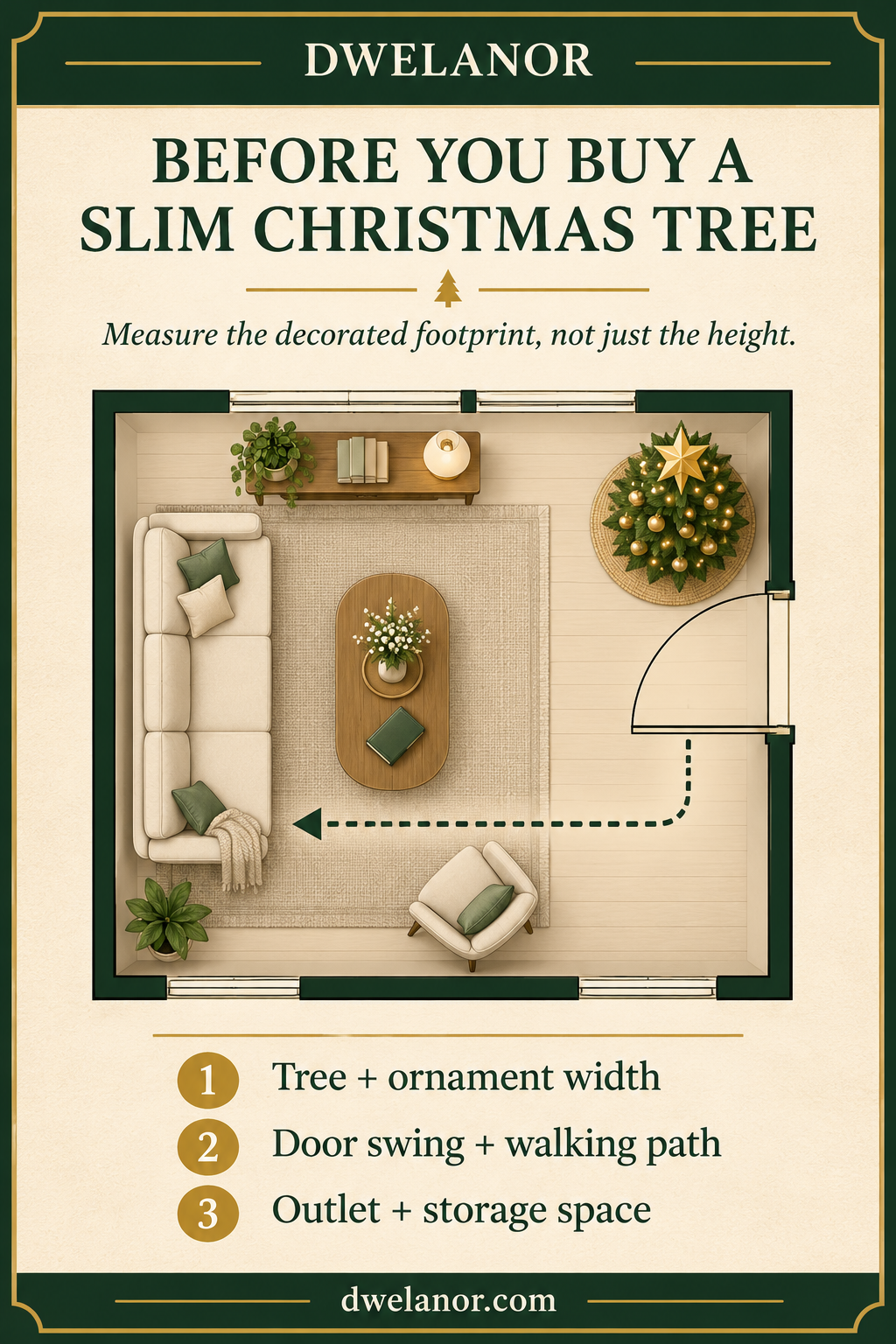
Start by measuring a proposed tree zone from wall to wall, including baseboards, doors, furniture legs and the route people use to pass. A tree’s advertised height is easy to notice, but its widest branch diameter may determine whether the room remains comfortable.
For a floor-standing tree, measure the following separately:
- Maximum decorated width: the widest branch span plus the projection of ornaments and any surrounding presents.
- Height: enough distance below the ceiling for the top decoration and a realistic margin for positioning it safely.
- Stand footprint: the base may be wider or differently shaped than the lowest branches.
- Door and drawer movement: the tree must not obstruct opening or closing nearby furniture.
- Walkway: the remaining circulation space must continue to work during everyday use and when guests visit.
- Electrical route: outlets and cables should be accessible without crossing a walking path.
Mark the proposed outline with painter’s tape. Put a chair or box in the taped area to simulate the tree’s projection, then walk the normal route while carrying a laundry basket or bag. If you find yourself stepping around the zone every time you enter the room, the tree is too large for that position.
For more precise furniture and circulation planning, use our Small Space Design Guide before choosing holiday decor.
2. Choose from four practical tree formats



These photographs and illustrations demonstrate visual formats, not tested products or a promise of specific dimensions. Confirm actual measurements with the merchant.
| Format | Best fit | What to verify | Main limitation |
|---|---|---|---|
| Tabletop tree | Studio apartments, desks, sideboards | Stable surface, full decorated height, branch width, secure base | Requires an available surface and safe placement |
| Slim or pencil tree | Narrow living-room corners | Actual maximum diameter, stand stability, ceiling height | Can still dominate the walkway if placed poorly |
| Wall-friendly tree display | Spaces with almost no floor clearance | Wall or removable fixing compatibility, decoration weight | Often more decorative than three-dimensional |
| Compact conventional tree | Small rooms with a usable corner | Overall footprint, stand and storage volume | Full lower branches can crowd nearby furniture |
Tree categories are not standardized dimensions. One manufacturer may call a tree “slim” while another uses “pencil,” and nominal sizes can conceal very different widths. Compare exact published dimensions for the specific model, not just the label.
3. Tabletop trees make sense when the floor cannot spare space
A tabletop tree can look substantial in a studio because it raises the decorations into the visible zone instead of filling a walkway at floor level. It works particularly well on a low sideboard, sturdy console or other surface that is not needed for everyday meals or computer work.
Choose the surface first. A tree that takes over a tiny dining table may create more frustration than a narrow floor tree. Check the stability and load guidance of the supporting furniture, and make sure the decorated tree cannot tip if bumped by someone opening a drawer, brushing past or reaching for a nearby item.
Keep the decorative group simple: the tree, a restrained base cover and possibly one separate seasonal accent. Clustering many small holiday items around the tree can make the room feel more crowded than a single deliberate arrangement.
For a home office, choose a tree and decorations that do not block monitor sightlines, task lighting or the equipment’s ventilation. Our Home Office Design Guide explains how to preserve useful desk space.
4. A slim tree may be better than a full-width miniature
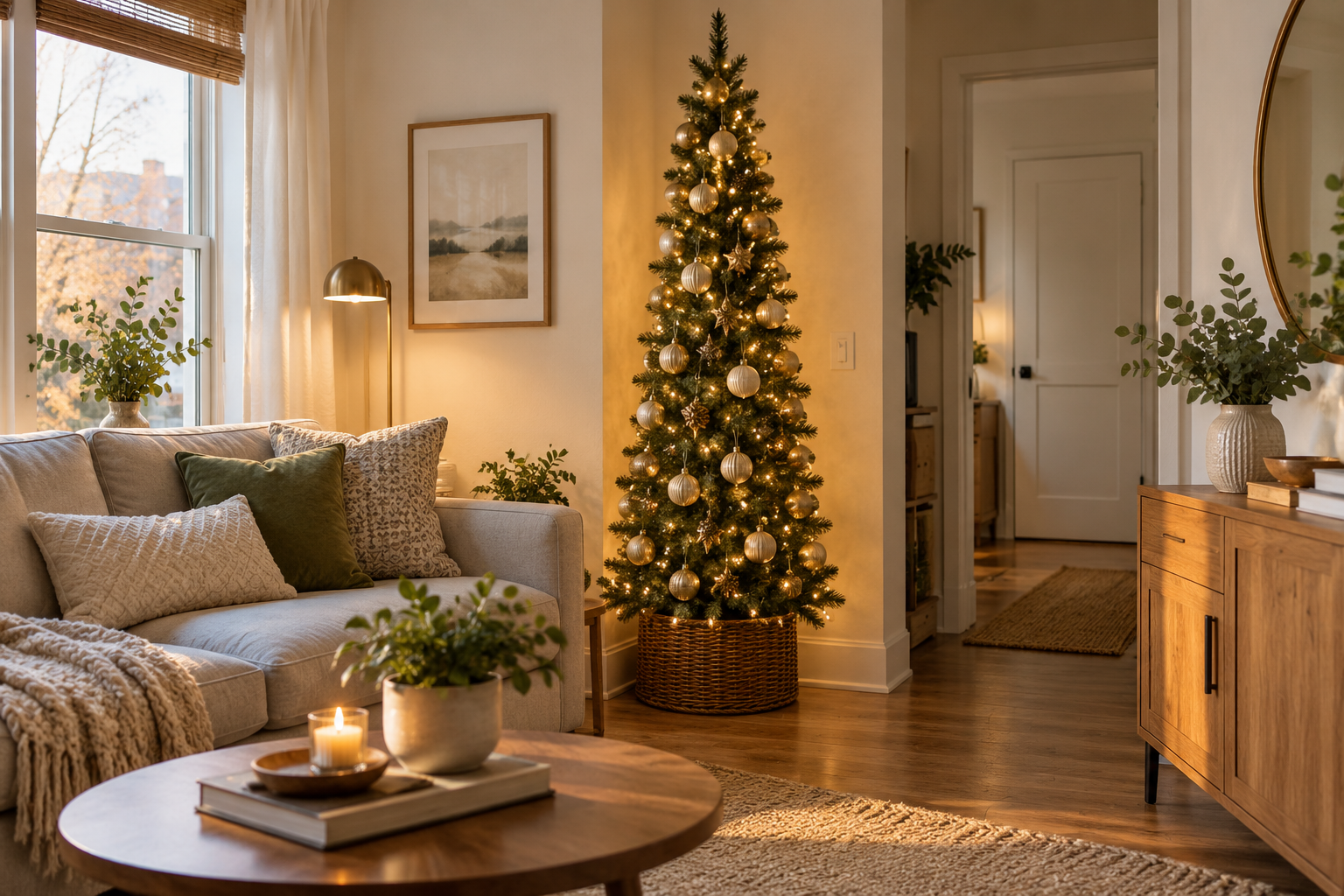
A floor-standing slim tree uses vertical space more efficiently when a room has sufficient height but limited width. Instead of shopping by height, compare the published maximum diameter and the precise stand footprint.
Check the proposed corner from two directions. A tree may be clear of a sofa when viewed from the front yet extend into a balcony-door route or clash with a cabinet door when seen from the side. Leave access to outlets, switches and ventilation.
If you have a deep sofa or media console, step back and check the visual balance. A slim tree can create a pleasing focal point without forcing the rest of the furniture to move, but only when the wall and traffic patterns support it.
Consider the number and size of ornaments. Large projecting decorations can make a slim tree effectively wider than the manufacturer photograph suggests. Lightweight ornaments spaced intentionally often suit a compact tree better than many bulky pieces.
5. Wall-friendly Christmas trees: lower floor space, more fixing questions
A flat or wall-oriented Christmas display can work in very small rooms, but “no floor space” does not mean “no installation considerations.” A framed fabric tree, lightweight felt design or purpose-made wall decoration may be preferable to attaching electrical cords and heavy decorations directly to an untested surface.
For renters, confirm whether wall fixings, hooks and adhesive products are allowed. Adhesive removal performance depends on the specific wall finish, surface preparation, load and surrounding temperature. Never assume a removable strip is guaranteed to leave paint or wallpaper intact.
Keep hanging items away from heaters, curtains, doors and the route used to leave the room. A decoration is not worth creating an obstruction or an avoidable hazard. See our Rental Decorating Guide for broader reversible-decor planning.
6. Is a real Christmas tree practical in an apartment?
A real cut tree can have a distinctive presence and fragrance, but it requires daily care, a suitable stand, access for transport, and a disposal or recycling plan. In a compact apartment, moving it through the building and keeping its water stand accessible may be as important as the size of the tree itself.
The U.S. Fire Administration advises watering live trees regularly, inspecting holiday lights and keeping decorations away from hazardous heat sources. For a live tree, consult its holiday fire-safety guidance. If these conditions cannot be met, a properly selected artificial tree may be more convenient.
Artificial trees also require attention to safety. The U.S. Consumer Product Safety Commission advises looking for a “Fire Resistant” label on artificial trees and carefully checking lighting and decoration products. See its holiday safety guidance. “Fire resistant” does not mean fireproof; follow the product’s instructions and keep the tree away from heat sources.
7. Plan tree lighting without creating a cable problem
For a small apartment, lighting often supplies much of the festive atmosphere. Integrated LED tree lighting may simplify the setup, while separate lights allow greater control over the look. Neither option is automatically safer or better: assess the specific product, electrical requirements and installation environment.
Use lights listed or tested by an appropriately recognized testing laboratory and intended for the actual location. Inspect cords and sockets before use. Follow manufacturer instructions on connecting multiple strands and do not overload outlets. The CPSC’s seasonal lighting guidance explains important electrical safety characteristics.
Do not run loose cords across the entryway or under rugs. Do not place a tree against an outlet or power strip where access would be difficult. If there is no safe place to power a tree, a simpler decoration may be the right answer.
Battery-powered accents and flameless candles can be useful in a small living room when used according to the product instructions. Keep battery compartments secure where young children may have access, and follow storage and charging guidance for rechargeable decorations.
8. Make the decorations work with your existing room
A warm, collected apartment does not need a different color palette every December. Start with what the room already uses: natural wood, warm white, forest green, brass, deep red, muted gold or whatever complements its furniture and textiles.
A tree can feel intentional with fewer decorations when they vary in scale and finish. Small lights create a consistent base, a few medium ornaments define the palette, and one or two distinct ornaments give the room personality. Avoid crowding every nearby surface with holiday accessories.
Use a cloth or compact base cover that fits the tree stand without creating a loose tripping edge. If the tree stands near a rug, make sure the stand stays stable on the actual floor and does not depend on a thick, compressible textile that can tilt it.
Our Living Room Design Guide covers the room layout and lighting relationships to preserve when adding a seasonal focal point.
9. Think about storage and next year before buying
Compact when displayed is not necessarily compact when stored. Artificial tree sections can require a long box or bulky container, and fragile decorations need protective packaging. Before purchasing, find the storage spot that will hold the tree for the other eleven months.
Measure the closet shelf, under-bed clearance or storage cupboard and compare it with the product’s packed dimensions if available. If no practical storage exists, consider a small tabletop tree with a compact box, or a wall display that stores flat.
Choose decorations you can comfortably put away without blocking household storage. Keep component labels and instructions with the tree so the setup remains manageable next year.
10. Small apartment Christmas tree buying checklist
| Check | What to confirm |
|---|---|
| Tree type | Tabletop, slim, wall-friendly or conventional |
| Displayed dimensions | Maximum branch diameter, top height, ornaments and base |
| Usable traffic | Door swings, seating, emergency exits and normal walking route |
| Stability | Manufacturer stand instructions, supporting furniture, household conditions |
| Safety | Fire-resistance information for artificial trees and approved electrical guidance |
| Power | Outlet access, cord routing, lighting compatibility |
| Storage | Collapsed dimensions and protective packing |
| Delivery and returns | Final product size, shipping terms and seller return policy |
The best choice for each space
Studio apartment with a spare sideboard: start by comparing stable tabletop trees that leave other surfaces usable. Narrow living room with a free corner: a slim tree can work if the maximum decorated width and stand leave a practical route. Room with almost no available floor area: a lightweight, properly secured wall-friendly display may be better than squeezing in a full tree. Home with adequate floor space but little storage: compare packed dimensions before choosing anything tall.
The point is not to find the smallest possible Christmas tree. It is to select a festive focal point that works with the apartment rather than against it, both during December and after the decorations come down.
Keep planning