
U.S. Work From Home Data
About 21.3 million U.S. workers usually worked from home in the 2025 American Community Survey, around 12.9% of workers age 16 and older. That compares with 22.0 million and 13.3% in the 2024 ACS. The share remains above the 5.7% reported in 2019, so practical home workspaces remain relevant, without implying that every household needs a separate office.
1. How many Americans usually work from home?
The 2025 ACS 1-year estimate counted 21,288,393 workers who usually worked from home out of 165,214,453 workers age 16 and over. That is approximately 12.9%, compared with 22,026,371 of 165,360,450 (about 13.3%) in 2024.
The Census Bureau’s 2025 analysis of home-based workers reported that the 2023 share was 13.8%, compared with 5.7% in 2019, 17.9% in 2021 and 15.2% in 2022. The trend therefore shows a retreat from the pandemic-era high without a return to the pre-2020 baseline.
2. Why the definition matters
The ACS question is tied to the usual means of transportation to work. A worker who commutes most days but works from home one or two days a week may not be counted in the same way as someone whose usual work location is home.
That means the 12.9% figure is best treated as a measure of people primarily working from home, not a ceiling on the number of households that need occasional or hybrid work space.
3. What this means for home-office demand
When more than one in eight workers usually works from home, a dedicated room is only one possible solution. Many households need compact desk zones in bedrooms, guest rooms, dining areas or living rooms.
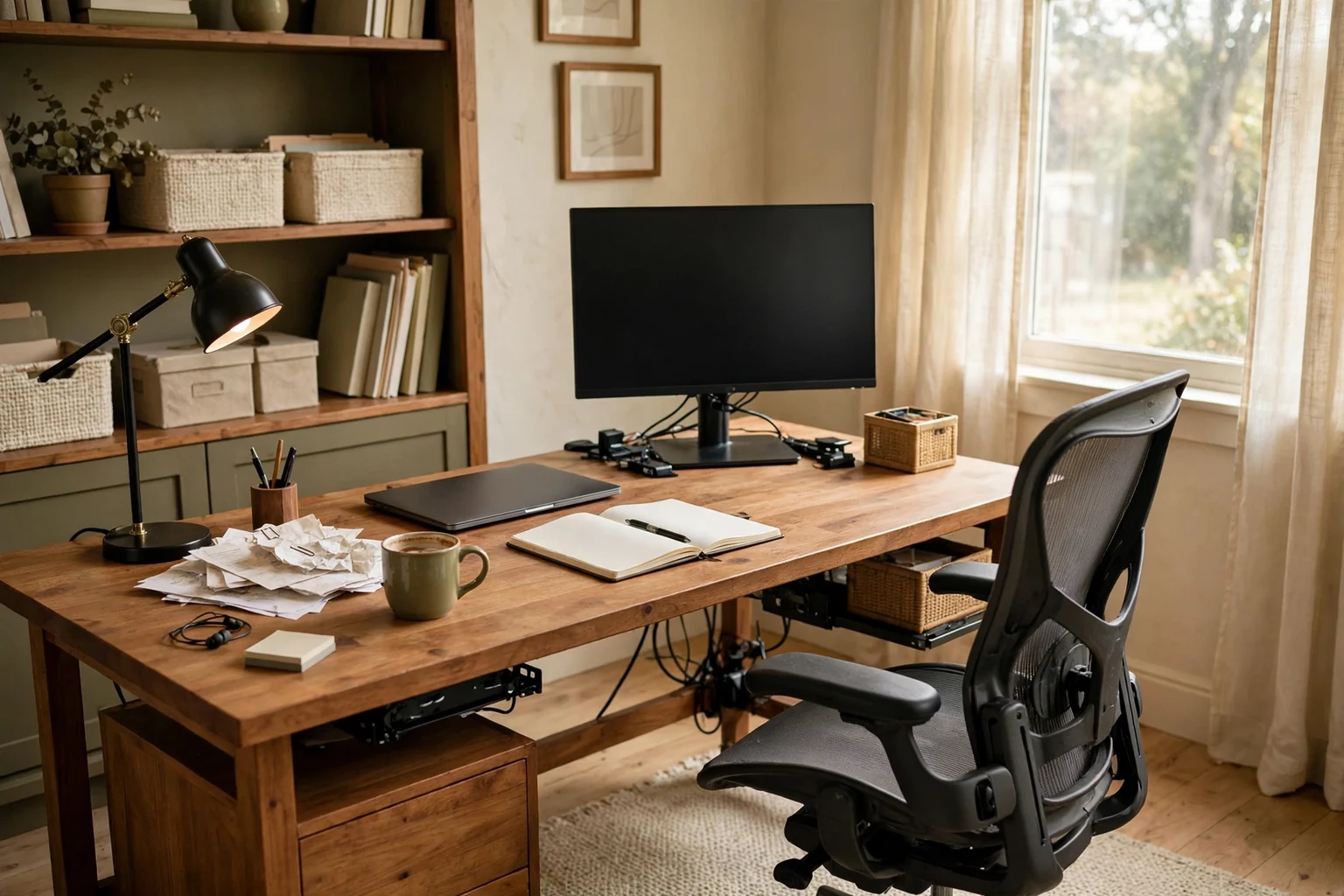
The design problem is therefore less about creating a corporate office at home and more about giving work a defined surface, supportive chair position, controllable light, power access and a way to put equipment away when work ends.
4. Remote work changes the value of small layout decisions
Desk depth, monitor distance, screen glare and chair movement matter more when a workstation is used for several hours rather than for occasional email. A narrow console may be enough for a laptop session but not for a monitor, keyboard and notebook used all day.
The same applies to lighting. Side daylight, a controllable task light and balanced room light can reduce glare and make video calls easier without turning the room into a harshly lit workspace.
5. Shared rooms need clearer boundaries
The persistence of home-based work also increases the value of dual-purpose rooms. Guest rooms can carry a desk, living rooms can hide work equipment in closed storage and bedrooms can use shallow wall-mounted desks where circulation allows.
The most successful hybrid rooms make the work zone visually and physically distinct enough that it can be used without taking over the room’s primary function.
6. Housing type affects the solution
A detached home may have a spare bedroom or finished basement, while an apartment may need a desk that fits into a single wall segment. The national work-from-home figure describes workers, not the size or type of the homes they occupy.
For that reason, the statistic supports flexible planning rather than one standard home-office footprint.
7. The long-term comparison is still the key signal
The 2025 level remains below the unusually high 2021 share, but it is still more than twice the 2019 rate reported by the Census Bureau. Home workspace is therefore a sustained residential planning issue, not solely a pandemic-era concern.
The 2025 estimate is a snapshot of usual commuting behavior, not a forecast. Future ACS releases may move the percentage again.
Key figures at a glance
| Measure | Estimate | Source year |
|---|---|---|
| Workers age 16+ | 165,214,453 | 2025 ACS |
| Usually worked from home | 21,288,393 | 2025 ACS |
| Work-from-home share | 12.9% | 2025 ACS, calculated from B08301 |
| Work-from-home share | 13.3% | 2024 ACS |
| Work-from-home share | 13.8% | 2023 ACS |
| Pre-pandemic comparison | 5.7% | 2019 ACS |
Why this matters for homes and interiors
For home design, the data support investing in work zones that can function for hours at a time. That may mean a dedicated office, but it can also mean a properly sized desk in a guest room, a glare-controlled corner or a storage system that lets a shared room switch modes quickly.
The figures do not prove that a particular desk size or room type is necessary. They show that home-based work remains common enough that office ergonomics, lighting and dual-purpose layouts deserve to be treated as mainstream residential planning issues.
Primary sources
U.S. Census Bureau, 2025 ACS Table B08301, usual means of transportation to work; official 2025 national estimate and margin-of-error file. The historical comparison sources below remain relevant to their stated years.
- U.S. Census Bureau, ACS Table B08301 — 2024 Means of Transportation to Work.
- U.S. Census Bureau, Home-Based Workers — Historical comparison for 2019 through 2023.
Related Dwelanor guides
- Home Office Desk Depth Guide — plan monitor distance and work surface depth
- Home Office Lighting Guide — control glare and video-call light
- Guest Room + Home Office Layout Guide — combine two functions
- Small Space Design Guide — fit work zones into compact homes
- Furniture Sizing Guide — protect chair movement and circulation
Bottom line
Remote work remains below its 2021 peak yet well above its 2019 baseline. The 2025 ACS estimated about 21.3 million people usually working from home, so adaptable, comfortable work zones continue to be useful for many households.