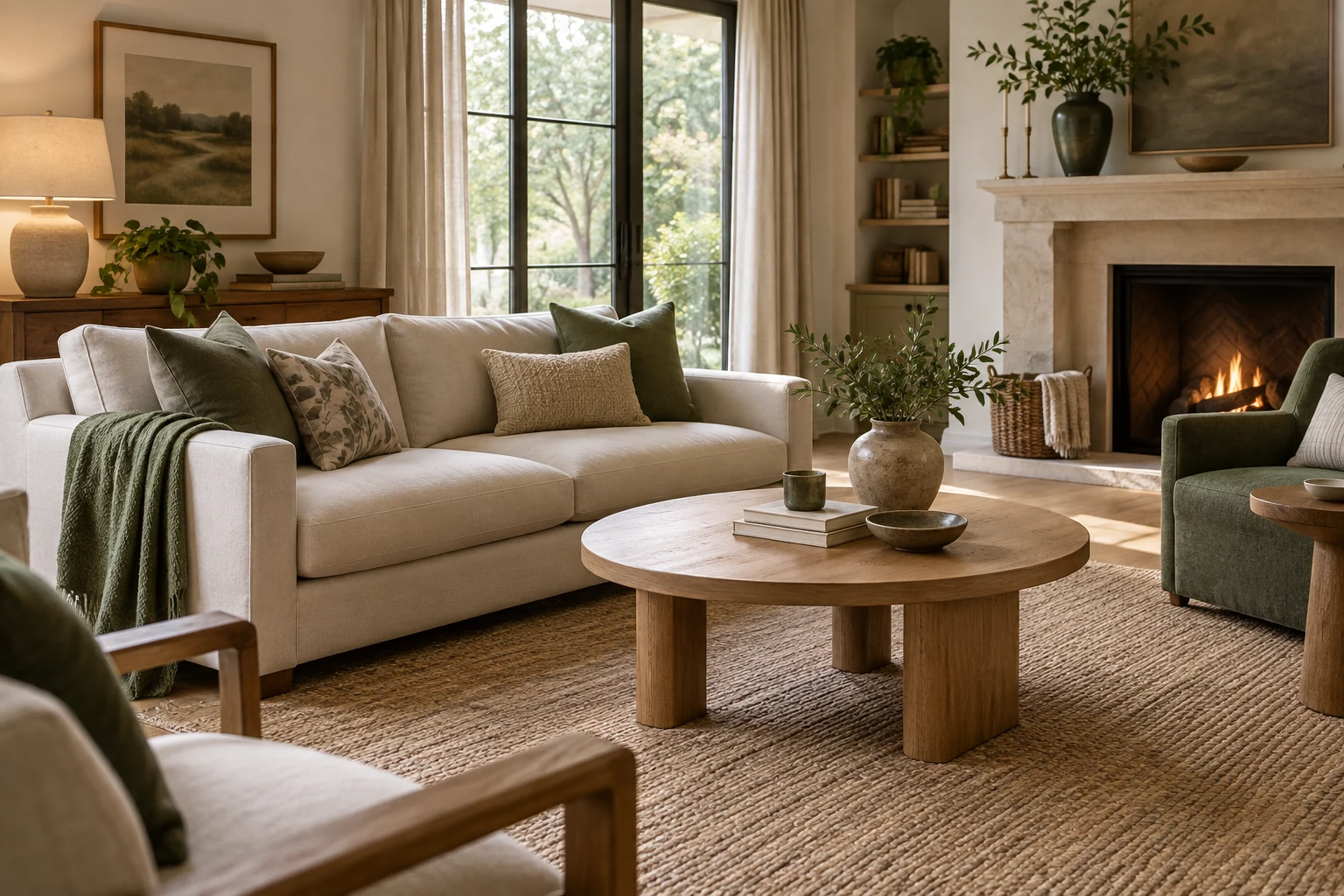
For a sofa with a 19-inch seat height, a coffee table near the seat height or slightly lower is usually a sensible starting point, but the final choice should come from reach, cushion compression, table function and room clearance rather than a fixed formula.
The useful sequence is measure the real seated height → decide how the table will be used → mock up the height → check reach → check circulation → compare visual scale.
Measure the sofa where people actually sit
Measure from the finished floor to the top of the seat cushion at the seating position you use most. If the cushion compresses noticeably, take a second measurement while someone is seated.
Do not measure from the sofa frame, arm or front rail. The useful comparison is the height of the surface your body relates to when reaching toward the table.
Why a slightly lower table often works
A coffee table that sits a little below the seat can feel relaxed because drinks, remotes and books remain easy to reach while the table stays visually beneath the main cushion line.
That does not mean lower is always better. A very low table may be inconvenient for someone who sits upright, has limited mobility or uses the table for games, food or a laptop.
When matching the sofa height can make sense
A table close to the sofa seat height can work well when:
- the seating is relatively upright;
- the table is used frequently for snacks, games or working;
- the user prefers less forward bending;
- the tabletop is visually light enough not to dominate the seating group.
Test the relationship with a box, tray or stacked books before ordering. A mock-up is more useful than relying on a product photo.
Lift-top tables should be judged in both positions
A lift-top coffee table has two different jobs: a low everyday surface and a raised work or dining surface.
Check:
- the closed height relative to the sofa;
- the raised height relative to your seated posture;
- how far the top moves toward you when lifted;
- whether knees, legs and nearby furniture still have clearance;
- stability in both positions.
Do not choose a lift-top table only because the raised position reaches a target number. The closed position still needs to work as part of the room.
Seat depth and cushion softness change the reach
A deep, soft sofa can place your body farther back and lower than the nominal cushion height suggests. A firmer, shallower sofa may put you closer to the table.
That is why two sofas with the same 19-inch seat measurement can feel different with the same coffee table.
When testing a mock-up, sit in your normal position rather than perched at the edge of the cushion.
Table thickness affects how the height reads
A slim top on narrow legs can feel visually light even when it is close to seat height. A thick stone, wood or upholstered table at the same height can appear more substantial.
Compare the full object, not only the top measurement. Visual weight, base design and material all affect whether the table feels balanced with the sofa.
Check the distance between sofa and table
Height only works when the table is also close enough to reach comfortably without obstructing circulation.
There is no single clearance number for every room. Test the actual seating group and leave enough space to:
- sit down and stand up comfortably;
- walk through the main route when necessary;
- open recliners or storage compartments;
- reach the tabletop without excessive leaning;
- avoid creating a tight corner around adjacent chairs.
For the wider layout, use the Furniture Sizing Guide and Living Room Design Guide.
Choose height by how the table will be used
| Main use | What to prioritize | Height approach |
|---|---|---|
| Relaxed lounging | Easy reach without visual bulk | Test slightly below seat height first |
| Drinks and snacks | Stable, reachable surface | Test slightly below or near seat height |
| Board games | Comfortable forward reach for several people | Near seat height may be easier |
| Occasional laptop use | Reduced forward bend | Consider near-seat or lift-top designs |
| Accessibility priority | Personal reach and transfer needs | Mock up the exact user position before buying |
Room size does not dictate coffee-table height
A small living room does not automatically need a lower table, and a large room does not automatically need a taller one.
Room size usually affects the table’s footprint, visual weight and circulation more than the ideal height. A compact room may benefit from a smaller or lighter-looking table, but the height should still relate to the seating and use.
Style should come after fit
Low-profile tables can suit minimalist interiors. More substantial wood or stone tables can suit traditional or collected rooms. Those are style decisions, not ergonomic rules.
Start with the sofa and how the table will be used. Then choose the form, material and finish that support the room’s design language.
Round, square and rectangular tables can use the same height logic
Shape changes circulation and reach but does not create a separate height rule.
- Round: useful where avoiding sharp corners matters.
- Rectangular: often works well with longer sofas.
- Square: can suit compact seating groups or sectionals.
- Nested tables: useful when surface area needs to expand temporarily.
Mock up the footprint at the same time as the height so you can judge both together.
What if the coffee table is intentionally very low?
A very low table can work when the sofa and room are designed around a lower horizontal composition. It may be less convenient for food, drinks or users who do not want to bend forward.
Choose it because the use and seating support that relationship, not because a style label says a low table is required.
What if the table is taller than the sofa seat?
A slightly taller table can be useful for specific tasks, but check whether it begins to block sightlines, crowd the knees or feel visually top-heavy beside the seating.
If work or dining is the main reason for wanting more height, a lift-top design or nearby side table may solve the problem without making the everyday coffee table unusually tall.
For a 19-inch sofa, what should you actually buy?
Use 17 to 19 inches as a practical test range, not as an absolute buying rule. If your sofa is soft and lounge-oriented, the lower end may feel better. If it is firm, upright or frequently used with food and games, a table closer to seat height may be more comfortable.
The best choice is the one that works with the real seated posture, tabletop use, circulation and visual scale.
Continue with the Furniture Sizing Guide, Living Room Design Guide, and Small Living Room Guide.