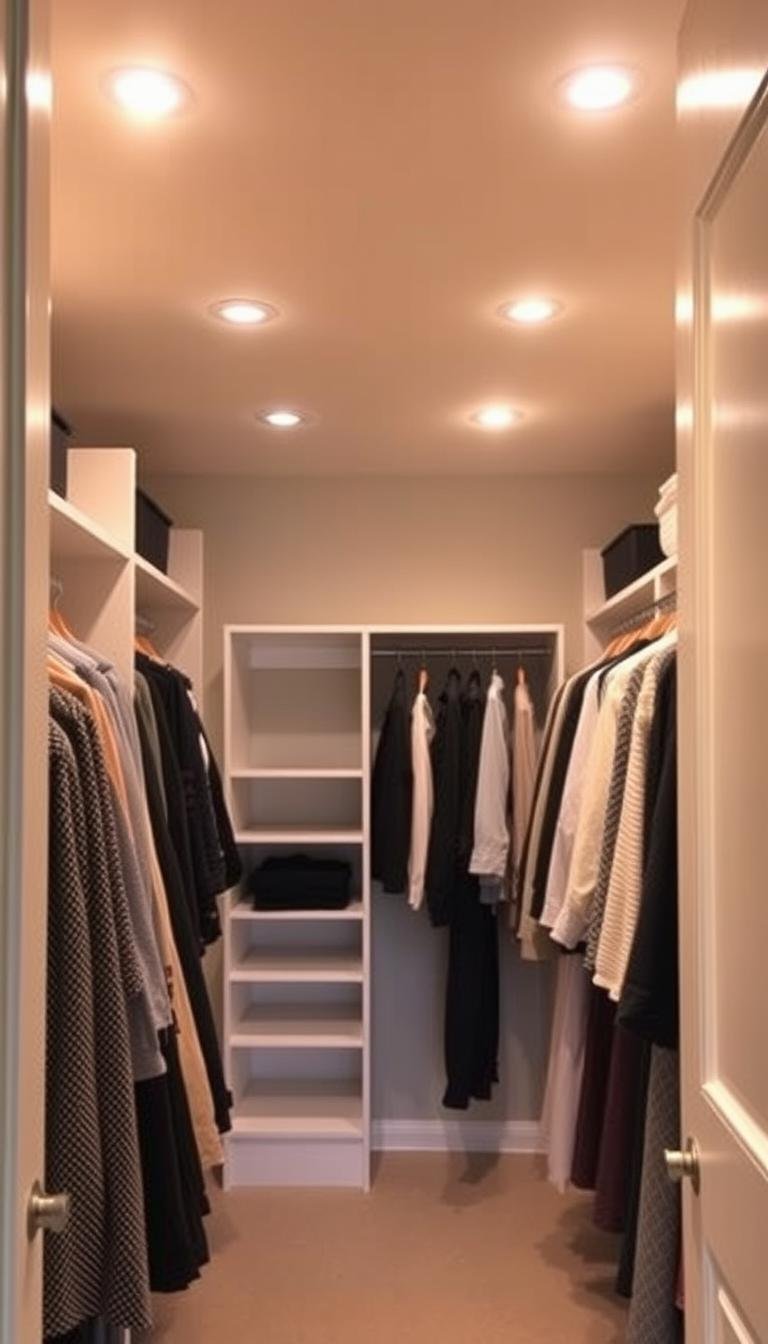
The best walk-in closet lighting starts with the dark zones created by shelves and hanging clothes, not with a fixed shopping budget. A ceiling fixture can provide general light, while slim bars, strips or cabinet lights can illuminate shelves, drawers and hanging runs that remain shadowed.
The useful relationship is closet geometry → storage layout → shadow zones → fixture type → color quality → brightness and dimming → power → mounting → electrical safety.
Use general lighting for the room first
A walk-in closet should have enough general illumination to enter safely, see the floor and distinguish the major storage zones. If the existing ceiling light is poor, improving the main room light may solve more than adding many small battery fixtures.
Check whether hanging garments block the light from reaching lower shelves or drawers. A centrally located fixture can look bright from the doorway while leaving the actual wardrobe in shadow.
Add task lighting where the wardrobe creates shadows
Useful task-light locations include:
- under shelves above folded clothes;
- inside tall cabinet bays;
- beside hanging runs where the user’s body blocks ceiling light;
- above a jewelry or accessory drawer;
- near a full-length mirror;
- inside deep shoe shelving.
The goal is not to light every shelf. Concentrate light where identification and retrieval are difficult.
Light bars work well for defined zones
Slim LED bars can provide a more continuous line of light than individual puck fixtures. They are useful beneath a shelf, along a cabinet side or above a drawer bank.
Compare:
- fixture length;
- beam spread and diffuser quality;
- brightness range;
- dimming;
- motion-sensor behavior;
- power source;
- mounting method;
- how the fixture is removed for charging or service.
A bar that is easy to recharge but difficult to remove from its mount will become annoying quickly.
LED strips suit long continuous runs
LED strip lighting can work under several shelves or along a long cabinet run when you want a continuous line rather than separate fixtures.
For a finished result, compare the strip with its channel, diffuser, connectors, driver and controls as one system. An exposed strip can create visible bright points and glare, while a compatible diffuser can make the light appear more even.
Use only cut points, connectors and power supplies specified for the strip system.
Puck lights are best for small isolated areas
Pucks are useful in a small cubby, over a jewelry tray or inside an occasional-use cabinet. They can create concentrated pools of light, so several widely spaced pucks may leave alternating bright and dark areas across a long shelf.
Choose them for localized tasks rather than as the default solution for the whole closet.
Vertical lighting can reduce body shadows
When a person standing in front of the wardrobe blocks the ceiling light, a slim vertical light beside a hanging run or mirror can improve visibility.
Place it so the source is not directly visible at eye level and does not interfere with clothes, drawer fronts or doors.
Vertical lighting can be especially useful beside a mirror because it can illuminate the user more evenly than a single ceiling light behind them.
Color rendering matters when choosing clothes
If you use the closet to compare navy and black, judge fabric colors or coordinate outfits, look beyond color temperature alone.
Useful specifications include:
- color rendering: higher-quality rendering helps colors appear more natural;
- color temperature: warmer light feels softer, while neutral light can make color comparisons easier;
- dimming: lets the same fixture serve early morning and daytime use;
- flicker performance: poor drivers can make a small enclosed room unpleasant even when the fixture is bright.
There is no universal rule that every closet should be 2700K. Compare samples against your bedroom lighting and the way you use the space.
Choose brightness by the surfaces and task
Dark cabinetry, deep cubbies and densely packed clothes absorb more light than white shelves and open storage. Mirrors and pale finishes can make a closet feel brighter, but they should not be used as substitutes for adequate lighting.
Rather than chasing a single lumen number, add light where the task remains difficult after the general lighting is on.
Motion sensors are useful when the behavior is predictable
Motion-activated lighting can work well for quick closet visits, especially for battery or rechargeable fixtures.
Check:
- detection range;
- how long the light stays on;
- whether it can remain on during a longer dressing session;
- whether daylight sensing can disable it unexpectedly;
- whether motion mode can be turned off.
A sensor that switches off while you are standing still at a mirror is not a useful convenience.
Rechargeable lighting: useful but maintenance-dependent
Rechargeable bars and pucks can avoid visible cords and permanent wiring. They work best in zones that are used briefly rather than continuously.
Before choosing one, ask:
- how often it will need charging at your preferred brightness;
- whether the battery is replaceable or serviceable;
- how the fixture detaches from its mount;
- whether charging requires the closet to be dark for hours;
- whether a nearby charging location exists.
Do not treat an advertised runtime as permanent. Battery performance changes with brightness, sensor behavior, age and temperature.
Replaceable-battery fixtures suit occasional-use areas
Battery pucks can be reasonable inside an infrequently opened cabinet or seasonal storage area. Across an entire walk-in closet, repeated battery replacement can become more work than the initial installation saved.
Use them selectively rather than automatically.
Plug-in lighting needs deliberate cable management
Plug-in strips or bars can provide consistent power without charging, but the cord becomes part of the design.
Keep cords away from:
- drawer slides;
- hinges;
- sharp cabinet edges;
- walkways;
- areas where clothes can snag them;
- heat sources;
- places where adapters would be buried behind fixed cabinetry.
Use the power supply and extension components approved for the lighting system.
Hardwired lighting belongs in the closet plan, not as an afterthought
Permanent closet lighting can create the cleanest result, especially in a remodel or custom storage installation. It also involves electrical requirements specific to clothes-storage spaces and the chosen fixture location.
New wiring, receptacles, junction boxes, switches and built-in lighting should be planned by a qualified electrician in accordance with the applicable electrical rules and fixture instructions.
Do not bury junction boxes, drivers or serviceable components behind fixed cabinetry.
Mounting adhesive is not universal
Painted wood, melamine, veneer, laminate, metal and unfinished surfaces can respond differently to adhesive mounts.
If the fixture uses adhesive:
- confirm the manufacturer approves the surface;
- prepare the surface as directed;
- observe the specified cure or wait time;
- make sure heat from the fixture or driver stays within the mounting system’s limits;
- check that removal will not damage a rental or valuable cabinet finish.
A magnetic mount can make charging easier when it uses a secure manufacturer-provided plate or compatible metal surface.
Do not install lights where clothes can rest against unsuitable fixtures
Closets contain fabric, paper boxes and other combustible materials. Use fixtures intended for their location and maintain the clearances required by the product and applicable electrical rules.
Do not improvise exposed lamps, hot fixtures or power supplies inside densely packed clothing bays.
Plan the mirror lighting separately
If the closet has a full-length mirror, check the reflection before adding decorative cabinet lights. A bright strip behind the user can create glare without improving the face or clothing view.
Side or front-biased light often helps more at the mirror than additional light directly overhead.
A useful layered closet-lighting plan
| Layer | Purpose | Typical solution |
|---|---|---|
| General | Safe room-wide visibility | Ceiling or approved permanent fixture |
| Wardrobe task | See shelves, drawers and hanging clothes | Bars, strips or cabinet lights |
| Mirror task | See clothing and appearance clearly | Side or front-biased light |
| Convenience | Quick access without searching for a switch | Motion or door-activated control |
Budget by zone instead of promising one total
A fixed price such as $60 becomes stale quickly because fixture prices, closet size and power requirements vary. A better budget method is to prioritize the zones:
- Fix the main room light if it is inadequate.
- Light the darkest daily-use hanging or shelf run.
- Add mirror lighting if needed.
- Add convenience lighting only after the useful task zones are solved.
This prevents buying ten inexpensive fixtures when two well-placed lights would work better.
What to avoid
- Covering every shelf with LED tape without checking glare or power requirements.
- Relying on one bright puck to illuminate an entire wardrobe.
- Using app-only controls when simple manual operation matters.
- Running cords through drawer paths or door hinges.
- Installing hardwired fixtures without accounting for clothes-storage electrical requirements.
- Hiding power supplies or junctions behind inaccessible cabinetry.
- Assuming adhesive mounts are safe for every cabinet finish.
For related closet planning, continue with our walk-in closet organization guide, hidden jewelry storage guide, slim shoe-rack guide, and the Dwelanor Room Guides.