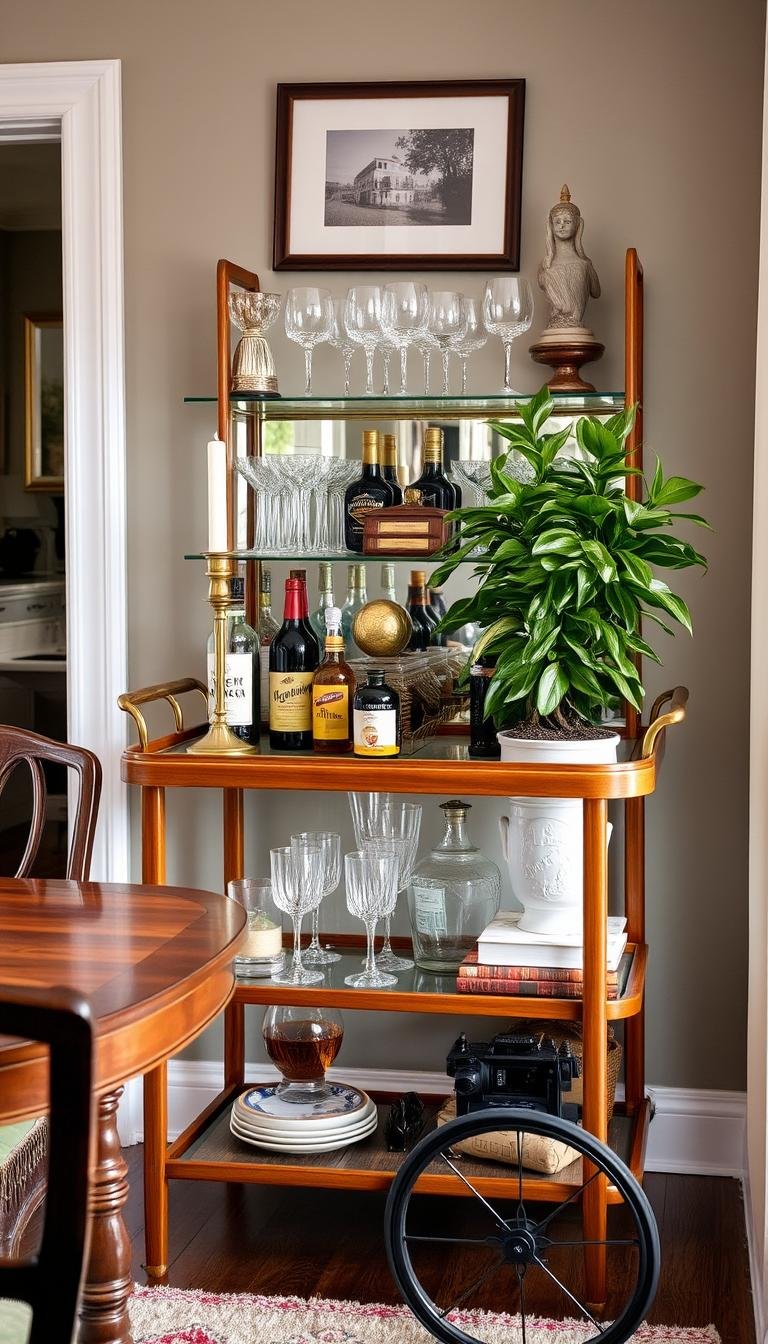
A good bar cart is flexible serving furniture, not a shelf that has to be filled with bottles. It should fit the dining room scale, stay out of circulation paths, carry the glassware and serving pieces you actually use, and look intentional when it is not being used for a gathering.
The useful relationship is room size → cart dimensions → circulation → storage load → serving routine → glassware/tools → decorative balance.
Choose the cart for the room, not for the product photo
Before buying a cart, measure:
- the available wall or corner;
- door and cabinet swing;
- distance behind dining chairs;
- the main path between kitchen and table;
- any nearby radiator, register or outlet;
- the height of wall art or mirrors above it.
A narrow dining room usually benefits from a shallower cart or console. A larger room can support more visual mass, but the furniture should still leave a comfortable path when chairs are occupied.
A cart is not always better than a console or cabinet
Choose the furniture type by how often it needs to move.
| Furniture | Best when | Main tradeoff |
|---|---|---|
| Wheeled cart | You move serving supplies between rooms | Needs stable casters and careful loading |
| Console table | The station stays against one wall | Usually less enclosed storage |
| Credenza | You want glassware and supplies mostly hidden | Larger footprint |
| Small cabinet | You want a compact permanent beverage zone | Less mobile |
If the cart will never move, a console or cabinet may look calmer and provide more useful storage.
Check the cart’s loaded stability
Glassware, bottles, pitchers and serving pieces add weight quickly. Choose a cart with a stable frame, shelves designed for the expected load and casters that operate as intended.
Before loading it fully:
- follow the manufacturer’s assembly instructions;
- confirm all hardware is tight;
- check whether casters lock;
- roll the cart across the actual floor;
- make sure it does not rock when an item is removed.
Do not rely on decorative wheels or a narrow base for heavy glass storage if the product is not designed for it.
Put heavy items low
The lower shelf is the better place for heavier bottles, pitchers, stacks of plates or other dense items because it keeps the cart’s center of gravity lower.
The top shelf should remain useful for serving rather than carrying every heavy object at once.
Leave working space on the top
A styled cart that has no empty surface cannot function as a serving station.
Reserve a clear zone for:
- pouring;
- setting down a glass;
- making coffee or tea;
- placing a pitcher;
- serving snacks;
- holding a tray during dinner.
The exact empty area depends on how the cart is used. The principle is simple: decoration should not consume the work surface.
Use one tray to contain small pieces
A tray can organize coasters, bottle openers, tea tools, napkins, stirrers or other small serving pieces without turning the top into scattered clutter.
Choose a tray that leaves visible surface around it. If the tray nearly fills the cart, it becomes another shelf rather than a useful organizer.
Glassware should match the household
You do not need five specialized glass shapes on permanent display. Keep the pieces that are used regularly and store occasional glassware elsewhere.
A practical cart might hold:
- everyday tumblers;
- wine glasses;
- small cocktail glasses;
- coffee cups;
- tea glasses;
- a water carafe.
Glassware that is rarely used is safer and easier to keep dust-free in closed storage.
A beverage cart can be alcohol-free
The same furniture works for coffee, tea, sparkling water, syrups, juices or a mixed beverage station. This can make the cart more useful every day rather than only during parties.
Examples:
- coffee grinder, beans and cups;
- tea tins, kettle-safe accessories and mugs;
- sparkling water and glassware;
- mocktail syrups, citrus and serving tools;
- breakfast carafes and trays.
Keep any powered appliance on furniture and electrical circuits appropriate for its use, and keep heat-producing equipment away from vulnerable finishes.
Place the cart near the serving route
The cart should support the route from kitchen to dining table without sitting directly in that path.
Good locations include:
- a dining room wall;
- a recess beside a credenza;
- a corner near the dining table;
- the transition between kitchen and dining area;
- a living room wall used during entertaining.
Avoid placing it where a dining chair backs directly into glassware.
Use the wall above the cart to make it feel intentional
A mirror, artwork or small picture grouping can visually anchor the cart.
Choose one clear wall element rather than filling every inch around the furniture. The cart already contains many small objects, so the wall often looks better with a larger, simpler composition.
Repeat one material from the dining room
The cart can connect to the room through one repeated element:
- wood tone;
- metal finish;
- black frame;
- rattan texture;
- glass;
- paint color.
It does not need to match the dining table exactly. Repetition is enough to make the piece feel related.
Use height variation sparingly
A cart looks more considered when every object is not the same height. Use one taller piece, one mid-height grouping and lower functional items.
The tall piece could be:
- a vase;
- a lamp where appropriate;
- a framed artwork leaning against the wall;
- a carafe;
- a plant suited to the light conditions.
Do not place tall fragile objects on a cart that will be rolled frequently.
Plants and flowers should not interfere with serving
A small vase or plant can soften glass and metal, but it should not occupy the primary work area.
Use a stable container and protect the furniture from water. If the cart moves, consider using a decorative object that does not spill.
Keep open bottles and sensitive beverages where their storage needs are met
A cart is not automatically the correct long-term storage environment for every beverage. Heat, light and temperature matter for some products.
For wine specifically, use our kitchen wine display and storage guide. Bottles intended for longer aging should not be left on a decorative cart simply because they look attractive there.
Closed storage can reduce visual clutter
If the dining room already has art, patterned wallpaper or decorative lighting, a fully stocked open cart may make the room busy.
A nearby credenza can store:
- extra bottles;
- rarely used glasses;
- napkins;
- serving tools;
- backstock beverages.
Then the cart can hold only the current serving setup.
A rolling cart should be staged differently from a stationary one
If the cart moves between rooms, keep the load lower and more secure. Avoid tall stacks, unstable bottles and top-heavy decor.
If it remains stationary, you can treat it more like a small console vignette, provided the casters are locked or the furniture is otherwise stable.
Style for daily life first, entertaining second
The cart should still look good on an ordinary Tuesday. Keep daily items accessible and use a nearby cabinet for party overflow rather than permanently staging everything that might be needed once a month.
Before a gathering, add the temporary pieces. Afterward, return the cart to its simpler baseline.
Keep children and pets in mind
Open glassware, sharp tools, small objects and heavy bottles may not belong within easy reach in every household.
If young children or active pets use the room, consider:
- closed storage;
- a higher console;
- keeping fragile items off the lowest shelf;
- placing the cart outside common play routes;
- removing sharp or breakable serving tools between uses.
A practical styling sequence
- Measure the room and circulation path.
- Decide whether a cart, console or cabinet is the better furniture type.
- Choose one main serving routine.
- Place heavy items on the lower shelf.
- Keep a clear working zone on top.
- Corral small tools on one tray.
- Add only the glassware used regularly.
- Repeat one dining-room material or finish.
- Add one restrained decorative element.
- Remove temporary party overflow after the event.
The simplest answer
To style a bar cart so it complements a dining room, keep it useful, visually light and connected to the room through one or two repeated materials. Leave open surface for serving, store heavy pieces low and avoid turning every shelf into a dense display.
Continue with our home bar ideas guide, wine display guide, closet mini bar guide, and the Dwelanor Room Guides.