
Practical Research · Holiday Lighting
Holiday Lighting Energy Costs: Calculate Your Real Bill
Use labelled watts, operating hours, days and your actual electricity tariff. Do not assume a national average or unverified price.
Dwelanor Editorial · Practical planning
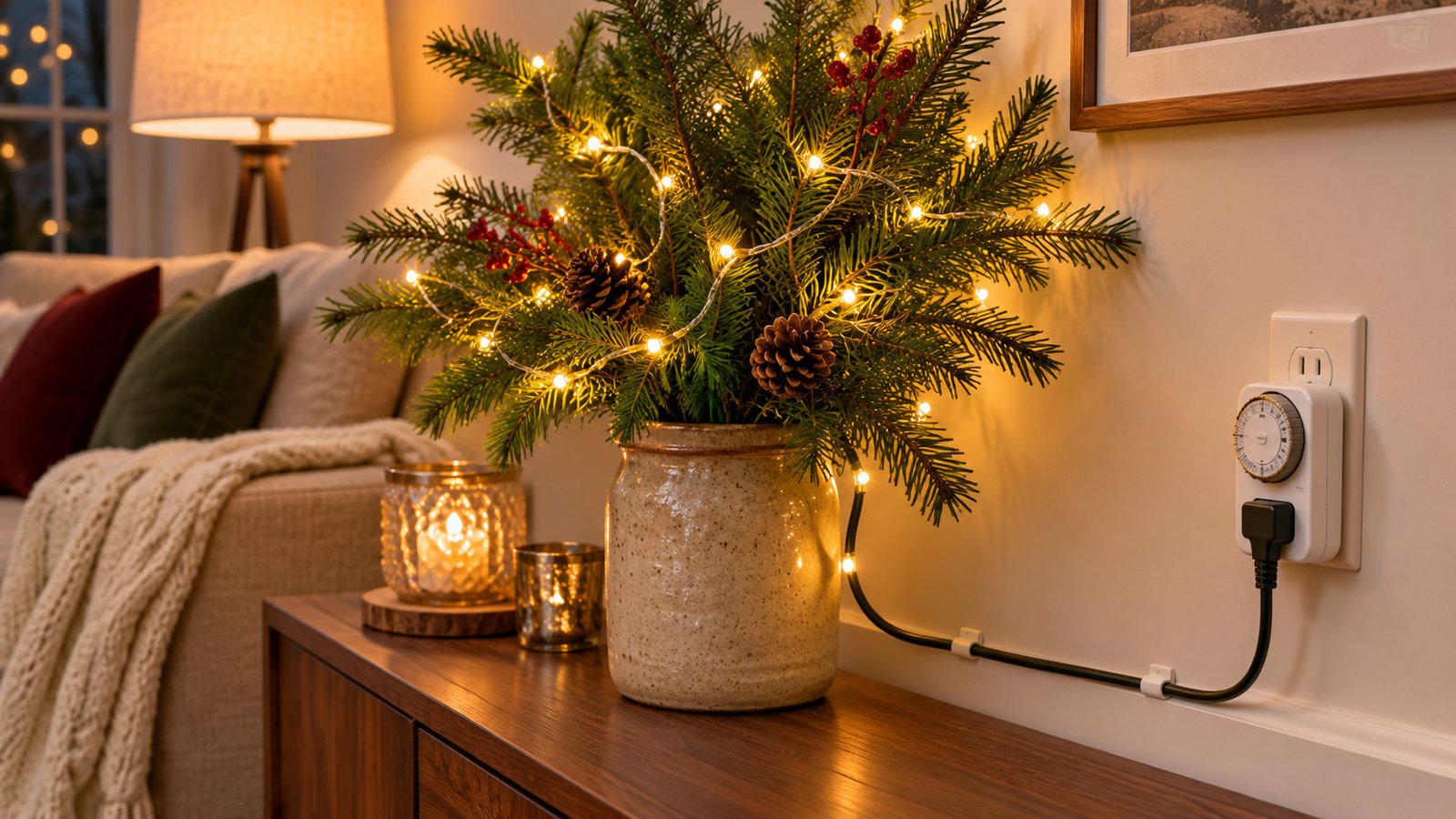
How much do Christmas lights actually add to the electricity bill? There is no honest single nationwide answer. The result depends on the measured or labeled input wattage of each light strand, how many are on together, their daily operating hours, the number of days they run, and the household’s actual electricity tariff.
Calculate the cost from your actual light strands
Use label wattage and your local electricity rate, not an invented nationwide average.
Find total watts
Add the power ratings of every light set running at the same time.
Calculate use
Multiply watts by hours per day and days used, then divide by 1,000.
Calculate cost
Multiply the estimated kWh by your electricity rate per kWh. Include other fees only if applicable.
Decision check: Energy used (kWh) = total watts × hours per day × days ÷ 1,000. Estimated energy cost = kWh × your applicable electricity price per kWh.
This research-led holiday lighting guide shows a transparent calculation you can reproduce without a manufacturer’s calculator. It explains why LED strings often save energy compared with older incandescent sets, and how to avoid mistaking energy efficiency for safety certification. The examples use hypothetical equipment, not a claim about a specific product currently for sale.
The holiday lighting energy formula
Energy in kilowatt-hours = (total watts ÷ 1,000) × hours used per day × days of use. Multiply that result by your actual electricity price per kWh to estimate the energy charge. Additional tariffs, taxes, fixed charges, demand charges or rebates may alter the actual bill, so this is a simple variable-energy model.
| Write down | Where to find it | What it affects |
|---|---|---|
| Total connected input watts | Product label or instructions; add all simultaneously running strings | Base electricity consumption |
| Hours on per day | Your actual timer or usage plan | Daily energy use |
| Days of operation | Your holiday calendar | Total seasonal energy use |
| Electricity tariff per kWh | Your utility bill, appropriate time-of-use tier | Variable energy charge |
| Extra electric decorations | Measured ratings for inflatables, projectors or moving ornaments | Total combined energy use |
Do not substitute “number of bulbs” for watts: a 100-light LED strand and an incandescent set can have very different electrical input. Likewise, the box’s marketing term “energy-saving” is not a wattage measurement.
What Department of Energy evidence actually says
The U.S. Department of Energy’s 2015 explanation of holiday lights described LED strings consuming about 70 percent less energy than conventional incandescent strings in the specific comparison used at that time. DOE also presented a six-foot-tree illustration with particular cost assumptions. These are historical illustrative comparisons, not current 2026 electricity prices and not an exact percentage guaranteed for every brand, length or light mode.
The correct comparison for products bought now is to read their individual label wattage and calculate the same hours for both. Some LEDs can have animated effects, controllers or power supplies that change use; read the complete system specification rather than assuming all LEDs are equivalent.
Worked example with hypothetical sets, not a national average
Imagine one household compares two illustrative configurations for the same decoration area. One set is rated at 40 watts; another is rated at 8 watts. The difference in consumption for the same daily schedule is proportional to their labeled input. If both run the same hours and days, the 8-watt set consumes one-fifth as much electricity as the 40-watt set. These are invented example ratings solely to illustrate the formula, not verified specifications for actual products.
Suppose you operate more than one strand. Add all simultaneously running wattages before calculating. A tree, window and patio display may also be controlled independently; calculate each separately when operating times differ, then add the kWh results. A timer reduces hours but does not make a damaged electrical product safe.
Real electricity cost is driven by your tariff
Do not use a generic “U.S. electricity rate” when estimating a specific customer’s bill. Residential rates differ by utility, state, season, time of day and plan. Use your own bill’s applicable kWh price and verify whether there are time-of-use tariffs. Dwelanor does not quote a current nationwide average here because a rough figure would mislead buyers into treating a personalized estimate as an observed 2026 cost.
For national context, the U.S. Energy Information Administration’s 2025 Electric Power Annual reports a final U.S. residential average electricity price of 17.23 cents/kWh for 2025, compared with 16.48 cents/kWh in 2024, a 4.6% increase. These are historical national annual averages, not a household’s current 2026 tariff. Use the applicable rate on your own bill for a personal estimate.
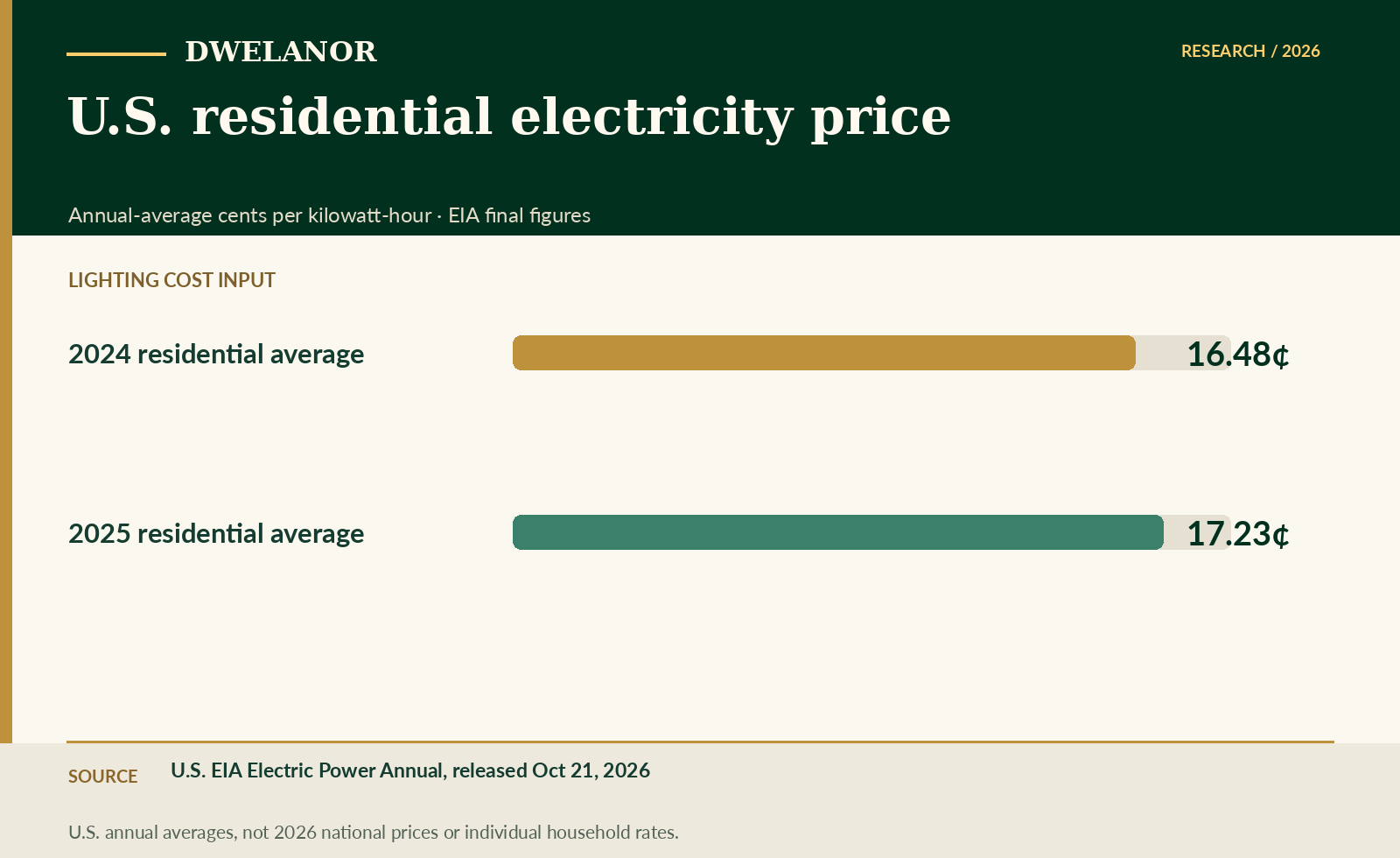
The formula in this guide therefore keeps tariff as an explicit input. A national benchmark is useful for comparison and citation, but it should not be presented as the price every U.S. household pays.
How to select holiday lights without compromising safety
Energy efficiency is separate from electrical safety. The CPSC’s guidance for seasonal and decorative lighting products covers minimum wire size, strain relief and overcurrent protection for relevant temporary-use 120-volt systems. Buy products intended for their installation environment and follow their cord, connection and power-supply instructions.
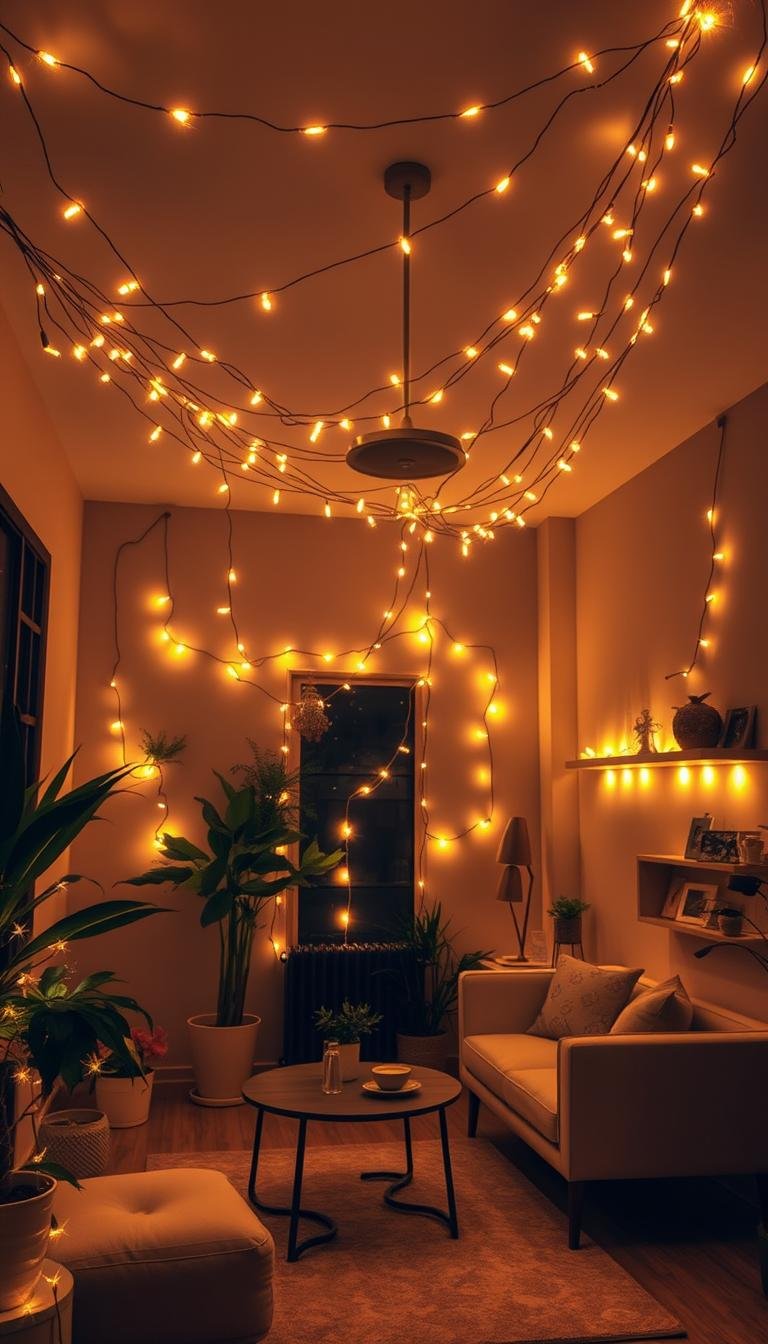
The U.S. Fire Administration recommends inspecting lights and discarding sets with damaged cords, and following manufacturer limits for connecting multiple strands. Keep wires away from moving windows, door hinges, high-traffic walkways and sharp furniture edges. Do not load an outlet beyond its rating, and turn lights off before sleeping or leaving home.
When a tree is involved, USFA advises keeping it at least three feet away from heat sources and maintaining the water level of a live tree. The Small Apartment Christmas Tree Guide focuses on floor footprint and storage, while the Renter-Friendly Decor Guide considers non-permanent placements.
LED light strands, battery lights and projectors: don’t compare unlike units
| Decorating technology | How to account for energy | Buying check |
|---|---|---|
| Plug-in LED string | Use labeled input watts and operation schedule | Controller and supply compatibility, environment rating |
| Incandescent string | Use actual labeled watts, not LED estimates | Heat, socket condition and maker’s string-connection limits |
| Battery-operated string | Household meter may not capture disposable battery energy directly | Battery replacement costs and disposal, run time under actual mode |
| Rechargeable lights | Include energy for recharging if modeling whole-house energy | Approved charger and safe placement |
| Projector or inflatable | Use complete device + motor/projector input watts | Outdoor rating, weatherproof plugs, trip hazards |
Comparing a rechargeable light’s “battery runtime” directly with a plug-in light’s wattage without considering output and charging is not a fair efficiency test. Use the correct units and product-specific conditions.
A copy-ready holiday energy calculation worksheet
system,watts,hours_per_day,days,kwh_formula,energy_cost_formula
tree lights,ENTER,ENTER,ENTER,(watts/1000)*hours_per_day*days,kwh*your_tariff_per_kwh
window lights,ENTER,ENTER,ENTER,(watts/1000)*hours_per_day*days,kwh*your_tariff_per_kwh
patio lights,ENTER,ENTER,ENTER,(watts/1000)*hours_per_day*days,kwh*your_tariff_per_kwh
other decorations,ENTER,ENTER,ENTER,(watts/1000)*hours_per_day*days,kwh*your_tariff_per_kwh
Copy the rows into a spreadsheet and replace the placeholders. Use one row per operating schedule. This is an original Dwelanor calculation template, not a dataset of national usage, survey results or estimates of actual product electricity costs. It does not include tax, service charges or battery lifecycle costs.
What should you buy first?
If you already own safe, low-wattage lights, setting sensible operating hours may be enough; replacing them solely for a headline saving could be wasteful. If buying new, compare documented wattage, appropriate indoor/outdoor certification, cable length, controller behavior, lighting appearance, storage needs and lifetime care. Don’t select the lowest-wattage product if it cannot meet the intended use safely.
Our lighting and glare guide explains how placement can matter more than adding brightness. Seasonal lights are not substitutes for adequate everyday task or stair lighting.
Frequently asked questions
Do LED Christmas lights always use 70 percent less electricity?
No. DOE published that comparison in a 2015 discussion of LED versus conventional strings. The actual difference for products purchased today depends on their measured wattages and duty cycles.
How can I find the exact wattage of my string lights?
Read the approved label, instruction booklet or manufacturer’s official specification for that exact set, and check whether listed values include the power supply/controller.
Will a timer reduce holiday lighting costs?
For a plug-in display running at consistent wattage, reducing operating hours reduces variable energy use. The total dollar effect still depends on the actual tariff and usage.
Are LED holiday lights automatically safer?
No. Energy efficiency and product safety are different questions. Check recognized testing, safe wiring, intended environment, strain relief and overcurrent protection as applicable.
Can I cite this formula?
Yes. It is a transparent calculation based on watts, hours and days. Distinguish worked hypothetical examples from real product testing; for DOE’s historical comparison, cite DOE directly.
Five-minute home-lighting cost check
- List each display you plan to run, separating tree, window, porch and any powered inflatables.
- Copy the actual labeled input watts from each complete device, including its power supply where specified.
- Write down how many hours per day and days you truly expect to use each display.
- Calculate each row’s kWh with the formula above and multiply by the appropriate tariff on your utility bill.
- Before turning lights on, inspect plugs, cables and placement against the CPSC and USFA guidance; don’t treat low electricity cost as proof of safety.
If you can’t find a device’s correct power rating, request its technical specification before quoting a cost estimate. Do not substitute an online wattage estimate from another product model.
Bottom line
Use exact watts, your real operating schedule and your actual tariff. That gives a useful, reproducible comparison without making unverified 2026 price or “typical household” claims. Safe mounting and electrical protection remain necessary regardless of energy savings.