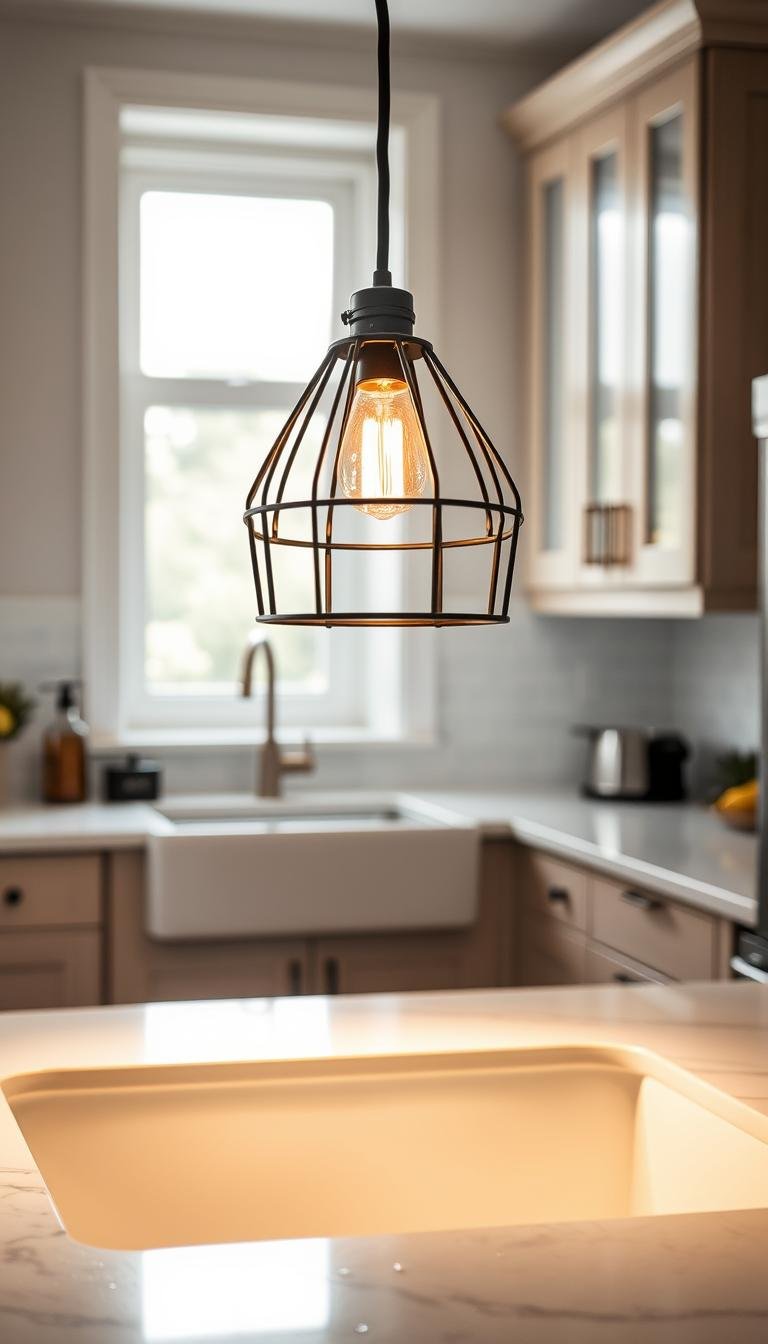
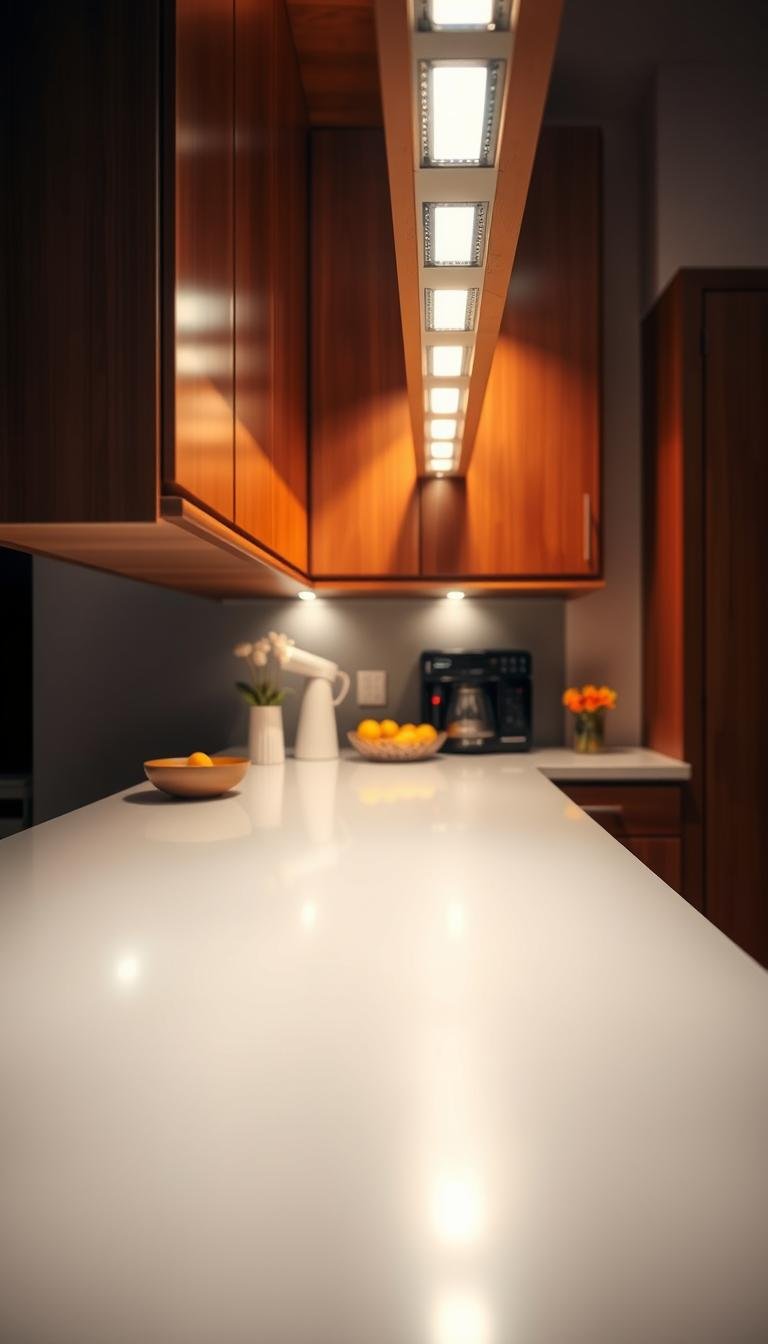
The best under-cabinet lighting for late-night use is warm-looking, dimmable, easy to control and bright enough to navigate without flooding the whole kitchen with light.
Bars, strips and pucks can all work. The right choice depends on cabinet layout, power access, mounting method, how evenly you want the counter lit and whether you prefer motion, a switch, a remote or smart controls.
Choose the lighting format first
Product models change quickly, but the basic formats stay useful:
- Light bars give even coverage over a defined counter zone and usually look the most finished.
- LED strips suit longer continuous runs and corners when you want a line of light rather than separate fixtures.
- Puck lights work well in small isolated areas, inside cabinets or over a short coffee station, but their narrower beams can create bright pools and dark gaps.
Warm light usually feels calmer at night
For evening use, a warmer color temperature generally feels less stark than cool daylight-style lighting. Many people prefer products around the warm-white range, while a more neutral setting can be useful when the same fixture also serves as task lighting during food preparation.
If you are comparing tunable-white fixtures, check whether the warmest setting is genuinely comfortable in your kitchen rather than assuming the number on the box will look the same against every backsplash and counter color.
Dimming matters more than maximum brightness
For late-night use, the lowest usable dimming level is often more important than the fixture’s maximum output. A light can be powerful enough for prep but still unpleasant at night if it cannot dim low enough.
Counter color, backsplash reflectivity, cabinet depth and fixture position all affect how bright the light feels, so there is no single lumen number that works for every kitchen.
Motion, switches, remotes and smart controls
Choose the control method you will actually use half-awake.
| Control | Good for | What to check |
|---|---|---|
| Motion sensor | Hands-free late-night trips | Detection area, auto-off behavior and whether motion can be disabled |
| Physical switch or dimmer | Simple, predictable control | Placement and lowest dimming level |
| Remote | Small cordless zones | Range, battery replacement and whether dimming is included |
| Smart/app control | Schedules and scenes | Whether basic operation still works without the app or internet |
Rechargeable, battery, plug-in or hardwired?
The power source changes the installation more than almost any other feature.
Rechargeable fixtures
Rechargeable bars are useful where outlets are awkward or cords would be conspicuous. Check how easily the fixture detaches for charging, how secure the mount feels and whether the charging routine will become annoying in a frequently used zone.
Replaceable-battery fixtures
Battery bars and pucks make sense for short-use areas such as a pantry shelf or small coffee station. They are less appealing across a long cabinet run because repeated battery changes can become the main maintenance task.
Plug-in fixtures
Plug-in bars and strips provide steady power without charging, but cord routing becomes part of the visual design. Check where the outlet sits and whether the supplied cable can be clipped neatly away from food-prep areas and heat sources.
Hardwired fixtures
Hardwired lighting can create the cleanest permanent result, but it should be installed according to the fixture instructions and applicable electrical requirements. If the project involves new wiring, junction boxes or modifying an existing circuit, use a qualified electrician.
Mounting method matters
Magnetic plates, adhesive strips and screw brackets can all work when they are used on surfaces the manufacturer approves. Cabinet finishes vary, so an adhesive that grips one painted or laminated surface may damage or release from another.
- Clean and prepare the mounting surface exactly as directed.
- Check the required waiting time before loading an adhesive mount.
- Keep fixtures, cables and power supplies away from heat and moisture beyond their rated conditions.
- Do not block ventilation openings on the light or power supply.
- Make sure removable fixtures can still be detached for charging or service.
Bars, strips and pucks compared
| Format | Best use | Main trade-off |
|---|---|---|
| Bar | Defined work zones and even counter coverage | Can leave gaps between separate cabinet bays |
| Strip | Long continuous runs and corners | Needs careful planning for cut points, connectors and diffusion |
| Puck | Small zones and cabinets | Can create visible pools of light if spaced poorly |
What to compare before buying
Rather than relying on a permanent “best product” ranking, compare current models on the specifications that affect the actual kitchen:
- color temperature or tunable-white range,
- lowest and highest brightness settings,
- beam spread and diffuser quality,
- power source and cable length,
- motion, dimming and timer behavior,
- mounting system and approved surfaces,
- ease of removal for charging or replacement,
- fixture dimensions and cabinet clearance,
- manufacturer warranty and replacement availability.
Placement for a softer late-night effect
Mount the fixture far enough toward the front of the cabinet that it lights the useful counter area rather than only the backsplash, while keeping it concealed from normal standing eye level where possible.
Very reflective counters and glossy backsplashes can amplify glare. In those kitchens, a diffuser and lower dimming level may matter more than choosing a higher-output fixture.
A simple decision guide
- For a rental: start with a removable rechargeable bar or another mount approved for the cabinet finish.
- For a long cabinet run: consider a strip or linked bars with tidy cable management.
- For a small isolated spot: a puck or short bar is usually enough.
- For hands-free night use: prioritize reliable motion sensing plus useful dimming.
- For a permanent remodel: compare plug-in and hardwired systems early so wiring and outlet placement can be planned cleanly.
What I would prioritize
For late-night use, prioritize a warm-looking setting, useful low-end dimming and controls that are easy to operate. Then choose the format that fits the cabinet: a bar for a defined zone, a strip for a long run or a puck for a small spot.
After that, choose the power and mounting method that fits the kitchen rather than whichever model happens to top a shopping list this month.
For related kitchen planning, see our guide to adding a breakfast bar when counter space is tight and our quiet ducted range-hood guide. For broader room planning, browse the Dwelanor Room Guides.