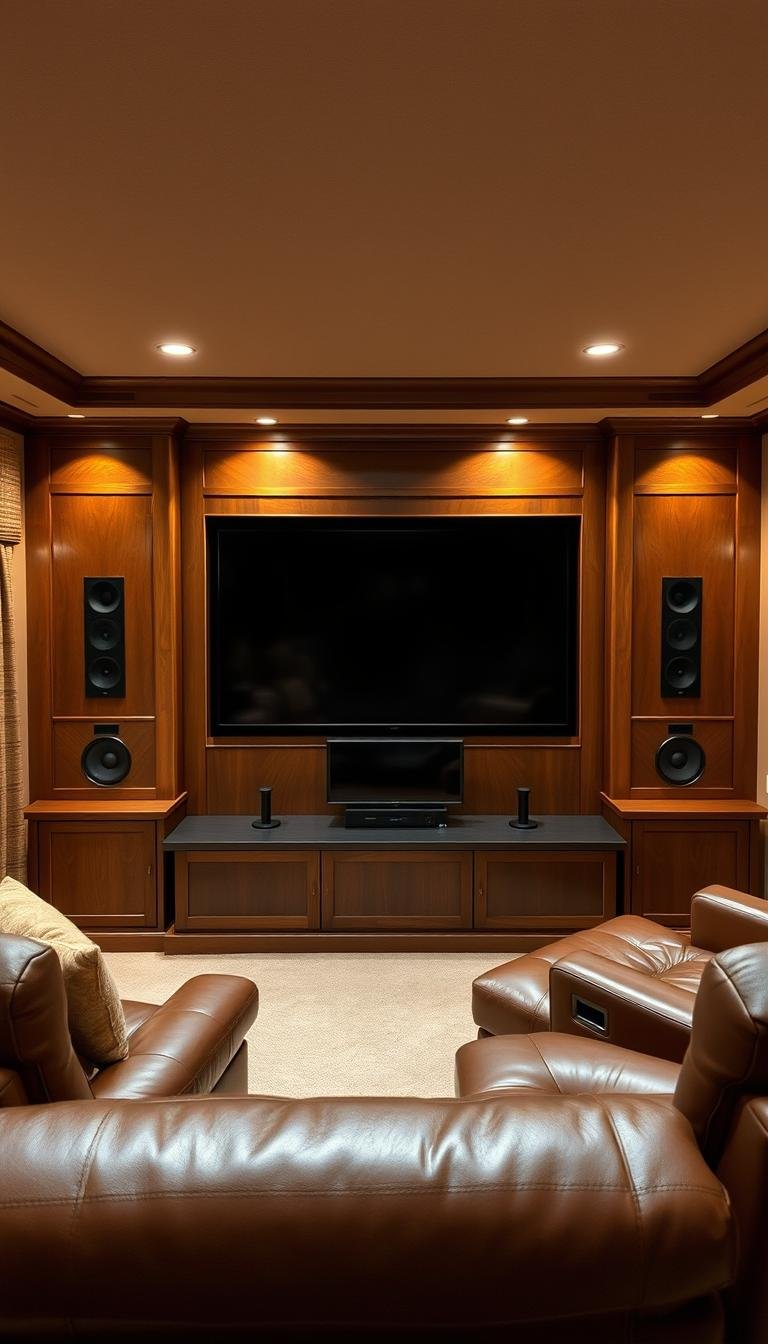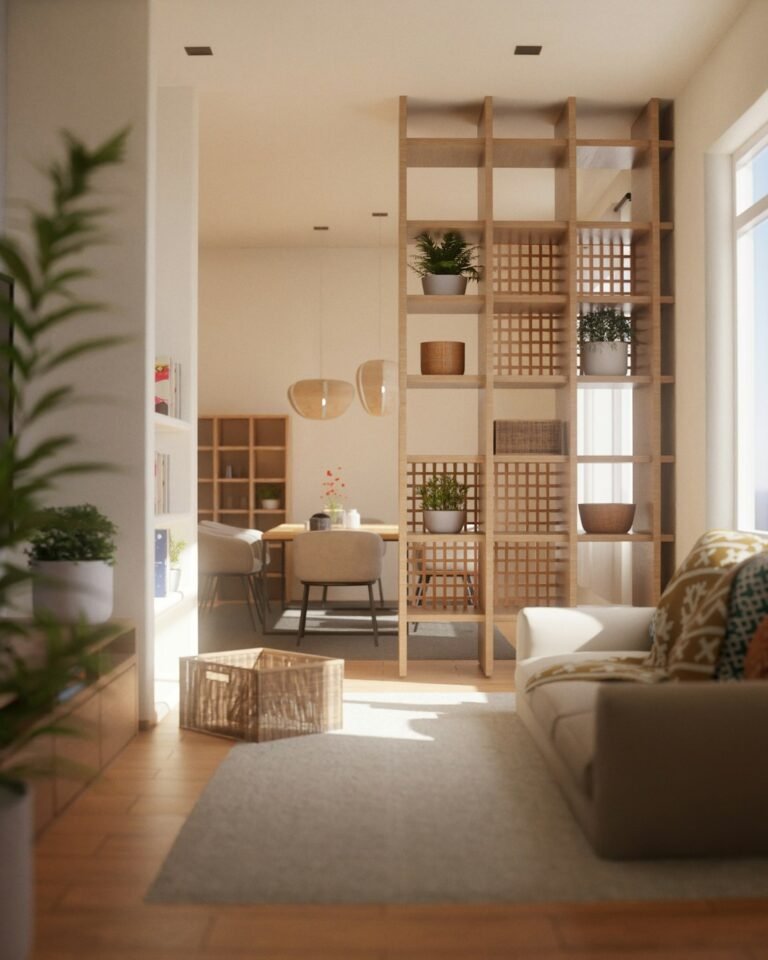
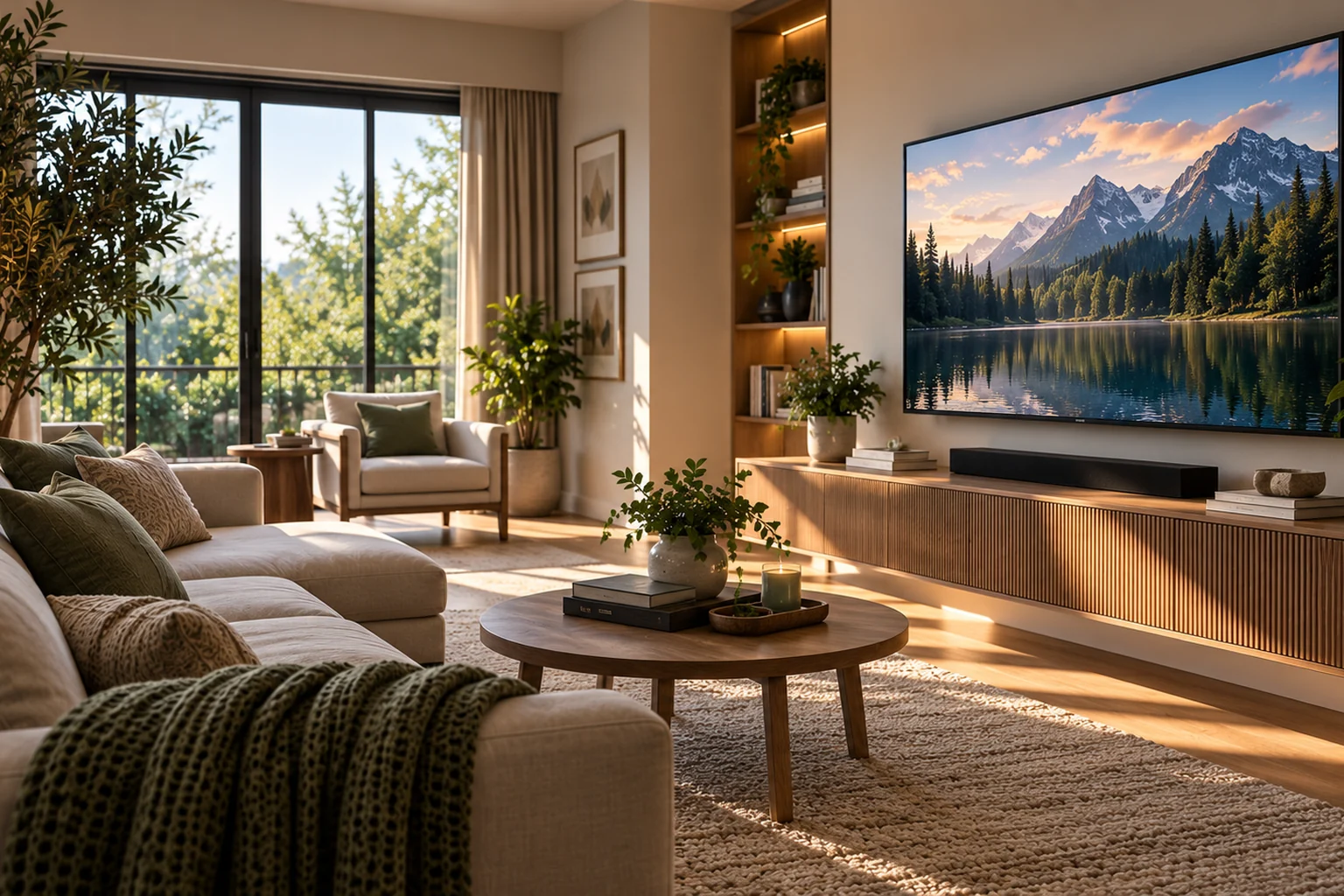
The best sofa-to-TV distance is the one that gives you a comfortable viewing angle for the screen size while still working with the room’s circulation and furniture layout. There is no single “1.5 to 2.5 times the diagonal” rule that fits every modern TV and viewing preference.
A better relationship is screen size → field of view → seating distance → screen resolution/content → eye height → room layout.
Use field of view as the starting point
Viewing distance changes how much of your vision the screen occupies. A farther sofa makes the TV feel smaller; a closer sofa creates a more immersive image.
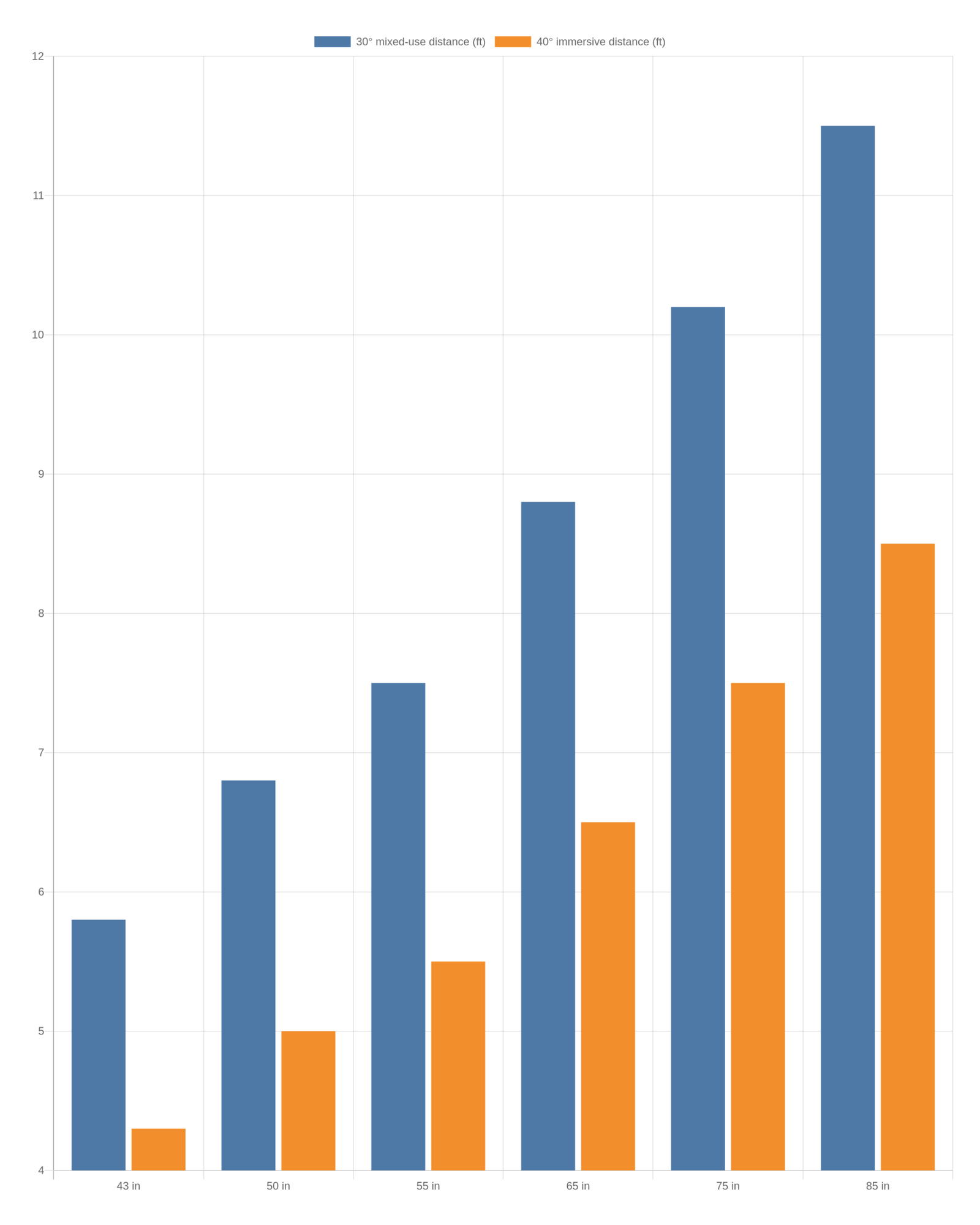
RTINGS’ current size-and-distance guidance, based on common home-theater field-of-view targets, uses about a 30-degree field of view as a useful mixed-use baseline and about 40 degrees for a more immersive cinematic experience. See the current RTINGS TV size-to-distance guide.
These are starting points, not medical limits. The right position depends on what you watch, how sensitive you are to a large image, and whether the room also needs to function for conversation, reading and circulation.
Approximate viewing distances for common 16:9 TV sizes
The table below shows approximate sofa-to-screen distances that produce about a 30° to 40° horizontal field of view. Measure from your usual eye position to the screen, not from the front edge of the sofa.
| TV size | Approx. 30° viewing distance | Approx. 40° viewing distance |
|---|---|---|
| 43 in | 5.8 ft | 4.3 ft |
| 50 in | 6.8 ft | 5.0 ft |
| 55 in | 7.5 ft | 5.5 ft |
| 65 in | 8.8 ft | 6.5 ft |
| 75 in | 10.2 ft | 7.5 ft |
| 85 in | 11.5 ft | 8.5 ft |
If you mostly watch casual TV, news or sports, the farther end may feel comfortable. If movies and games are the priority, a closer position may feel more engaging.
4K resolution allows closer viewing without obvious pixel structure
Modern 4K TVs can generally be viewed closer than older lower-resolution displays before individual pixels become apparent. Sony’s current guidance notes that a suitable distance for 4K viewing can be about 1.5 times the screen’s vertical height, while also emphasizing that viewing environment and personal preference matter. See Sony’s current viewing-distance guidance.
Resolution is not the only reason to choose a distance. A screen can be sharp at a close position but still feel too visually dominant for a particular user or room.
Measure from your eyes, not from the sofa front
A deep sectional and a shallow upright sofa can place your eyes at very different distances even when the furniture fronts line up.
For an accurate measurement:
- Sit in your normal viewing position.
- Measure from your eyes to the TV screen plane.
- Repeat from other frequently used seats.
- Compare those distances with the field-of-view range for your screen size.
If one side seat is much farther away or at a severe angle, the layout problem may be seating orientation rather than TV size.
Screen height is a separate decision from viewing distance
A good viewing distance does not compensate for a TV mounted uncomfortably high.
For most living rooms, start by placing the central viewing area of the screen near the seated eye line, then adjust for the actual sofa posture, screen height and mount. The exact center does not need to hit a universal number of inches from the floor.
A reclined viewer may tolerate a slightly higher display than someone sitting upright. The important test is whether you can watch naturally without holding your head tilted upward for long periods.
Do not use the fireplace to determine the TV height
A fireplace often pushes the screen much higher than normal seated eye level. It can also introduce heat and ventilation concerns.
If the TV must be above a fireplace, follow both the fireplace and TV manufacturers’ clearance and temperature requirements. Samsung’s current guidance says it does not recommend placing a TV above a fireplace because of heat and elevated viewing position, and says its TVs should not exceed 104°F/40°C. See Samsung’s wall-mounting guidance.
For that specific layout, use our 65-inch TV above a fireplace guide.
Room circulation can override the theoretical viewing distance
The mathematically ideal sofa position is not useful if it blocks a doorway or creates an awkward traffic path.
Check:
- the primary walkway through the room;
- door and cabinet swings;
- access to windows and curtains;
- side tables and floor lamps;
- recliner or chaise extension;
- heating and cooling vents;
- conversation distance between seats.
It is often better to choose a slightly smaller or larger screen than force the sofa into a position that makes the room dysfunctional.
Do not apply a universal sofa-to-wall gap
There is no required 12–18-inch gap behind every sofa. A sofa can sit close to a wall, float in the room, or leave a full circulation path behind it depending on the layout.
Leave the space required for the actual function: recliner movement, drapery, floor vents, a console table or a walking path. Decorative formulas should not override those needs.
Glare can make a good distance feel wrong
A technically correct viewing distance can still be uncomfortable if windows or lamps reflect strongly on the screen.
Before finalizing the mount:
- check the screen at the brightest time of day;
- compare window reflections from the main seat;
- test curtains, shades or blinds;
- avoid placing bright lamps directly opposite the screen;
- consider an articulating mount only if the TV and mount manufacturer allow the needed position.
For a dark or difficult living room, control glare and ambient light rather than simply moving the sofa farther away.
Gaming may favor a different distance than casual TV
Games often benefit from a more immersive field of view, but interface elements near the screen edges can become tiring if the display fills too much of your vision.
Try the closer end of the range, then test games with dense HUDs, subtitles and menus. The correct gaming distance is the one that feels immersive without forcing frequent head movement to read interface elements.
Sports and group viewing may favor the farther end
For a room where several people watch from different angles, a slightly farther main seating distance can make the whole screen easier to take in from side seats.
Panel technology also affects off-axis picture quality. If side-seat performance matters, compare the actual TV’s viewing-angle behavior rather than solving everything with furniture placement.
How to choose TV size when the sofa cannot move
If the seating location is fixed, work backward from the eye-to-screen distance.
For example, at roughly 8–9 feet, a 65-inch TV falls near a mixed-use 30° field-of-view starting point, while a 75-inch screen creates a more immersive image. At around 6–7 feet, a 55- to 65-inch TV may be more appropriate depending on how cinematic you want the experience to feel.
Use painter’s tape to mark the screen dimensions on the wall before buying. The diagonal size alone can be deceptive because the actual width grows substantially between TV sizes.
How to choose sofa position when the TV size is fixed
If you already own the screen:
- Mark the approximate 30° and 40° viewing-distance positions.
- Place the sofa temporarily within that range.
- Watch your normal content for several evenings.
- Check walking paths and side-seat sightlines.
- Adjust before permanently wall-mounting the TV or anchoring furniture.
A few inches usually matter less than whether the screen height, glare and room flow are comfortable.
Wall mounting does not automatically improve viewing
Wall mounting can free floor space and let you position the screen precisely, but only if the wall mount, wall structure and TV are compatible.
Follow the TV and mount manufacturer’s VESA compatibility, fastener, wall and ventilation instructions. Do not select a mount based on screen size alone; weight and attachment conditions matter too.
For cable planning on difficult walls, see our TV-wire concealment guide.
Continue with our TV-above-fireplace guide, TV wire-hiding guide, small living room layout guide, and coffee-table height guide.