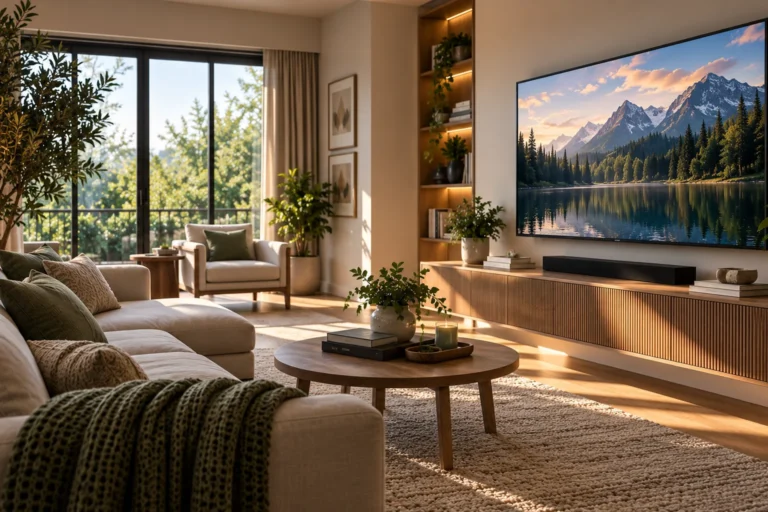

A 65-inch TV above a fireplace should be mounted only after two questions are answered: can the TV stay within the fireplace and television manufacturers’ heat/clearance requirements, and can the screen be viewed comfortably from the main seating position? If either answer is no, another wall is usually the better location.
The useful relationship is fireplace type → mantel/clearance → heat exposure → TV ventilation → mount geometry → seated eye line → viewing distance.
Start with the fireplace and TV manuals
There is no universal rule such as “3–4 inches above the mantel” that applies to every fireplace and every television. Gas, wood-burning and electric units all have different installation requirements, and each TV has its own temperature, ventilation and wall-mount instructions.
Samsung’s current wall-mounting guidance explicitly says it does not recommend mounting a TV over a fireplace because of heat and elevated viewing position, and notes that Samsung TVs should not exceed 104°F/40°C. See Samsung’s current wall-mounting guidance.
That does not mean every above-fireplace installation is automatically impossible. It means the exact fireplace and TV documentation—not a decorating rule—sets the safety boundaries.
Do not choose the TV height from the mantel alone
A mantel can force the screen much higher than the seated eye line. The result may look symmetrical in a photo but feel uncomfortable during a two-hour movie.
Before mounting:
- Sit in the main viewing position.
- Measure your natural eye height.
- Mark the proposed TV outline on the wall with painter’s tape.
- Look at the center of that outline without tilting your head upward.
- Repeat from other frequently used seats.
If the proposed center feels conspicuously high during this mock-up, the finished installation is unlikely to become more comfortable simply because the screen is mounted.
How high is a 65-inch TV physically?
A typical 65-inch 16:9 screen is roughly 32 inches tall, although the exact overall cabinet height depends on the model and bezel. That means moving the bottom edge only a few inches changes the screen center by the same amount.
Use the actual TV dimensions from the manufacturer rather than a generic 65-inch rectangle when marking the wall.
Heat is a separate constraint from viewing comfort
Even a visually comfortable height is not acceptable if the television is exposed to temperatures or clearances outside its allowed range.
Check:
- the fireplace manufacturer’s required clearances to combustibles and electronics;
- the mantel requirements for that fireplace;
- the television’s permitted ambient operating temperature;
- TV ventilation clearances;
- whether heat rises directly across the proposed TV location;
- whether the fireplace is wood-burning and can expose the TV to ash or soot.
Do not invent a mantel depth or “heat shield” solution independently of the fireplace manufacturer. A deeper mantel may alter the heat path, but whether it is permitted and effective depends on the actual fireplace system.
Do not treat a quick temperature test as a universal certification
Some manufacturers suggest checking the temperature in the proposed TV area while the fireplace is operating. That can be useful as part of the decision, but it does not replace the fireplace and TV installation requirements.
Heat output changes with fireplace type, burn rate, room conditions and how long the system operates. If the installation is close to a published limit, use a qualified fireplace or AV installer rather than relying on one casual measurement.
A pull-down mount can improve viewing height—but not solve heat
A pull-down mount can move a high television downward during viewing and return it above the mantel afterward. That can improve ergonomics when the fireplace wall is the only practical location.
But a pull-down mechanism does not make an otherwise unsafe heat or clearance condition acceptable. The TV still occupies the above-fireplace zone when stored, and the mount itself must be suitable for the TV’s weight, VESA pattern, wall construction and movement.
When a tilt mount is enough
A tilt mount can aim the screen downward toward the seating position when the display is only moderately above eye level. It changes the viewing angle, not the actual height.
If viewers still need to hold their head tilted upward, the screen is probably too high for long-term comfort even if the picture is angled toward them.
Viewing distance still matters
TV height and sofa distance are related. A screen mounted somewhat high may feel less extreme from farther away, while the same height can feel awkward from a close sofa.
For a 65-inch screen, our sofa-to-TV distance guide uses roughly a 30°–40° field-of-view range as a practical testing zone. Use that together with the vertical sightline rather than evaluating height in isolation.
Plan the entire wall before drilling
An above-fireplace TV wall includes more than the TV:
- fireplace opening and surround;
- mantel;
- TV and mount;
- studs or other structural support;
- power and signal cabling;
- soundbar or speakers;
- streaming devices or connection boxes;
- service access;
- ventilation around the television.
Trying to solve each component after the TV is installed often creates awkward cable runs and poor access.
Wall structure and mount capacity are non-negotiable
A 65-inch TV and an articulating or pull-down mount can create substantial loads on the wall. Follow the exact TV and mount instructions for wall type, fasteners and attachment points.
Sony’s current wall-mounting guidance warns that improper installation can cause injury or property damage and notes that the wall and attachment system must have sufficient strength for the specific television. See Sony’s wall-mounting guidance.
If the wall is masonry, plaster, unusually framed, or built around a fireplace chase whose construction is uncertain, use a qualified installer.
Do not improvise in-wall power
Power cords supplied with televisions are not automatically permitted for concealed in-wall use. If you want hidden wiring, use a code-compliant power solution and in-wall-rated signal cabling appropriate to the installation.
For difficult walls, see our TV-wire concealment guide.
When another wall is the better answer
Choose another location when:
- the fireplace manual does not permit the proposed configuration;
- the TV would exceed its allowed temperature or ventilation conditions;
- the screen center is far above comfortable seated sightlines;
- the mount cannot be attached securely to the wall structure;
- cable/power routing would require unsafe improvisation;
- the fireplace wall forces severe glare or off-axis viewing.
A side wall, media console or adjacent built-in may create a better daily viewing experience even if it is less symmetrical.
A practical decision sequence
- Identify the exact fireplace and TV models.
- Read both installation manuals.
- Confirm fireplace clearances and TV temperature/ventilation requirements.
- Measure the actual 65-inch TV cabinet dimensions.
- Mock the TV outline above the fireplace.
- Test sightlines from the primary seats.
- Check the sofa-to-TV viewing distance.
- Choose fixed, tilt or pull-down mounting only after the geometry works.
- Verify wall structure, mount rating and VESA compatibility.
- Plan power, signal cables and device locations.
The simplest answer
There is no single “best height” for every 65-inch TV above every fireplace. The lowest position that satisfies the exact fireplace/TV clearances and remains comfortable from the actual sofa is the better target. If those conditions push the screen uncomfortably high or expose it to excessive heat, move the TV to another wall.
Continue with our sofa-to-TV distance guide, TV wire-hiding guide, small living-room layout guide, and the Dwelanor Room Guides.