
Laundry Room Planning
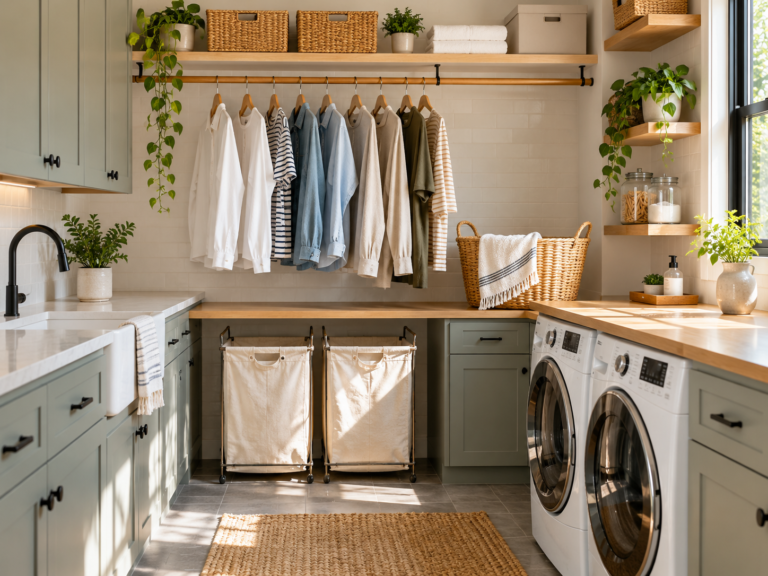
A laundry folding counter should be designed around the exact washer and dryer, not around a generic countertop dimension. Front-load machines can support a continuous work surface, but vibration, control panels, detergent drawers, service access and wall connections all affect how deep and how high the finished counter can be.
Measure the appliances → check doors, controls and hookups → decide standing work height → set counter depth → preserve ventilation and service access → test folding space.
1. Measure the actual appliance depth
Published cabinet depth can exclude hoses, plugs, door projections or a curved rear panel. Measure from the wall to the furthest point of the installed machine, including the connections it actually needs.
If the washer and dryer are not yet installed, use the manufacturer’s installation drawing rather than the showroom body dimension.
2. Check top controls and detergent access
Some front-load machines place controls or detergent drawers near the top edge. A counter that sits too low or projects awkwardly can make those parts difficult to use.
Open every drawer and control flap on the showroom model or existing machine before fixing the counter height.
3. Choose working height from the user
A folding surface should feel comfortable for the people who use it most. Rather than copying a kitchen counter automatically, mock up the surface with a board or table and fold a load of towels.
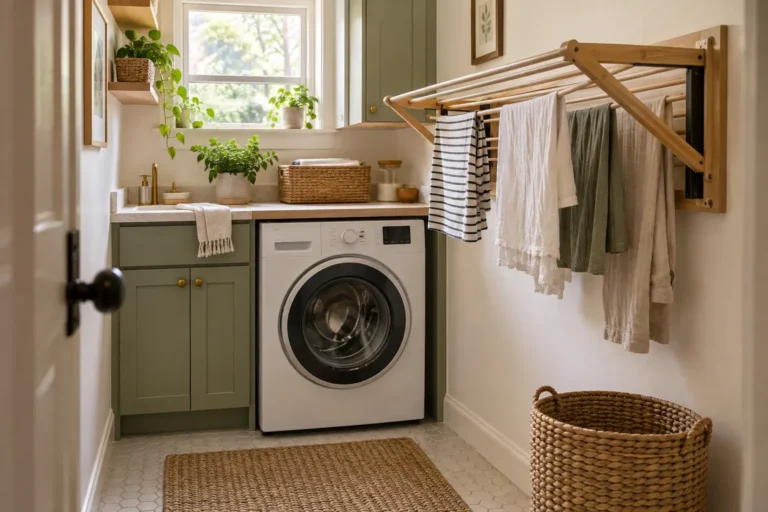
If the counter sits above machines, appliance height plus required clearance may determine the minimum. If that feels too high, a separate lower folding zone may be better.

4. Give the counter enough depth for real loads
A very shallow shelf is fine for detergent but frustrating for folding sheets and towels. The working surface should support the size of items you actually fold without forcing them into a narrow strip.
At the same time, avoid making the counter so deep that it blocks controls, windows or comfortable reach to the back.
5. Preserve vibration clearance
Washers move during spin cycles. A rigid counter should not rest directly on a machine unless the appliance manufacturer specifically supports that arrangement.
Use wall cleats, side panels or cabinetry that carries the counter independently, while maintaining the clearances required by the equipment.
6. Keep service access possible
Laundry equipment eventually needs hoses, filters, drain access or replacement. A beautiful built-in that traps the machines behind permanent trim turns routine service into demolition.
Use removable panels, accessible shutoffs and enough front clearance to pull the machines out when needed.
7. Plan the landing and sorting zones
The most useful counter often does more than folding. It can hold a laundry basket, receive clean clothes, support stain treatment or act as a temporary sorting surface.
If baskets live underneath or beside the counter, include their handles and pull-out movement in the plan.
8. Choose a moisture-tolerant surface
Laundry rooms deal with damp items, detergent spills and occasional leaks. Select a counter finish that tolerates the room’s real use and seal exposed edges where appropriate.
The material should also be smooth enough that knitwear and delicate fabrics do not snag during folding.
Laundry counter worksheet
| Element | Measure | Why it matters |
|---|---|---|
| Installed appliance height | _____ | Sets minimum counter position |
| Installed appliance depth | _____ | Controls useful counter depth |
| Rear hookup projection | _____ | Prevents crushed hoses/plugs |
| Desired work height | _____ | Checks comfort for folding |
| Pull-out/service zone | _____ | Keeps machines maintainable |
Before you buy or install
- Use manufacturer installation dimensions.
- Open detergent drawers and controls.
- Keep the counter structurally independent unless approved otherwise.
- Preserve service access and shutoff access.
- Test folding height with real laundry.
- Choose a surface suitable for moisture and cleaning.
Related Dwelanor guides
- Laundry Room Design Guide
- Storage & Organization Guide
- Wall-Mounted Drying Racks
- Small Space Design Guide
- Home Textiles Guide
- Decor & Design Guide
FAQ
Can a countertop sit directly on a washer and dryer?
Do not assume it can. Machines vibrate and require installation clearances, so support the counter independently unless the manufacturer explicitly allows another arrangement.
How deep should a laundry folding counter be?
Deep enough for the largest items you regularly fold, but sized around the installed appliance depth and room circulation rather than a universal number.
What if the machines make the counter too high?
Use a separate lower folding surface, pull-out shelf or adjacent cabinet rather than accepting an uncomfortable working height.
Bottom line
Design the folding counter from the appliance installation outward. Working height, useful depth, vibration clearance and future service access all matter more than matching a standard kitchen counter.