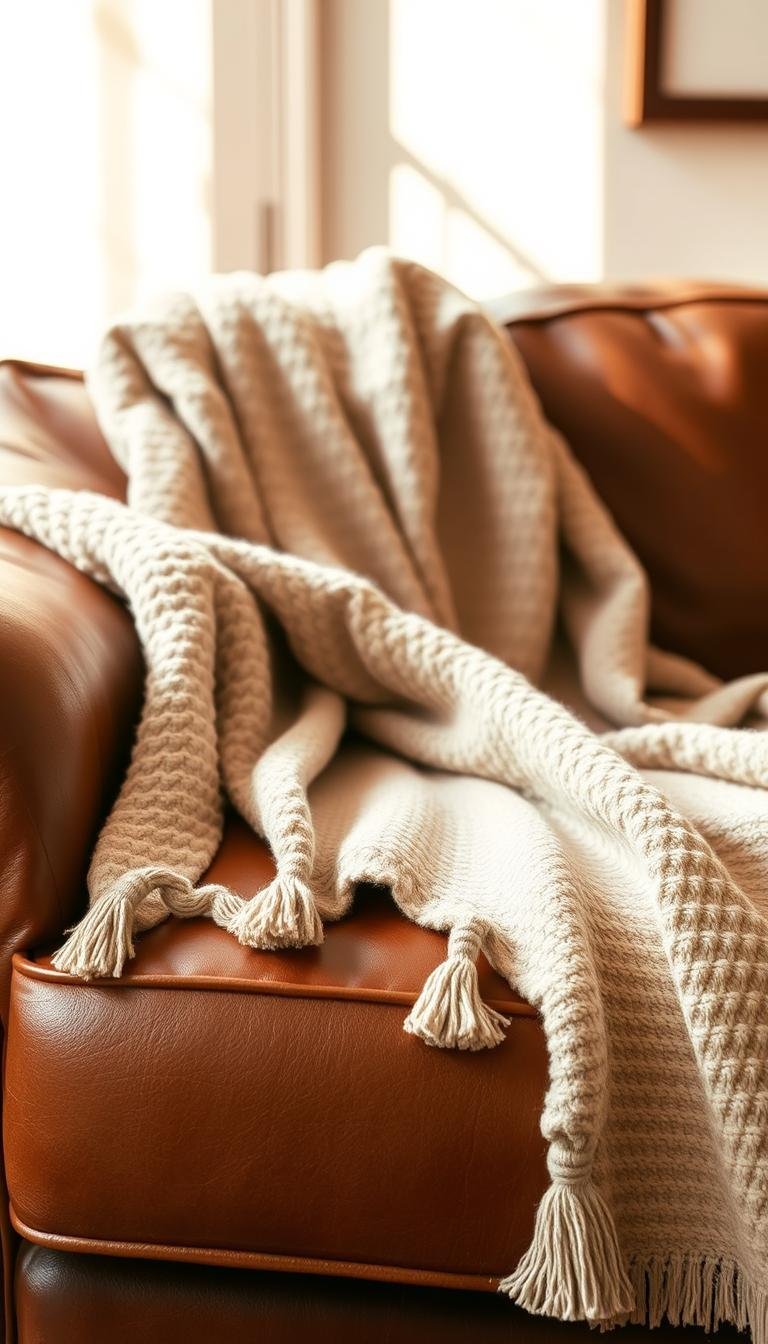
To keep a throw blanket from sliding off leather, use a heavier or more textured throw, fold it into a compact shape, place it where the sofa geometry can support it, and avoid adhesives or unknown anti-slip materials directly against the leather.
The useful relationship is leather finish → throw material → throw weight → fold → cushion geometry → user movement → upholstery care.
Why throws slide on leather
Leather upholstery often has a smoother surface than woven fabric. A lightweight blanket with a smooth face can move every time someone sits down, stands up or shifts against the cushion.
The amount of movement depends on:
- the leather finish;
- the throw fiber and weave;
- the blanket’s weight;
- how much fabric hangs over the front of the sofa;
- whether the sofa has loose or fixed cushions;
- where people normally sit.
Start with the right throw material
A smooth, lightweight throw is more likely to migrate than a denser woven blanket. Texture and mass both help.
Useful categories to compare include:
| Throw material | Typical behavior on leather | What to check |
|---|---|---|
| Cotton weave | Moderate grip and easy everyday use | Washability, shrinkage and dye transfer |
| Wool or wool blend | More weight and surface texture | Care requirements and potential fiber shedding |
| Linen blend | Light and relaxed | Can slide more if the weave is smooth |
| Fleece | Often more friction than a smooth woven throw | Lint, static and backing finish |
| Silky or satin-like textile | Usually the most likely to slide | Better used decoratively rather than as an everyday sofa protector |
Always check whether a new textile can transfer dye onto light leather, especially when the throw is dark or strongly colored.
Fold instead of spreading the throw across the whole sofa
A full blanket draped across the entire seat has a large area that can be pulled forward when someone sits. A controlled fold is easier to keep in position.
Try:
- a lengthwise fold over one sofa arm;
- a compact rectangle over a favorite seat;
- a diagonal corner drape;
- a narrow fold across the lower back cushion.
The goal is to reduce the amount of unsupported fabric hanging toward the floor.
Use the sofa’s cushion geometry
If the sofa has loose cushions and a normal gap between them, part of the throw can often be placed gently into that crease to help hold the fold.
Do not push objects, rods or improvised wedges deep into the sofa. Reclining mechanisms, frames, upholstery seams and cushion attachments can sit beneath the visible gap.
A natural fabric tuck is enough when the sofa design allows it.
Decorative pillows can provide light restraint
A pillow placed over the upper part of a folded throw can add enough weight to reduce everyday movement while still looking intentional.
This works best for a decorative throw that is not being pulled on and off constantly. If the blanket is used every evening, accept that it may need to be folded again rather than turning the sofa into a hardware project.
A fitted sofa protector is better when protection is the real goal
If the throw exists mainly to protect leather from pets, children or daily wear, a purpose-made furniture protector may work better than an ordinary blanket.
Look for a protector that:
- is approved for contact with leather;
- does not use a rubber, PVC or adhesive backing that the sofa maker prohibits;
- fits the sofa geometry;
- does not interfere with recliners or controls;
- can be removed and washed easily.
For dog-related leather protection, see our leather sofa and dog guide.
Do not put generic rug pad or shelf liner directly on leather
Anti-slip netting, rug pads and shelf liners are designed for other surfaces. Their materials can interact with leather coatings and finishes in ways that are difficult to predict.
Do not place one directly on the sofa unless both the leather manufacturer and the grip-product manufacturer support that use.
Avoid adhesives on leather
Hook-and-loop tape, double-sided tape and adhesive-backed grippers can leave residue, pull finish or create a visible patch when removed.
Even if the adhesive is attached to the blanket rather than the leather, the hard hook side or fastener can press against the upholstery when someone sits.
A removable textile solution is usually safer.
Avoid clips and pins that can press into the upholstery
Blanket clips, upholstery pins, screw pins and hidden hooks can create concentrated pressure or puncture the leather.
Do not pierce the upholstery or clamp directly to finished leather. If a purpose-built sofa cover includes straps, install them exactly as the cover manufacturer intends and keep hardware away from the visible leather surface.
Do not use pool noodles or foam rollers as hidden wedges
Stuffing a roller into a sofa crease can stress upholstery, block mechanisms or create a hard pressure line that was never part of the furniture design.
If the throw only stays in place when a large object is wedged inside the sofa, the better solution is a different throw, a fitted cover or a simpler drape.
Throw size matters
A very large blanket can be comfortable but creates more unsupported weight over the sofa edge. A smaller throw can be easier to style and reset.
Measure:
- seat width;
- seat depth;
- arm height;
- back-cushion height;
- the amount of drop you actually want.
Choose a size that creates deliberate folds rather than excess fabric pooling on the floor.
Be careful with dark dyes on light leather
Color transfer can occur with some textiles, particularly when there is friction, moisture or heat.
Before leaving a new dark throw on a pale sofa for long periods, check the textile care information and test cautiously in a low-visibility area if the manufacturers permit it.
Keep the leather and throw clean
Dust and grit trapped between fabric and leather can create abrasion over time.
Clean the sofa using the furniture manufacturer’s approved method and wash the throw according to its care label. Make sure the blanket is fully dry before placing it back on leather.
Styling a throw on a sectional
On a sectional, avoid trying to cover every seat with one large blanket. A more controlled look usually comes from one or two throws placed in the zones where they are actually used.
For example:
- one folded throw over the chaise;
- one smaller throw on an outer arm;
- a compact blanket basket beside the sectional for throws that are used nightly.
This also keeps the blankets from being dragged across multiple cushion seams.
A throw basket can solve the problem entirely
If the sofa is mainly being styled rather than protected, the cleanest solution may be to store the blanket beside the sofa and bring it out when needed.
A basket, bench or storage ottoman can keep throws nearby without asking a slippery sofa to act as blanket storage.
A practical order of fixes
- Choose a denser or more textured throw.
- Reduce the amount of loose overhang.
- Fold the blanket deliberately.
- Use a natural cushion crease if appropriate.
- Add a normal pillow for light visual restraint.
- If protection is the goal, choose a leather-compatible fitted protector.
- Avoid adhesive, pins, generic grip mesh and hidden wedges.
Continue with our leather sofa protection guide, throw-pillow guide, side-table guide, and the Dwelanor Room Guides.