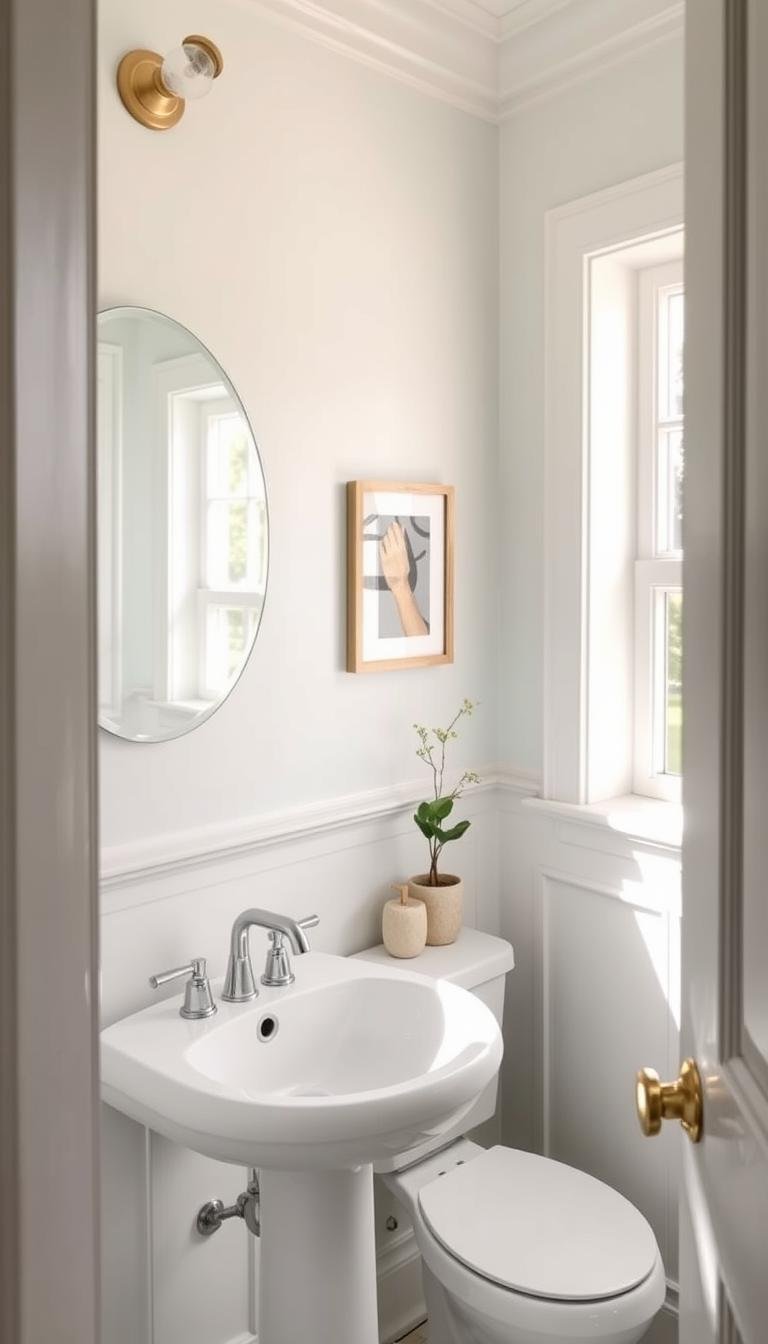
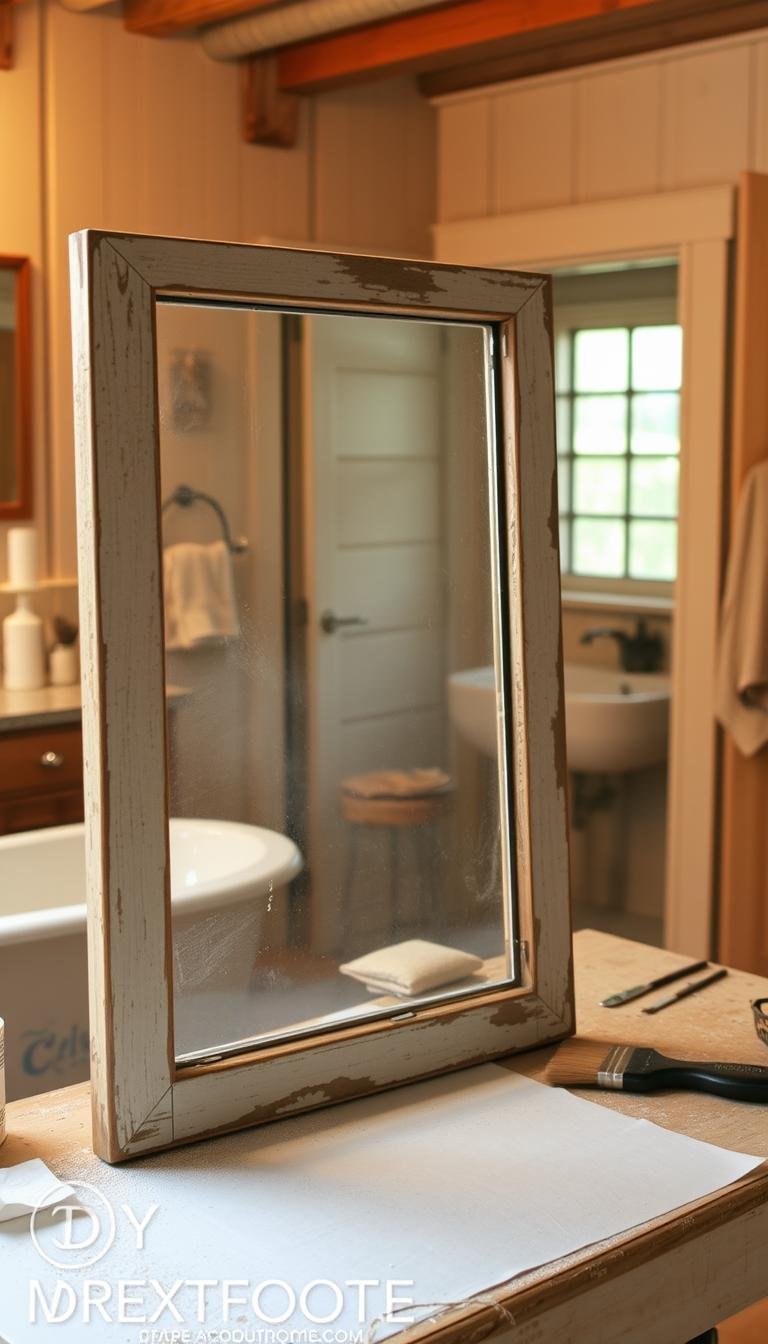
An old window frame can become a distinctive bathroom mirror, but the frame has to be safe, structurally sound and suitable for the finished mirror weight before appearance matters. Salvaged windows can contain fragile glass, loose glazing, deteriorated wood and old coatings that should not be disturbed casually.
The useful relationship is salvaged frame → condition → old-paint risk → glazing/mirror method → frame repair → bathroom finish → mirror retention → wall mounting.
Decide whether the old frame is actually worth reusing
Inspect the frame before buying mirror glass or planning a finish.
Reject or professionally assess a frame with:
- extensive rot or soft wood;
- loose or separating joints;
- cracked or unstable glazing;
- significantly warped rails or muntins;
- sharp, damaged hardware that cannot be secured;
- unknown old coatings that would need extensive disturbance to restore.
Character is useful; structural deterioration is not. If a salvaged frame is unsuitable, a newly built window-style frame can reproduce the visual idea without the risks of old glazing and coatings.
Treat pre-1978 paint as a potential lead issue
Older painted window frames can contain lead-based paint. Sanding, scraping, sawing or drilling through lead-containing coatings can create hazardous dust.
If the frame may come from pre-1978 housing, do not begin by “sanding it smooth.” Use an appropriate lead assessment/testing approach and follow current lead-safe work practices if the coating will be disturbed. A qualified restoration or lead professional is appropriate when condition or scope is uncertain.
Keeping a stable old finish intact can be preferable to aggressively stripping it simply to achieve a distressed look.
Choose the mirror method based on how the mirror will be used
There are three practical approaches.
| Approach | Best when | Main limitation |
|---|---|---|
| Professionally cut mirror panes | You need a clear everyday reflection | Adds weight and requires safe retention |
| Mirror-effect coating on intact glass | The piece is mainly decorative and the original glass is sound | Reflection is usually less clear than real mirror |
| New divided-light mirror frame | The salvaged frame is unsafe, damaged or the wrong size | Less original historic material |
For a primary vanity mirror, real mirror glass is generally the more functional choice because facial reflection matters. A mirror-effect finish can be attractive on a decorative accent piece but should not be represented as equivalent to purpose-made mirror glass.
Measure every opening separately
Old window frames may not be square, and divided-light openings may vary slightly. Measure each opening individually rather than assuming one repeated pane dimension.
A glass or mirror shop can advise on appropriate tolerances, edge finishing and mirror type for the frame. Do not order panes based only on the nominal size of the original window.
Remove or stabilize old glazing carefully
Old glass and glazing can be brittle. The safest method depends on the condition of the frame, coating and glazing system.
If original panes must be removed and there is old paint, fragile glass or deteriorated putty, a glazier/restoration professional may be the sensible route. The goal is not to preserve every old component at the expense of safe handling.
Wear suitable eye and hand protection when handling glass and keep the work supported on a stable surface.
Mirror retention should be mechanical and appropriate to the assembly
Do not rely on craft glue, hot glue or decorative caulk as the primary restraint for mirror panes.
The frame should use a retention method compatible with the mirror, frame construction and finished weight—such as appropriate glazing/retaining components specified for the application.
Also check that any adhesive or sealant contacting mirror backing is approved for mirrors; incompatible products can damage reflective backing.
Repair the frame before adding mirror weight
Loose joints, cracked muntins and damaged rails should be repaired structurally rather than hidden under filler or paint. The finished frame must carry the mirror panes without racking or allowing the openings to change shape.
If the frame needs major joinery repair, the project has moved beyond a cosmetic upcycle. A woodworker or restoration professional can determine whether repair is worthwhile.
Choose a bathroom-appropriate finish
A bathroom mirror experiences humidity and occasional splash, even when it is not inside a shower.
Choose a coating system compatible with the existing substrate and previous finish. Seal or finish exposed wood as required by that system, especially at cut or repaired areas.
Do not create an artificial distressed finish by sanding through unknown old paint. If patina is part of the appeal, preserving a stable existing surface can be both safer and more authentic.
Plan the finished weight before choosing wall hardware
Multiple mirror panes can make a salvaged window assembly much heavier than the empty frame. Weigh the completed mirror or calculate conservatively before choosing hanging hardware.
The mounting system has to work as one chain:
mirror panes → pane retention → frame joints → frame hanger/cleat → fasteners → wall structure.
If any link is uncertain, the safe working capacity of the whole assembly is uncertain.
French cleat, hangers or another system?
A properly selected French cleat can distribute a heavy mirror load well, but only when the cleat attachment to both frame and wall is suitable for the finished weight and the wall substrate.
Other rated mirror-hanging systems may also work. Follow their manufacturer instructions and use suitable structural attachment points. Do not assume a generic drywall anchor or picture hook can support a large salvaged-window mirror.
For heavy mirror mounting, see our dedicated heavy mirror hanging guide.
Place it like a vanity mirror, not just wall art
If the mirror will sit above a sink, confirm that the divided-light pattern still gives enough uninterrupted reflective area for daily grooming.
Check:
- vanity and sink centerline;
- faucet and backsplash clearance;
- sconce or vanity-light positions;
- outlets and switches;
- the sightlines of regular users;
- door swing and nearby cabinetry.
A beautiful six-pane frame may make a poor primary mirror if muntins cross the face at eye level.
When the frame should be decorative instead
If the divided lights interfere with useful reflection, use the salvaged-window mirror on another bathroom wall and install a simpler functional mirror above the sink.
This lets the old frame serve as a decorative object without forcing it to perform a task its geometry does not suit.
Cleaning and maintenance
Use cleaners compatible with both the mirror surface and frame finish. Avoid overspraying cleaner onto frame joints or mirror edges; apply it to the cloth where appropriate.
Periodically check:
- mirror retainers;
- frame joints;
- wall mounting hardware;
- signs of moisture damage;
- loose or corroding metal components.
If the frame starts moving or the glazing/retention becomes loose, remove the mirror from service until the problem is corrected.
A safer project sequence
- Inspect the frame and decide whether it is structurally viable.
- Assess old-paint risk before disturbing any coating.
- Choose real mirror, mirror-effect glass or a new frame.
- Measure every opening.
- Have mirror panes safely cut and finished where needed.
- Repair frame structure before adding weight.
- Finish exposed material with a compatible bathroom-appropriate system.
- Install appropriate mirror retention.
- Determine finished weight.
- Select and install a rated wall-mounting system.
The Dwelanor approach
Reuse the old frame only if the result can be both safe and functional. Preserving character is worthwhile; preserving unsafe glazing, unstable joinery or hazardous coatings is not.
For related planning, see our bathroom vanity mirror styles, vanity mirror sizing guide, heavy mirror hanging guide, and removable wall hanger guide.