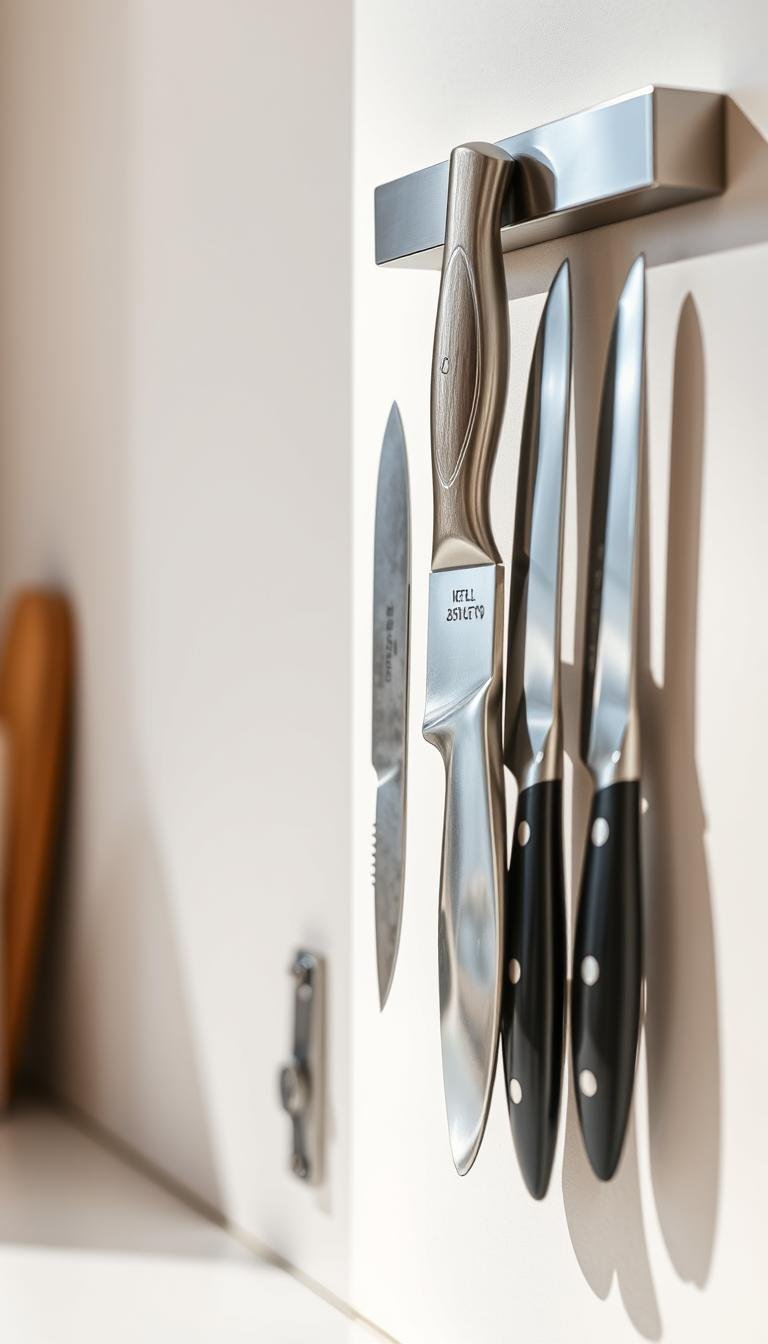
A good magnetic knife strip should hold every knife securely without encouraging the cutting edge to scrape across a hard surface. The most useful things to compare are the face material, how evenly the magnet holds across the usable length, mounting stability, spacing between handles, and how naturally each knife releases.
Wood-faced bars can be gentler and quieter at the contact point. Stainless or coated metal can be easier to wipe clean. Neither material is automatically safer; placement and handling matter more than the finish alone.
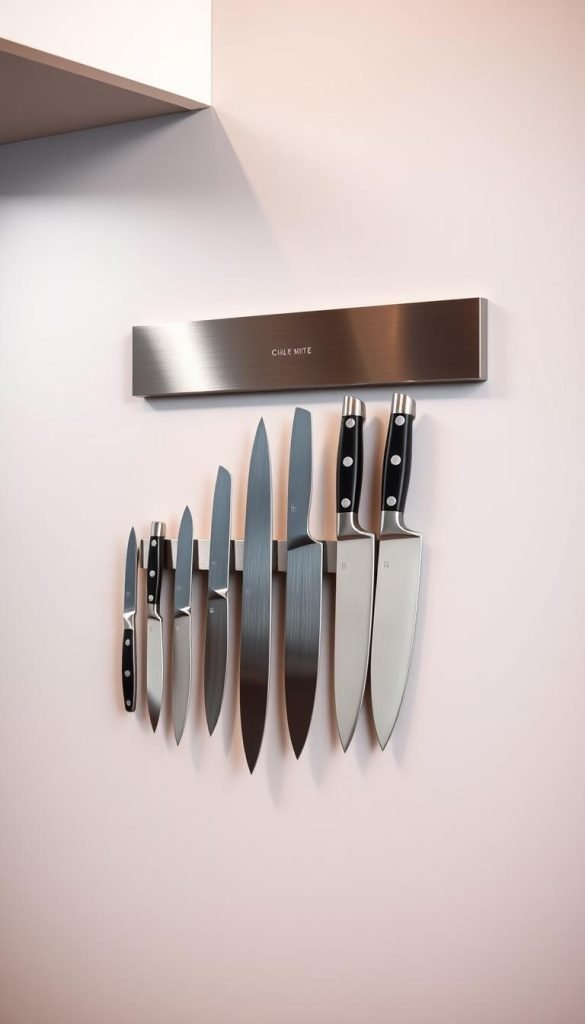
What keeps a magnetic strip from scratching knives?
The cutting edge should not be dragged sideways across the strip. Place the spine or flat of the blade against the face first, then roll the knife gently into position. Remove it by reversing that motion rather than sliding the edge along the holder.
That handling technique matters on wood, steel, and coated holders alike.
Wood versus metal faces
| Face material | Strength | Trade-off |
|---|---|---|
| Wood-faced | Softer, quieter contact; warm visual finish | Needs appropriate cleaning and occasional care |
| Textured/coated metal | Easy to wipe; can add grip | Harder contact surface |
| Smooth bare metal | Minimal look and simple cleaning | Can feel slippery or harsh if knives are dragged sideways |
For either type, inspect the face for raised screws, rough trim, loose veneer, or anything that could catch a blade.
Even magnetic hold matters more than a headline strength number
Unexplained Gauss figures are not very helpful to shoppers because brands rarely publish measurements taken under the same test conditions. What matters in the kitchen is whether the pull feels consistent across the whole usable strip.
A good bar should hold a small paring knife without letting it slide toward a stronger spot, while also supporting the heaviest knife you intend to hang without pivoting or creeping.
Size the strip around the handles, not just the blades
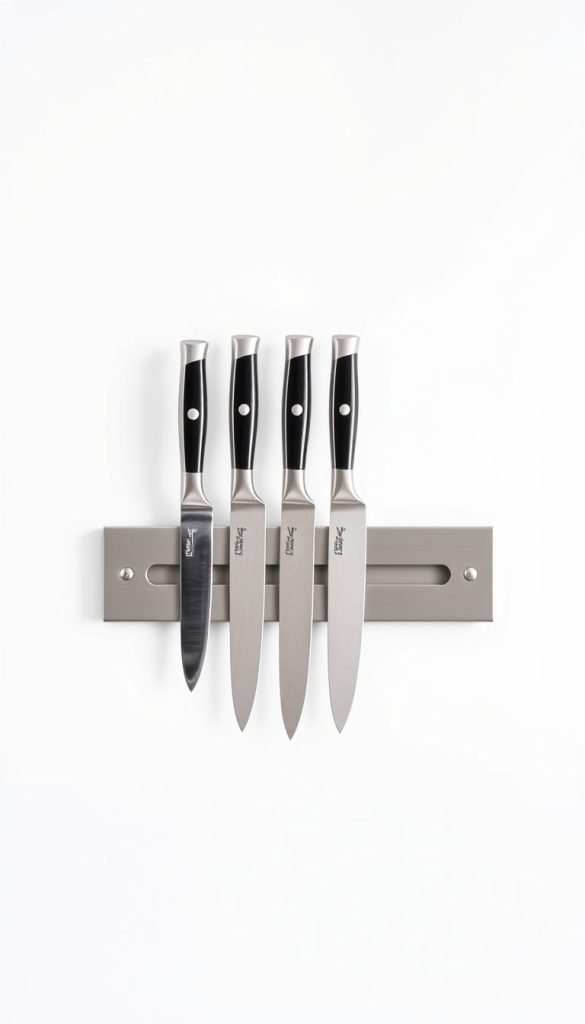
Handle spacing often determines capacity before blade width does. Lay your knives on a counter at the spacing you want, measure the total width, then buy a strip with some room left at both ends.
A crowded strip makes it harder to remove one knife without bumping another. If your collection is large, two shorter bars can be more usable than one overloaded bar.
Mounting is a safety issue
A powerful magnet attached to a weak mount is still a poor knife-storage system. Follow the holder manufacturer’s installation instructions and use fasteners appropriate for the wall construction.
- Mount the strip where children cannot reach it.
- Keep blade tips and handles clear of cabinet doors, switches, and shelves.
- Do not place the strip where someone can brush against exposed blades in a walkway.
- Check that the bar does not flex or move when the heaviest knife is removed.
- Avoid adhesive-only mounting unless the manufacturer explicitly rates that mounting method for the loaded strip.
Where to put it
The best location is close to the prep area but outside the direct splash, steam, and heat zones around the sink and cooktop. Knives should be easy to reach without crossing a busy circulation path.
Leave enough vertical clearance for the longest knife, including its handle and blade tip. If the bar is mounted low, check that the tips do not approach the countertop or backsplash edge.
Tip-up or handle-up?
Orientation depends on placement. The important thing is that the exposed blade cannot be contacted accidentally and that each knife can be removed without twisting into neighboring knives.
For many home kitchens, handle-up is intuitive because the grip remains obvious and accessible. On higher installations, another orientation may work better. Follow the holder maker’s guidance where specified.
Keep knives dry
Dry each knife before hanging it. Moisture trapped against wood can damage the finish, while moisture against metal can encourage spotting or corrosion on susceptible blades.
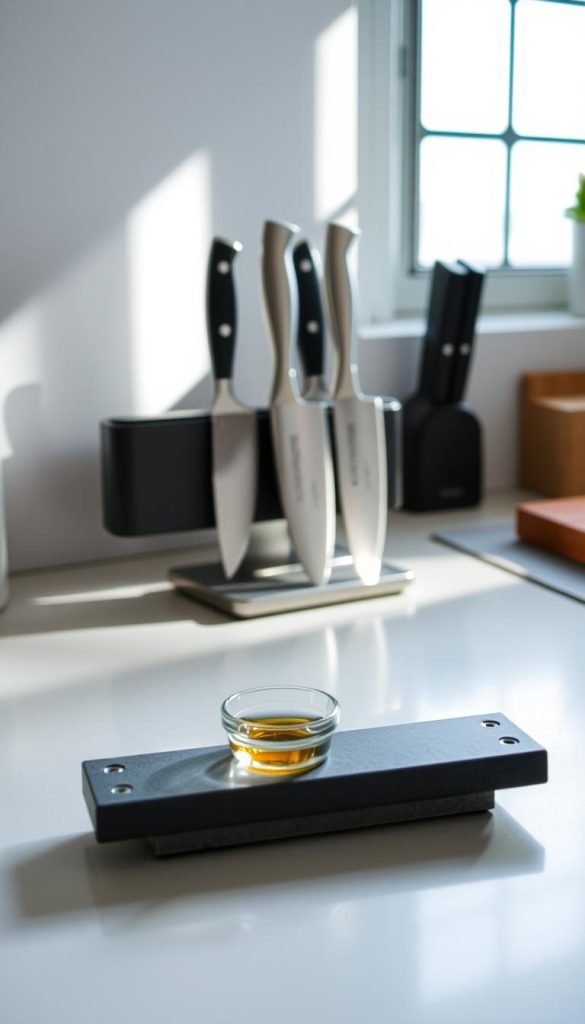
What to compare before buying
- Usable length: enough room for your actual handles.
- Face material: smooth and intact with no exposed rough hardware.
- Magnetic coverage: even hold across the face.
- Mounting system: clear instructions and a rigid wall attachment.
- Cleaning: a surface you can keep free of grease and moisture.
- Return policy: useful if the real-world hold is weaker or stronger than expected.
What about countertop magnetic blocks?
A freestanding magnetic block can be a better option for renters or kitchens where drilling is not practical. Choose one with a stable base that does not tip when a heavy knife is removed, and make sure the knives do not overlap or expose blades into a circulation path.
The practical choice
If blade protection is the priority, a smooth wood-faced strip with even magnetic coverage is an appealing option. If low maintenance matters more, a well-made textured or coated metal strip can work just as well when knives are placed and removed correctly.
Do not buy based on an unexplained magnet-strength number or a permanent “best overall” ranking. Buy the strip that fits your knife set, mounts securely to your wall, and lets you remove each knife without dragging the edge.
For related kitchen planning, see the Dwelanor Room Guides, the magnetic spice-jar guide, and our guide to under-cabinet lighting.