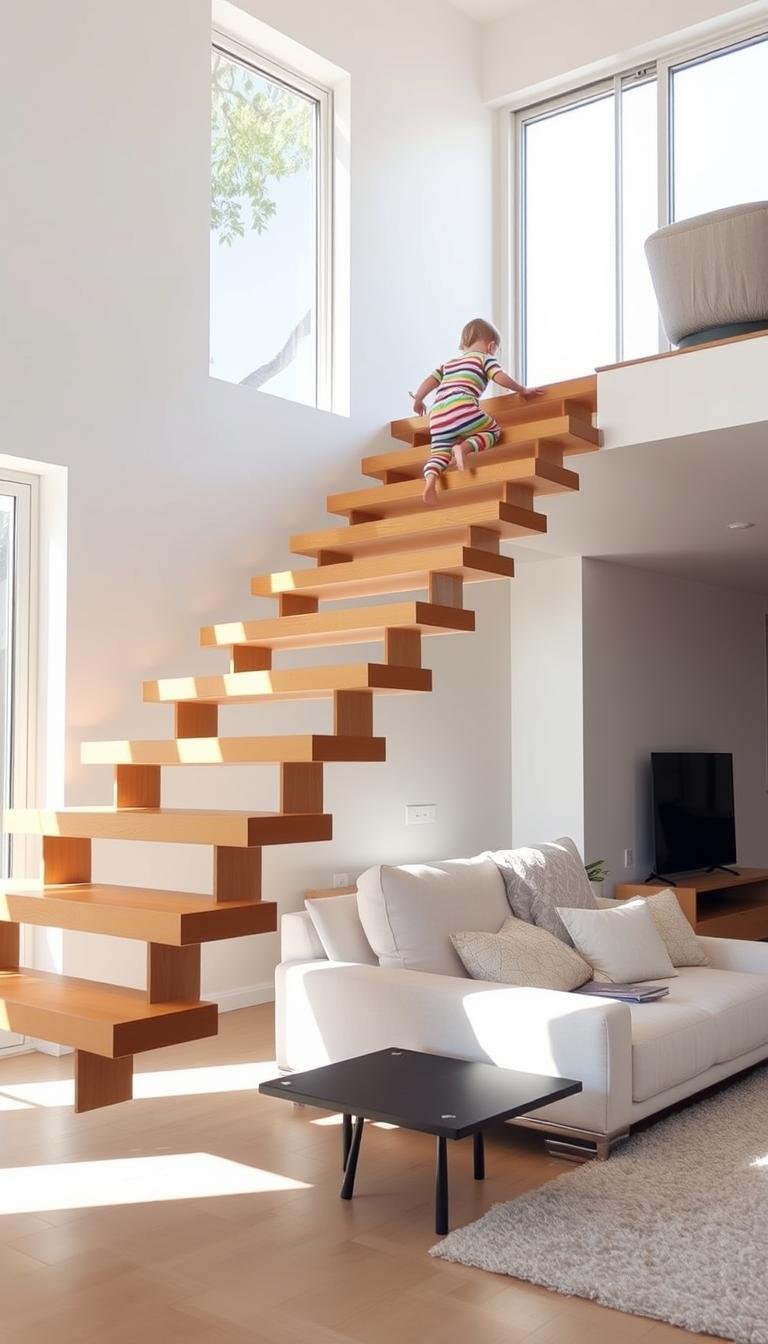
The first priority with a toddler and floating stairs is preventing unsupervised access. Use a stair gate that the manufacturer approves for the exact location, keep climbable furniture away from the landing, and supervise whenever the barrier is open.
Floating stairs can need extra attention because open risers, open guards, slim rail systems, and visually light construction may create gaps or footholds that attract a climbing child. Do not assume that a structurally sound staircase is automatically child-safe.
Start with access control
A physical barrier is more reliable than repeatedly telling a toddler not to climb. Use a gate designed for stair use and follow its instructions for the top or bottom of the stair, wall attachment, banister adapters, latch position, and hardware.
Do not stack gates or improvise extensions unless the manufacturer specifically supports that configuration. If the stair has unusual posts, glass, open stringers, or a custom guard, get installation advice before drilling into structural or guard components.
Top-of-stair and bottom-of-stair gates are not interchangeable
Gate requirements can differ by location. A product that is suitable at the bottom of a stair may not be approved at the top. Use the manufacturer’s location guidance rather than assuming any pressure-mounted or hardware-mounted gate is appropriate everywhere.
The U.S. Consumer Product Safety Commission specifically advises using a safety gate that meets current child-safety standards and, at the top of stairs, using a gate that screws to the wall. Pet gates should not be substituted for child safety gates. See the CPSC childproofing guidance.
Recheck the gate regularly. Toddlers grow, push, pull, and explore hardware, and a gate that was secure months ago may need adjustment.
Remove easy climbing aids near the stair
Look at the landing from a toddler’s perspective. Move stools, lightweight chairs, toy bins, side tables, baskets, and other objects that can be pushed or stacked into climbing position.
Anchor furniture that presents a tipping hazard according to the furniture maker’s instructions and use appropriate wall hardware for the actual wall construction. Do not rely on improvised straps, stacked furniture, or unstable barriers.
Open risers and guard openings
If the spaces between treads or within the guard concern you, have the existing stair reviewed before making permanent modifications. Building requirements vary by jurisdiction and by the stair system, and changing one component can affect clearances, loads, or the way the guard is anchored.
Possible professional solutions may include compatible infill, revised guard components, or changes to risers, but the correct option depends on the exact staircase. Avoid attaching homemade panels to a proprietary floating-stair system without confirming that the system can accept them.
Do not use generic internet dimensions as a retrofit plan
Guard heights, opening limits, tread geometry, handrails, and structural requirements depend on locally adopted codes and the building type. A number quoted from a general article may not apply to your home.
Before altering structural parts, guards, treads, risers, or handrails, check with the local building department, the stair manufacturer, or a qualified professional.
Improve traction without creating a trip edge
Keep treads dry and clear. If additional grip is needed, choose a traction product that is suitable for the tread material, compatible with the finish, and installed so edges cannot lift or create a new tripping hazard.
Do not apply a generic adhesive product without checking whether it can damage wood, stone, glass, coatings, or the manufacturer’s warranty.
Lighting matters
Good visibility helps caregivers and older children use the stair safely. Replace failed bulbs promptly and consider lighting that makes tread edges and landings easier to see.
If adding built-in electrical lighting, use an installation appropriate to the stair and local electrical requirements. Avoid loose cords or temporary lights where they can create another hazard.
Teaching helps, but it does not replace a gate
Simple, consistent language such as “stairs with a grown-up” can support the physical barrier. Calm redirection is useful, but a toddler’s impulse control is still developing, so training should not be treated as the primary safety system.
Offer age-appropriate active play in a separate supervised area away from the stair. Avoid creating makeshift climbing setups from boxes, loose cushions, chairs, or other unstable household objects near hard surfaces or landings.
Supervision and routine
Make stair access predictable. Keep the gate closed when the stair is not actively being used, ask caregivers to follow the same routine, and avoid leaving the barrier open because someone will “only be gone for a minute.”
As the child grows, reassess the setup. A barrier that once seemed too tall to climb may become a new challenge later.
When to involve a professional
Get professional help when:
- the gate cannot be mounted according to its instructions;
- the stair uses glass, cable, custom metalwork, or a proprietary floating system;
- you are considering changing guards, risers, handrails, treads, or structural connections;
- there is movement, looseness, damage, or uncertainty about the existing stair;
- you are unsure which local building requirements apply.
A qualified professional can evaluate the actual assembly rather than relying on generic retrofit advice.
A practical safety checklist
- Use a gate approved for the exact stair location.
- Keep the gate closed whenever the stair is not being actively used.
- Move climbable or pushable furniture away from the landing.
- Keep treads dry, clear, and well lit.
- Inspect gates and hardware regularly.
- Do not improvise structural changes to guards, risers, or handrails.
- Check local requirements before permanent modifications.
- Supervise closely whenever the barrier is open.
Conclusion
For a toddler, the most effective floating-stair strategy is layered: prevent unsupervised access, remove nearby climbing opportunities, maintain good traction and visibility, and treat permanent stair modifications as a building-safety project rather than a decorating hack.
If the existing stair design leaves you uncertain about gaps, guards, risers, or gate attachment, have the exact system reviewed before changing it. For more home layout and safety guidance, continue with the Dwelanor Room Guides.