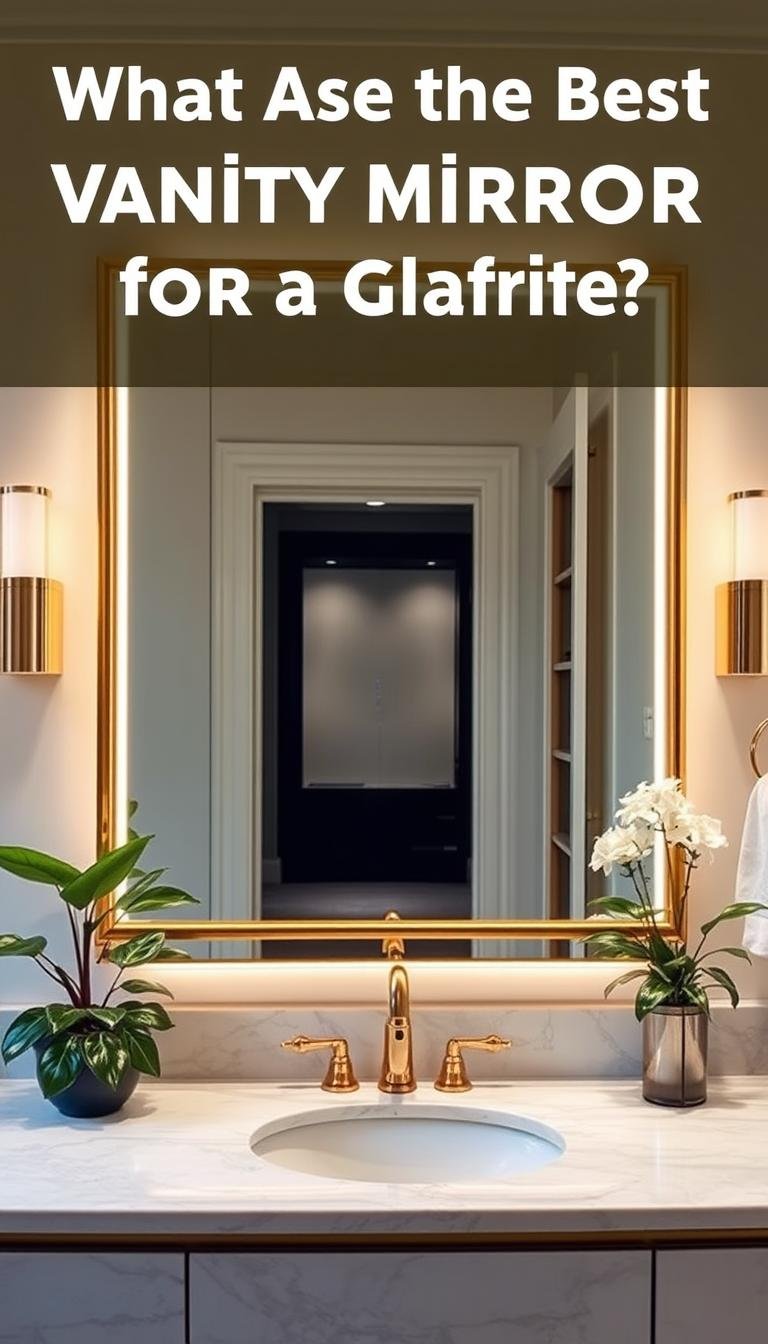
The best bathroom vanity mirror style is the one that fits the vanity, lighting and wall composition while reinforcing the room’s design language. Shape and frame matter, but they should be chosen after the practical relationships are clear: vanity width → sink position → mirror size → lighting → wall finish → frame material → mounting.
This guide focuses on style. For exact proportions around a 48-inch vanity, see our mirror sizing guide.
1. Thin-frame rectangular mirrors
A slim rectangular mirror is the most flexible choice because it follows the horizontal and vertical geometry already created by a vanity, backsplash and cabinetry.
Use a thin black, brass, bronze or nickel frame when you want the mirror to define the vanity zone without becoming the main decorative object. The frame finish can repeat faucet or lighting finishes, but exact matching is not required.
Best suited to: modern, transitional, industrial and streamlined traditional bathrooms.
2. Frameless mirrors
Frameless glass reduces visual interruption and lets tile, wallpaper, stone or cabinetry carry more of the room’s character. It works especially well when the wall finish itself is decorative or when maximum reflected area matters.
A frameless mirror still needs carefully finished edges and a mounting method suitable for its size and weight. “No frame” does not mean “no design decision.”
3. Arched vanity mirrors
An arch introduces a curved upper edge into a room that is often dominated by rectangles. It can soften slab-front cabinetry, linear tile and square sinks while adding vertical emphasis.
Arches pair naturally with curved faucet spouts, rounded sconces and softer decorative styles, but they can also work in minimalist rooms where the shape itself becomes the only ornament.
4. Round mirrors
A round mirror creates a distinct focal shape and can relieve the visual weight of a boxy vanity. Because a circle loses reflective area at the upper corners compared with a rectangle of the same outside width, test the size carefully rather than assuming equal width means equal usefulness.
Round mirrors work particularly well in powder rooms and single-sink bathrooms where one strong shape can anchor the wall.
5. Oval mirrors
An oval combines the softness of a round mirror with more vertical reflective area. A tall oval can make a narrow wall feel more elongated and is useful when the vanity is modest in width but the wall has generous height.
Compare vertical and horizontal ovals based on wall proportions rather than style labels alone.
6. Rounded-corner rectangles
A rectangle with softened corners offers more reflective area than a circle while avoiding a fully angular profile. It is a useful bridge between modern and transitional design.
This shape also pairs well with fluted vanities, curved pulls and rounded plumbing fixtures because it repeats those forms without becoming overly decorative.
7. Wood-framed mirrors
Wood introduces warmth and texture, particularly beside cool tile, stone and metal fixtures. Match the wood by undertone and visual weight rather than trying to duplicate the vanity finish exactly.
Bathroom suitability depends on the frame construction and finish. Persistent moisture, splashing and poor ventilation can affect wood, so choose a product intended for the environment and follow its care instructions.
8. Metal-framed mirrors
Metal frames can create either contrast or continuity with the surrounding fixtures.
- Black: adds crisp definition against pale walls and tile.
- Warm brass/bronze: introduces warmth and can connect with warm stone, wood or cream finishes.
- Nickel/chrome: works with cooler palettes and reflective plumbing finishes.
Do not choose only by color. Frame width, sheen, edge profile and how the metal relates to the sconce backplates all affect the final composition.
9. Medicine-cabinet mirrors
A mirrored medicine cabinet combines reflection and storage. That makes it a different functional entity from a decorative wall mirror.
Recessed cabinets can sit nearly flush but require a suitable wall cavity and careful coordination with framing and utilities. Surface-mounted cabinets project farther from the wall but can avoid opening the wall.
Check cabinet depth, door swing, hinge side, interior shelf arrangement, outlet locations and mounting requirements before deciding that a medicine cabinet is the right “style.”
10. Integrated-light mirrors
LED or backlit mirrors combine the mirror with task or ambient lighting. Their style value comes from the clean perimeter and reduced need for separate decorative fixtures; their practical value depends on light quality and electrical suitability.
Compare dimming, color temperature, published color-rendering information where available, defogger controls, electrical connection and bathroom-location approval. For a detailed feature checklist, see our anti-fog smart mirror guide.
11. Oversized and wall-wide mirrors
A wide mirror can visually expand a small bathroom by reflecting more of the room and simplifying the vanity wall. It is especially effective when the wall contains attractive light, tile or architectural detail worth repeating in reflection.
Large mirrors are also heavier and may interact with outlets, sconces, backsplash height and wall edges. Treat mounting and handling as part of the design.
12. Two-mirror vanity layouts
Two mirrors make sense when a double vanity has two distinct sink/user stations. Center each mirror on its own sink or user zone, then coordinate the pair with the lighting.
Do not split one generous mirror into two tiny ones simply to create symmetry. Each mirror still needs enough reflective area for daily use.
13. Sculptural and asymmetrical mirrors
Wavy, organic and asymmetrical mirrors behave more like decorative objects than neutral reflective panels. They work best when the rest of the vanity wall is visually restrained.
The useful reflective area may be much smaller than the stated overall dimensions, so outline the exact shape on the wall before ordering.
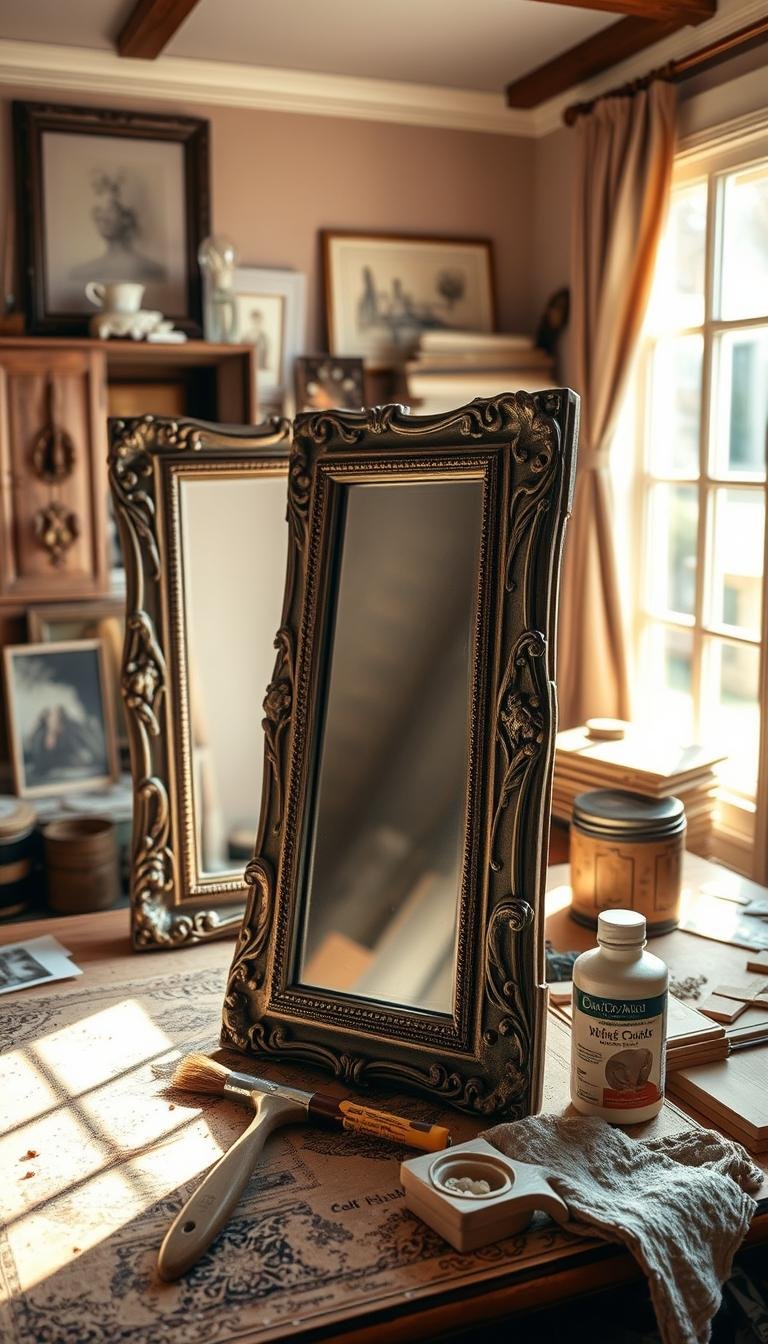
14. Vintage and antique mirrors
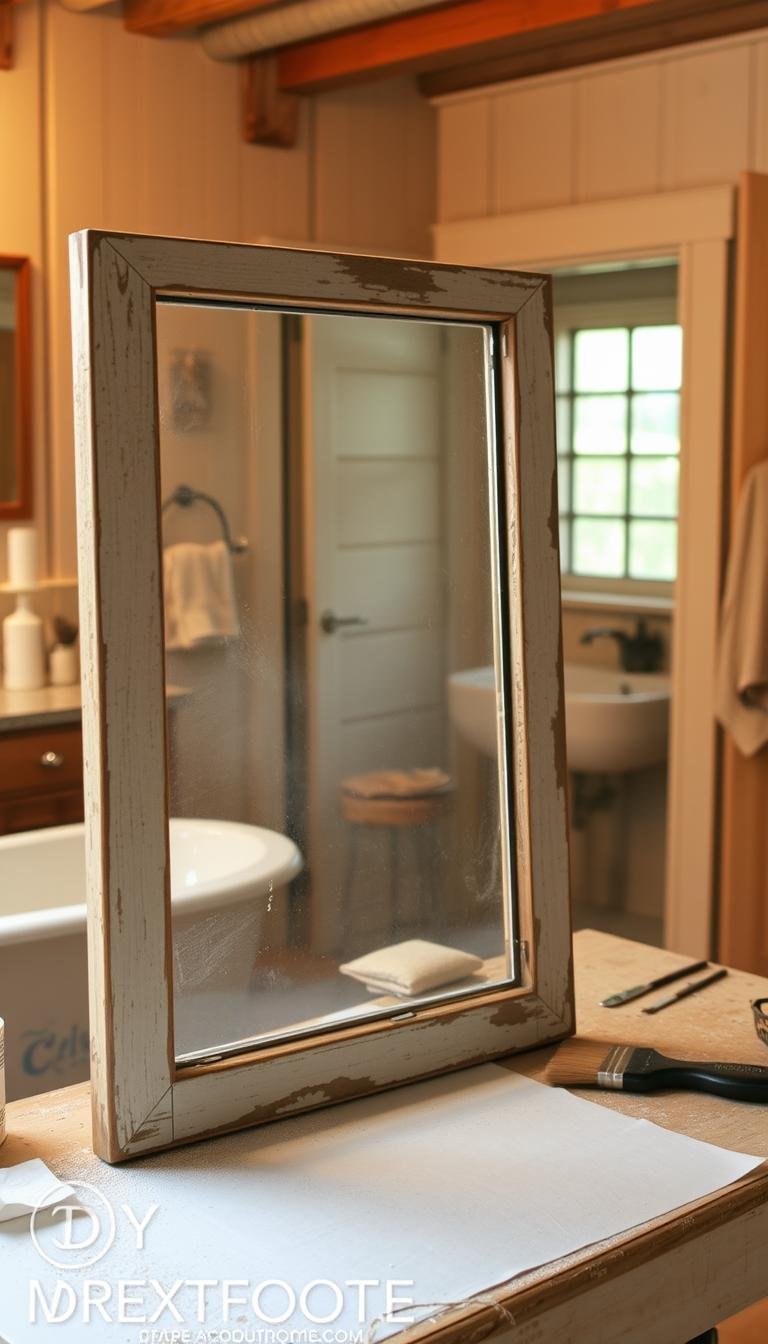
An older mirror can introduce patina and irregularity into an otherwise new bathroom. Before mounting, inspect the frame, backing, hanging hardware and glass condition rather than assuming an old installation system is still safe.
Vintage frames can be paired with new mirror glass when the original glass is damaged or unsuitable, preserving the decorative object while updating the functional component.
15. Mirrors over wallpaper or patterned tile
When the wall finish is already busy, the mirror should either provide strong visual contrast or deliberately recede.
A thin frame often works because it gives the mirror a clear boundary without adding another pattern. Frameless glass can also work when the wall finish is intended to remain visible around the edges.
Remember that the mirror reflects the pattern elsewhere in the room, so a small print may visually multiply more than expected.
How mirror style connects to the rest of the vanity wall
The mirror should be considered with these entities rather than in isolation:
| Entity | Attributes to compare |
|---|---|
| Vanity | Width, cabinet color, sink position, countertop thickness |
| Mirror | Overall size, shape, frame, reflective area, weight |
| Lighting | Side/above/integrated, fixture width, glare, color quality |
| Wall finish | Paint, tile, wallpaper, stone, pattern scale |
| Plumbing/hardware | Faucet shape, metal finish, backplates, outlets |
| User | Sightline, height, storage and grooming needs |
Choose the shape by what the room needs
Need more vertical emphasis? Compare tall rectangles, arches and ovals.
Need to soften hard geometry? Compare rounds, arches and rounded-corner rectangles.
Need maximum reflection? Compare large rectangles and frameless spans.
Need storage? Compare medicine cabinets rather than decorative mirrors.
Need integrated task lighting? Compare powered LED mirrors with ordinary mirrors plus sconces.
Do the full-size tape test
Before buying, tape the exact outside shape on the wall. Include the frame width and mark nearby sconces, outlets and backsplash. View the mock-up from the doorway and from the sink.
This test reveals whether the mirror is too small, visually crowded or poorly aligned far more reliably than a style label such as “glamorous,” “modern” or “farmhouse.”
The Dwelanor approach
Pick the mirror that clarifies the vanity composition. Start with size and function, then use shape, frame and finish to reinforce the room’s design language.
Continue with our 48-inch vanity mirror sizing guide, anti-fog smart mirror guide, tiny bathroom spa ideas, and tub-surround materials guide.