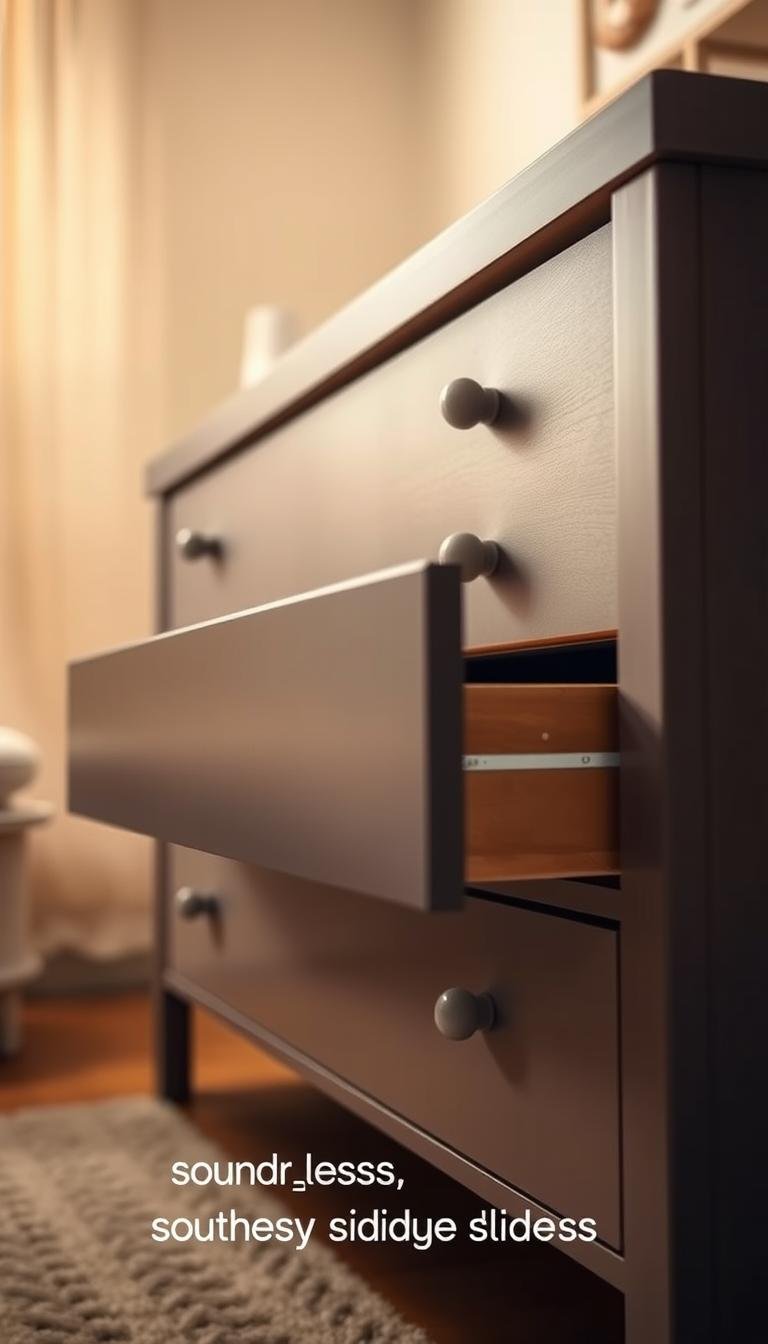
A quiet nursery dresser does not need a special “silent” drawer slide. It needs compatible, well-aligned hardware with controlled soft-close movement and enough load capacity for the drawer. A slide that binds, rebounds or lets the drawer front hit the cabinet will still sound loud no matter how it is marketed.
For an existing dresser, first check whether the noise comes from loose hardware, a drawer rubbing the cabinet, a damaged slide or the drawer front striking the frame. If replacement is justified, compare mount type, required clearance, slide length, load rating, soft-close mechanism and installation requirements.
What makes a drawer slide quieter?
Controlled deceleration
Soft-close hardware uses a damping mechanism to slow the drawer near the end of travel. The useful result is not “silence”; it is a controlled close that reduces the final impact between the drawer and cabinet.
Correct alignment
Even good slides can chatter or bind when they are not installed parallel and square. Before replacing hardware, tighten loose screws, inspect the drawer box for rubbing and check whether the cabinet itself is out of square.
Appropriate load rating
Choose a slide whose published load rating comfortably covers the drawer and its normal contents. Oversizing the rating does not automatically make the slide quieter, and the rating only applies when the hardware is installed as specified.
Stable drawer construction
A loose drawer front, thin bottom panel or flexible cabinet can create noise that gets blamed on the slides. Treat the dresser as a system rather than assuming the rail is always the problem.
Side-mount vs. undermount soft-close slides
| Type | Why consider it | What to verify |
|---|---|---|
| Side-mount soft-close | Often easier to inspect and retrofit on an existing dresser | Required side clearance, slide length, screw positions and drawer-box condition |
| Undermount soft-close | Concealed hardware and a clean visual finish | Exact drawer-bottom construction, rear notches/holes, locking devices and dimensional requirements |
Undermount is not inherently quieter in every dresser. It can feel refined when the drawer is designed for it, but converting a drawer box that was built for side-mount hardware can require substantial modification.
Start by identifying the existing hardware
Remove one drawer according to the dresser or slide manufacturer’s instructions and inspect the current setup.
- Is the slide mounted on the side or underneath?
- What is the slide’s actual length?
- How much clearance exists between the drawer box and cabinet?
- Are the screw holes damaged or enlarged?
- Does the drawer rub anywhere when the slide is disconnected?
- Is there a model number or manufacturer mark on the hardware?
If the exact replacement hardware is still available, replacing like-for-like may be easier than converting the drawer to another slide family.
Measure before ordering replacement slides
Do not order by a common size such as “18-inch” or “22-inch” without measuring the actual cabinet.
Record:
- Drawer-box depth. Measure the box itself, not only the drawer front.
- Cabinet depth. Make sure the chosen slide fits without hitting the back.
- Side clearance. Side-mount slides require the drawer and cabinet opening to match the manufacturer’s clearance specification.
- Drawer-bottom details. Undermount systems may require specific bottom thickness, setback, notches or rear holes.
- Expected load. Include the drawer weight and what will normally be stored inside.
Use the slide manufacturer’s dimensional drawing as the final authority. A generic clearance rule can be wrong for the exact system you buy.
How to diagnose a noisy nursery drawer before replacing anything
| Noise or behavior | Possible cause | First check |
|---|---|---|
| Hard thump at the end | Soft-close mechanism missing, worn or not engaging | Inspect the damper and engagement point |
| Grinding or scraping | Drawer rubbing or damaged slide | Look for wear marks and alignment problems |
| Clicking | Loose screw, moving bracket or latch | Tighten hardware to specification |
| Drawer rebounds open | Misalignment, obstruction or failed close mechanism | Check level, parallel installation and slide condition |
| Rattle while moving | Loose drawer front or cabinet components | Check the whole drawer assembly, not just the rail |
What features are actually worth paying for?
Soft-close mechanism
This is the main feature to prioritize when the problem is the final slam. Verify that the mechanism is built into the slide system rather than added as an unrelated accessory.
Full extension
Full-extension slides make the back of the drawer easier to reach. This does not inherently make them quieter, but it can improve usability in a changing station or dresser.
Disconnect or locking devices
Easy drawer removal can make cleaning and adjustment simpler. On undermount systems, check that the correct locking devices are included and compatible with the slide.
Replacement parts and documentation
A well-documented slide system is easier to install correctly and repair later. Clear dimensional drawings and readily available replacement clips, locks or slides can be more valuable than vague “premium quiet” marketing.
Do not buy by dresser brand alone
Two dressers from the same furniture brand can use different drawer hardware, and hardware can change between production runs. Identify the actual slide or measure the actual drawer before ordering a replacement.
If you are buying a new dresser, test drawer movement in person when possible: open the drawer partly and fully, close it gently, and see whether the soft-close mechanism engages consistently. Do not infer long-term quietness from a product name alone.
Can you retrofit soft-close slides to an existing dresser?
Often, but compatibility decides whether the job is straightforward.
A side-mount-to-side-mount replacement may be relatively simple when the length and clearance match. Converting to undermount hardware can require changes to the drawer bottom, rear, clearance and mounting points.
If the dresser is valuable, the drawer construction is unusual or the modification would weaken the box, use a cabinetmaker or furniture professional rather than forcing incompatible hardware into place.
Installation matters as much as the slide
Follow the exact manufacturer template or dimensional drawing. Small alignment errors can create resistance, uneven closing or noise.
- Install slides parallel to each other.
- Use the specified screws and mounting holes.
- Do not reuse damaged screw holes without an appropriate repair.
- Test one drawer through its full travel before modifying the rest of the dresser.
- Load the drawer gradually and confirm the soft-close mechanism still engages normally.
What should you avoid?
- Buying a slide only because a marketplace listing calls it “silent.”
- Assuming polymer, ball-bearing or undermount automatically means quieter.
- Using a higher load rating as a substitute for correct fit.
- Mixing components from unrelated slide systems.
- Adding felt, grease or improvised dampers where the hardware manufacturer does not recommend them.
- Converting drawer boxes without checking the structural requirements of the new system.
Nursery safety matters more than drawer noise
A dresser in a nursery is also a child-safety issue. The U.S. Consumer Product Safety Commission advises securing top-heavy furniture and following the manufacturer’s anchoring instructions. Current U.S. clothing-storage-unit requirements under the STURDY law are intended to reduce tip-over hazards for young children.
CPSC Anchor It! furniture tip-over guidance
CPSC clothing storage unit requirements and FAQs
Do not let a quieter close create a false sense that the dresser itself is safe. Install anti-tip restraints and use the furniture according to the manufacturer’s instructions.
So what are the quietest drawer slides for a nursery dresser?
Choose a compatible soft-close system that fits the existing drawer box precisely and closes smoothly under its normal load. For many retrofits, side-mount soft-close slides are the simplest place to start. Undermount soft-close slides can provide a clean, refined result when the drawer is designed for them.
The “quietest” hardware is the system that is correctly sized, aligned and installed in a rigid drawer and cabinet—not the product with the strongest silence claim.
For related nursery and bedroom planning, see choosing quieter nursery closet doors, diagnosing a creaking bed, and the Dwelanor Room Guides.