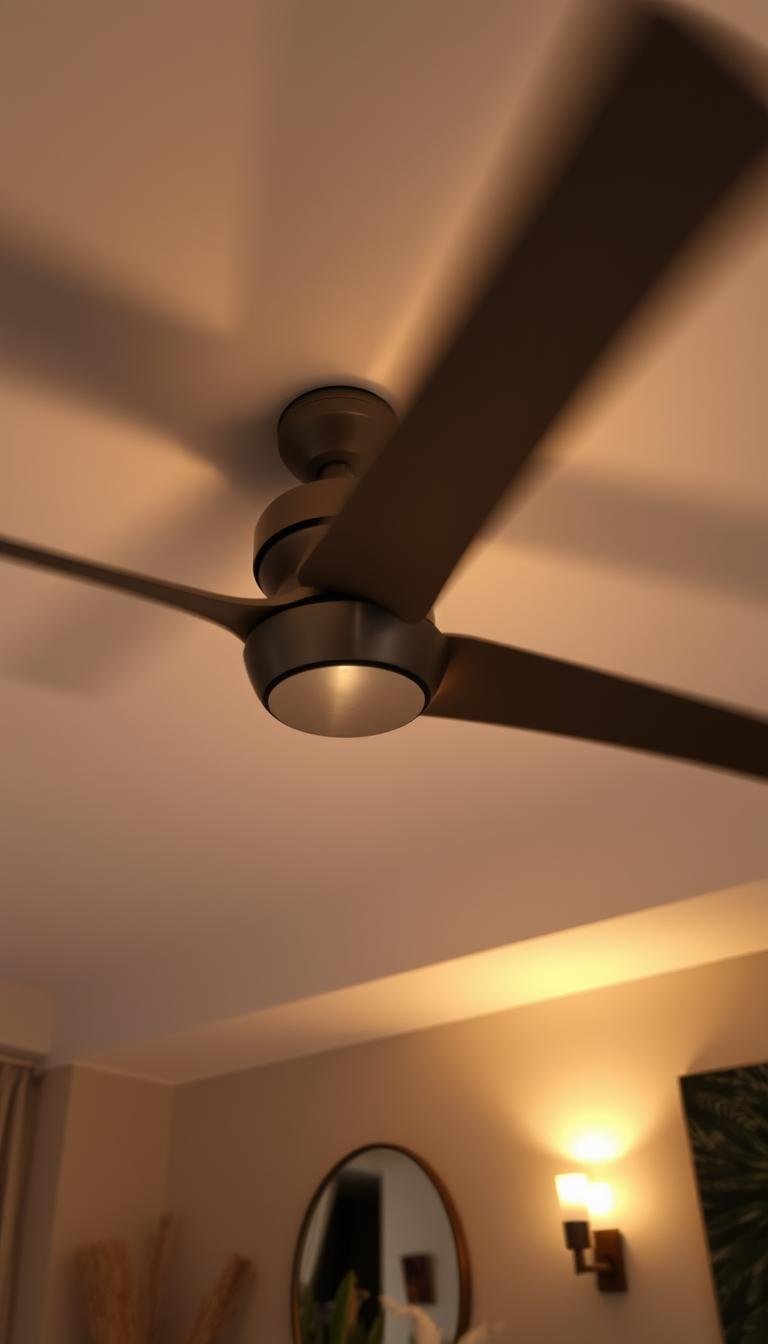
The quietest ceiling fan is usually the one that can move enough air without needing to run flat-out. That means motor quality matters, but so do blade balance, fan size, mounting, and the way the light kit and controls are built.
For bedrooms and living rooms, start with a model from a manufacturer that publishes real airflow and efficiency data, then choose the span and mounting style for the room. A quiet motor cannot compensate for a loose bracket, badly balanced blades, or a fan that is too small and has to run at high speed all evening.
What actually makes a ceiling fan quiet?
Noise usually comes from one of four places: the motor, moving air, vibration through the mounting hardware, or electronics in the light kit or control system.
Motor quality
DC motors are common in quieter premium fans because they offer smooth speed control and efficient low-speed operation. That does not make every DC fan silent, and it does not mean a well-made AC fan will be noisy. Hunter, for example, still sells quiet fans built around its WhisperWind AC motor as well as newer high-efficiency designs.
Blade balance
A fan that wobbles will usually sound worse over time. Precision-balanced blades, rigid blade arms, and a properly seated motor housing reduce the small vibrations that turn into clicks, rattles, and ceiling resonance.
Blade shape and airflow
More blades do not automatically mean less noise. Blade pitch, shape, stiffness, and the amount of air the fan can move at a lower speed are more useful things to compare. Hunter says its SureSpeed range uses optimized motors and precision blades to produce higher air velocity while maintaining quiet, wobble-free operation.
Mounting
This is the part shoppers often underestimate. The fan must be attached to a ceiling box and hardware rated for ceiling-fan loads, and the canopy, downrod, blade arms, and light kit all need to be secure. If the box flexes or a bracket sits unevenly, even a good fan can sound cheap.
Do not shop by an unsupported decibel number
Many ceiling-fan listings do not publish a standardized sound test, so comparing one brand’s “30 dB” claim with another brand’s marketing copy is not especially useful. Unless the manufacturer explains how and where the measurement was taken, treat the number cautiously.
A better shortlist uses data that manufacturers and certification programs routinely publish:
- high-speed airflow in CFM;
- airflow efficiency in CFM per watt;
- number of usable speed settings;
- motor type;
- fan span and mounting options;
- indoor, damp, or wet-location rating;
- warranty and replacement-parts availability.
ENERGY STAR also publishes minimum airflow and efficiency requirements for certified ceiling fans, so the label is useful when energy performance matters. ENERGY STAR says certified ceiling fans are up to 44% more efficient than conventional models.
Choose the fan for the room, not the product photo
Bedroom
For a bedroom, low-speed behavior matters more than maximum airflow. Look for multiple speed settings, stable mounting, and controls that are easy to use from bed. If the fan has an integrated light, check whether the light can dim independently and whether reviewers report buzzing from the driver or receiver.
Living room
A living room often needs more airflow because the room is larger or more open. Here, a slightly larger fan that can move the required air at a lower speed is usually preferable to a small fan running at maximum speed.
Low ceilings
Use a low-profile or hugger model designed for that ceiling height rather than shortening parts that were not designed to be modified. Low-profile fans can still be quiet; what matters is that the model is engineered for flush mounting.
Tall or vaulted ceilings
A correctly sized downrod can improve airflow and keep the fan away from the ceiling surface. Follow the manufacturer’s installation chart instead of using a generic downrod formula, especially on sloped ceilings.
What “designer” should mean here
A designer-looking fan should work with the room rather than becoming the room’s main visual event. In most interiors, the easiest details to live with are a simple motor housing, restrained blade shape, one consistent finish, and a light kit that does not look tacked on.
For warm or collected rooms, wood-toned blades or softer bronze finishes often integrate better than high-contrast glossy hardware. In cleaner modern rooms, a three-blade fan with a simple matte finish usually disappears more easily.
The practical point is to choose the silhouette before the decorative extras. A fan that looks good in a staged photo but hangs too low or feels visually oversized will never look intentional.
AC or DC motor?
| Motor type | Typical strengths | What to watch |
|---|---|---|
| DC | Fine speed control, efficient low-speed operation, often lighter motor housing | Electronics and replacement controls can be model-specific |
| AC | Long-established technology, many proven designs, often simpler controls | Fewer speed steps on some models; quality varies widely |
Do not reject a fan simply because it uses an AC motor. Hunter’s current Presto Low Profile, for example, uses a reversible AC motor while the manufacturer markets it for quiet, wobble-free operation. Build quality matters more than the motor label alone.
How to compare two fans before buying
If two designs both suit the room, compare them in this order:
- Correct size and mounting type. Eliminate anything that does not fit the room or ceiling.
- Published airflow. Make sure the fan can actually move enough air for the space.
- Low-speed control. More usable speed steps make it easier to find a quiet setting.
- Balance and mounting design. Look for a solid canopy, rigid blade arms, and a manufacturer with replacement parts.
- Light quality. If you need a light, check lumens, color temperature, dimming behavior, and whether the light can be controlled separately.
- Warranty and service. A quiet fan is not a bargain if a proprietary receiver fails and cannot be replaced.
A note on smart controls
Smart features are convenient, but they should be treated as a control layer, not as proof of better fan engineering. App control, voice assistants, and schedules can be useful in a bedroom or open-plan room, but the fan still needs good mechanical balance and reliable electronics.
If smart control matters, check what still works when Wi-Fi is down and whether the fan can also be operated from a wall control or remote.
How to keep a quiet fan quiet
Most long-term noise problems are mechanical rather than mysterious. If a previously quiet fan starts clicking or wobbling, check for dust buildup, loose blade-arm screws, a loose canopy, or a light-kit component that has started to vibrate.
- Clean blades evenly so one side does not accumulate much more dust than another.
- Tighten visible hardware to the manufacturer’s instructions; do not overtighten plastic or light-kit parts.
- Use the balancing kit supplied with the fan if wobble appears.
- If you hear electrical buzzing from a receiver, dimmer, or light driver, use compatible controls and replacement parts rather than improvising.
- If the mounting box moves, stop using the fan until the support is checked.
So what should you look for?
For a quiet ceiling fan that still looks considered, prioritize the boring engineering first: correct size, solid mounting, balanced blades, useful low speeds, and a manufacturer that publishes real performance data. Then choose the finish and silhouette that fit the room.
That approach is less glamorous than a permanent “best fan” ranking, but it ages better and is far more useful. Product lines change. The reasons a fan stays quiet do not.
For more room-planning help, see the Dwelanor Room Guides, our guide to under-cabinet lighting, and the app-controlled reversible ceiling fan guide.