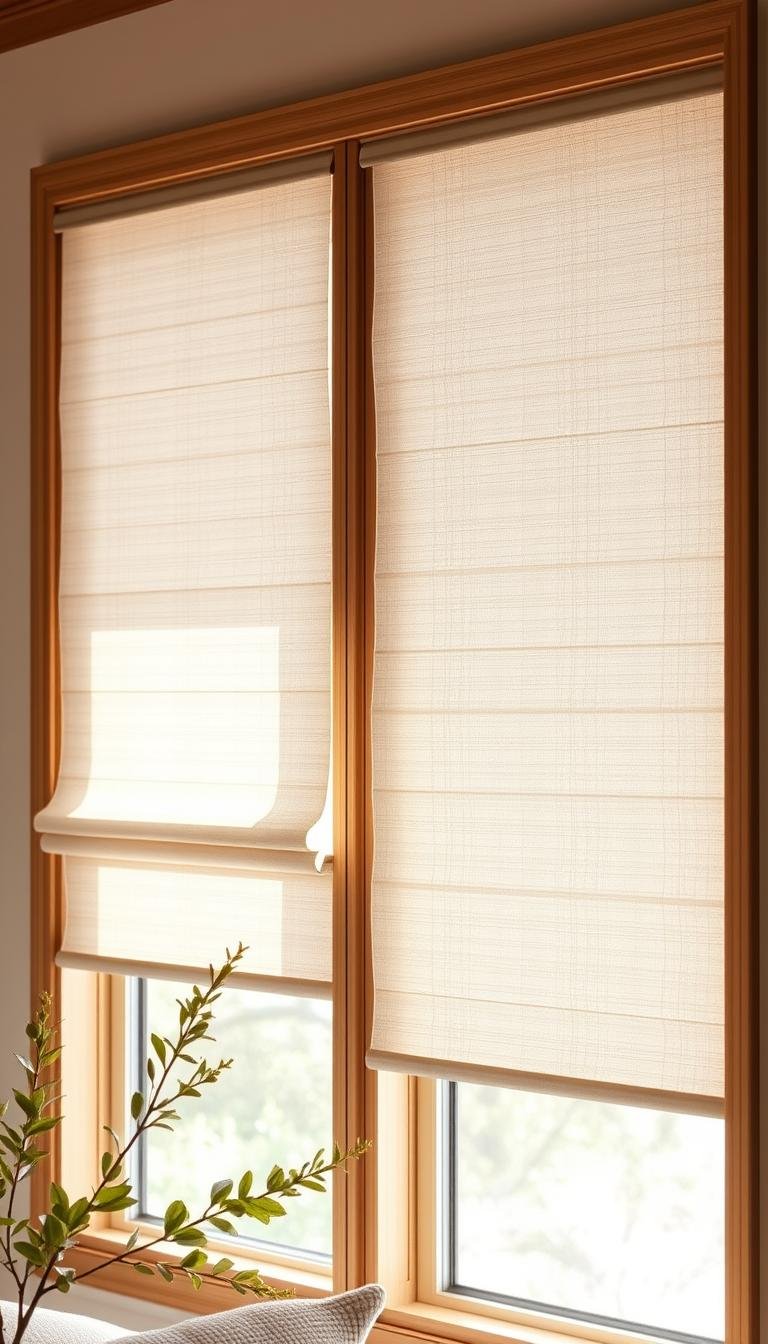
Linen-look roller shades can give you the soft, woven appearance of fabric without the bulk of curtains, but the best value is not determined by one advertised price. Width, drop, fabric, opacity, control type and hardware can all change the final cost. Start by finding a convincing matte weave in the right light-control category, then compare the made-to-measure price for your actual window.
If your goal is an affordable shade that looks more like linen than plastic, prioritize texture, low sheen, neutral colour, a straight hem and tidy hardware. Those details do more for the finished look than a brand name or a temporary sale price.
What makes a roller shade look like linen?
The visual effect comes mainly from the face fabric. Look for a subtle woven texture, small variations in the yarn appearance and a matte finish. A perfectly smooth or shiny surface usually reads more like vinyl, even when the colour is called linen, flax or oatmeal.
Useful colours include warm white, ivory, oatmeal, beige, greige and soft grey. The safest choice is the one that works with the room’s wall colour and natural light rather than the colour name on a website.
- Matte rather than glossy surface
- Visible but restrained woven texture
- Neutral colour that works in daylight and at night
- Straight bottom rail or hem
- Hardware that does not visually dominate the fabric
Choose light control before you compare prices
Two shades can look almost identical in a product photo and behave very differently once installed. Decide what the room needs before choosing a fabric.
Light-filtering roller shades
These are usually the best fit for living rooms, dining areas and home offices where you want to soften daylight rather than eliminate it. A textured light-filtering fabric often shows the linen effect particularly well because daylight reveals the weave.
Privacy varies. Some fabrics that look opaque from inside during the day become more transparent when interior lights are on at night. Check the manufacturer’s privacy description or order a sample if the window faces a street or neighbour.
Room-darkening shades
Room-darkening fabric reduces more light but does not necessarily create a fully dark bedroom. It can be a useful middle ground when you want more privacy and glare control without the heavier appearance of a blackout backing.
Blackout roller shades
For bedrooms and media rooms, compare fabrics specifically described as blackout by the manufacturer. The fabric itself is only part of the result: light can still enter around the sides of an inside-mounted shade.
If darkness matters more than showing the window trim, an outside mount with enough overlap can reduce those edge gaps. Our guide to blackout window treatments that still look residential covers the same trade-off in more detail.
Inside mount or outside mount?
Inside mount places the shade within the window recess. It gives a clean, built-in look and leaves the trim visible, but the roller mechanism normally requires some clearance and can leave narrow light gaps at the sides.
Outside mount places the shade over the opening. It can visually enlarge the window and provide more overlap for privacy or darkness, but it covers more trim and needs enough flat mounting surface around the opening.
Do not rely on a generic deduction rule. Measure the window and follow the exact measuring instructions for the shade system you are considering, because manufacturers handle inside-mount deductions differently.
How to measure without creating an expensive mistake
- Decide on inside or outside mount first. The measurements are not interchangeable.
- Measure each window separately. Even windows that appear identical can vary slightly.
- Use a rigid metal tape measure. Record the dimensions in the units requested by the manufacturer.
- Check mounting depth. An inside mount needs enough recess depth for the brackets and roller or cassette.
- Check obstructions. Handles, locks, tile, trim and deep window cranks can affect placement.
- Follow the seller’s ordering rules. Do not make your own width deductions unless the instructions explicitly tell you to.
If a retailer offers samples, order them before placing a large multi-window order. A small swatch can reveal shine, colour undertone and openness that product photography hides.
Cordless, chain-operated or motorized?
| Control type | Why consider it | What to check |
|---|---|---|
| Cordless | Clean appearance and simple manual operation | Maximum width/weight, reach height and operating feel |
| Continuous-loop chain | Useful leverage on some larger shades | Current safety hardware and installation requirements |
| Motorized | Convenient for tall, wide or hard-to-reach windows | Battery access, charging, remote/app compatibility and replacement parts |
Choose the simplest system that fits the window and the people using it. For every control type, follow the current installation and safety instructions supplied with the product.
Do you need a cassette or valance?
A cassette or valance hides the roller and brackets. It is not essential, but it can make a budget shade look more finished because the hardware becomes less noticeable.
If the upgrade substantially increases the price, compare that cost with the visual benefit. In a casual room, an exposed roll in a matching finish may be perfectly acceptable. In a living room where the shade is a major design element, a neat cassette can be worth more than spending extra on a slightly more elaborate fabric.
Linen-look polyester vs real linen
Many linen-look roller fabrics are synthetic or blended rather than pure linen. That is not automatically a disadvantage. Roller shades need dimensional stability so they can roll evenly and stay relatively flat.
Judge the material by the things that matter in use: appearance, opacity, cleanability, stability, care instructions and suitability for the room. If material composition or textile certifications matter to you, verify the exact current product documentation rather than assuming that a linen-like appearance describes the fibre content.
Which rooms benefit most?
Living room
A light-filtering woven shade works well when you want daylight with a softer, quieter window treatment. If the room already has a rug, textured upholstery and other fabric, keep the shade pattern restrained.
Bedroom
Prioritize darkness and privacy before texture. A linen-look blackout fabric can combine both, but mounting method and side gaps still matter. If street noise or sleep disruption is also a concern, compare our guide to quiet window coverings for bedrooms.
Home office
Light filtering is often more useful than full blackout because it can reduce glare without making the room cave-like during the day. Position the shade based on the window and screen rather than choosing opacity from appearance alone.
Kitchen or bathroom
Check whether the exact fabric and hardware are approved for the humidity and cleaning conditions of the room. A linen look does not automatically mean a material is suitable near sinks, steam or frequent splashes.
How to compare affordable options fairly
A headline starting price is rarely the final number for your window. Compare the same specification across sellers:
- finished width and drop;
- light-filtering, room-darkening or blackout fabric;
- inside or outside mounting hardware;
- control type;
- cassette or valance, if desired;
- shipping or oversized-item charges;
- sample availability;
- measurement or remake policy;
- warranty and replacement-parts support.
A shade that costs a little more but includes the right size, reliable hardware and a useful fit policy can be better value than an unusually cheap listing that becomes difficult to return or replace.
Can you really get linen-look roller shades for around $29?
Sometimes a small ready-made shade or promotional entry size may be advertised around that level, but it is not a reliable budget for every window. Larger dimensions, custom sizing, blackout fabric, cassettes and upgraded controls can all raise the price.
Use $29 as a possible sale or small-size starting point, not as the standard cost of a properly fitted linen-look shade. Compare the final configuration you actually need.
Common mistakes
- Choosing by colour name alone. “Linen” can describe colour rather than texture.
- Buying blackout fabric but ignoring side gaps. Mounting can matter as much as the material.
- Ordering several windows before seeing a sample. Texture and undertone are difficult to judge on a screen.
- Assuming every window is the same size. Measure each opening.
- Paying for features you will not use. Motorization and decorative cassettes are valuable only when they solve a real problem.
- Ignoring serviceability. Check how batteries, controls, brackets or replacement parts are handled before buying a complex system.
The simplest way to choose
Start with the room’s light and privacy requirement. Then choose a matte woven fabric that genuinely looks good in a sample, measure for the exact mounting type, and compare final prices using the same size and options.
For most living spaces, a neutral light-filtering linen-look shade with simple hardware is the easiest combination to get right. For bedrooms, prioritize blackout performance and mounting overlap first. For more window and room-planning ideas, browse the Dwelanor Room Guides.