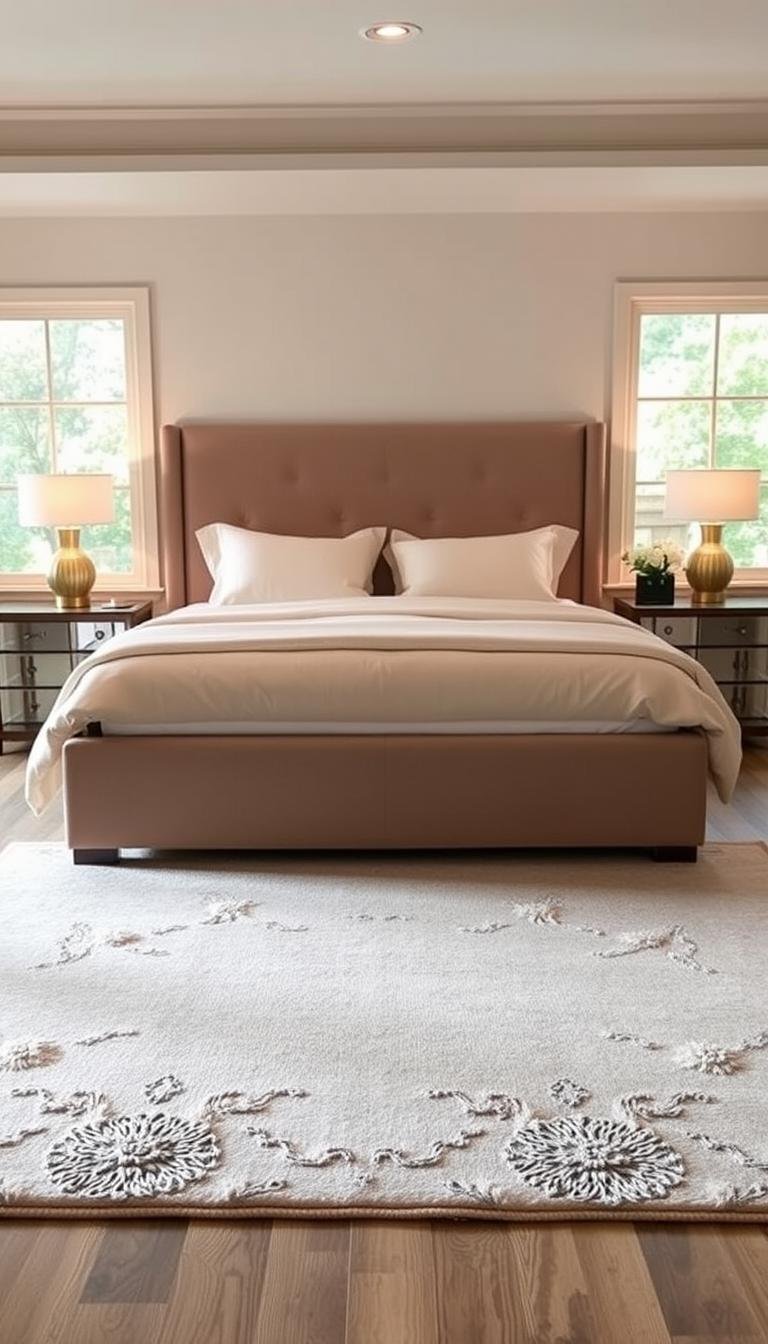
A 9 × 12-foot rug is a useful starting size for many king-bed layouts, but it is not automatically the right answer. The correct rug depends on the bed frame, nightstands, bench, room width, door clearances and how much soft flooring you want beside the bed.
The most reliable method is to decide which furniture should sit on the rug, then tape that rug footprint on the floor before ordering. For a standard king mattress, 9 × 12 often provides a comfortable amount of rug beside and beyond the bed; tighter rooms may work with an 8 × 10 placed under the lower portion of the bed, while larger rooms may need 10 × 14 or more.
Common rug sizes under a king bed
| Rug size | Typical use | What to check |
|---|---|---|
| 8 × 10 | Lower portion of bed, often with nightstands off the rug | Whether enough rug remains beside the bed for a comfortable step |
| 9 × 12 | Useful starting point for many king bedrooms | Bed-frame width, nightstand placement and room perimeter |
| 10 × 14 | Larger rooms or layouts that include more furniture on the rug | Door swing, dresser clearance and whether the rug overwhelms circulation |
| Side runners | Narrow rooms or budgets where a large area rug is impractical | Stable placement and consistent spacing beside the bed |
These are layout patterns, not rules. Rug dimensions vary by manufacturer, and bed frames can be considerably wider or longer than the mattress itself.
Measure the bed frame, not only the mattress
A standard king mattress is typically about 76 × 80 inches, while a California king is typically about 72 × 84 inches. The actual furniture footprint can be larger because of rails, upholstery, a platform, headboard wings or a footboard.
Measure:
- the full outside width of the bed frame;
- the full frame length if the rug will extend under most of the bed;
- the nightstand width and position;
- any bench or ottoman at the foot;
- the clear floor area between furniture, doors and walls.
Should the nightstands sit on the rug?
Either arrangement can work. What matters is that it looks deliberate and the furniture remains stable.
Nightstands off the rug
This is common when an 8 × 10 or smaller rug starts farther down the bed. It saves rug area near the headboard and can work well in a tighter room.
Nightstands on the rug
A larger rug can extend far enough toward the headboard to support the nightstands as part of one anchored furniture group. Check that all legs sit securely rather than leaving one leg on a thick rug edge.
Do not force the nightstands onto a rug simply because a diagram says they belong there. Stable placement and the room proportions matter more.
How much rug should show beside a king bed?
Design guides often use roughly 18–24 inches of visible rug beside a bed as a starting reference, but treat that as a visual test rather than a mandatory clearance. A wide upholstered frame may need more rug; a compact room may have less available floor.
The practical question is: when you get out of bed, do your feet land comfortably on the rug without the rug edge creating an awkward transition in the walkway?
Use painter’s tape to mark candidate rug edges and walk the room before buying.
How much bare floor should remain around the rug?
There is no universal 10-, 12- or 20-inch rule around bedroom rugs. The visible border depends on room size, baseboards, furniture placement and the relationship to nearby doors.
A rug usually looks more intentional when it has some breathing room rather than nearly touching every wall, but use the room itself as the reference. In a very large bedroom, a larger border may look natural; in a compact room, insisting on a wide border can force the rug too close to the bed.
Three reliable placement approaches
1. Rug under the lower portion of the bed
Place the rug so it begins in front of the nightstands and extends beyond the foot of the bed. This can make an 8 × 10 useful in a smaller king bedroom while still providing soft floor beside the lower half of the bed.
2. Rug under most of the bed and nightstands
A larger rug, often around 9 × 12 or 10 × 14 depending on the room, can support the bed and nightstands as one group. This creates a more expansive visual anchor but requires more width near the headboard.
3. Runners beside the bed
Two runners can provide a soft landing without covering the center of the room. This is useful in narrow bedrooms, rooms with vents or doors that complicate a large rug, or where a smaller budget is a priority.
What about a bench at the foot of the bed?
If the bench should sit on the rug, include its full footprint in your tape mock-up. Make sure its legs do not straddle a thick rug edge, which can make the bench feel unstable.
If the room is tight, the bench can sit beyond the rug or be omitted. Do not size the entire rug around a bench that makes circulation worse.
King bed versus California king
A California king is narrower and longer than a standard king, so a rug can relate differently to the frame even when the room is the same size. Do not automatically move up one rug size solely because the bed is a California king.
Measure the real frame and tape the candidate footprint. A long frame may need more rug at the foot while still fitting comfortably within the same room width.
Door clearance and pile height
Rug sizing is not only visual. Check whether bedroom, closet and ensuite doors will clear the rug and pad. A thick pile plus a cushioned pad can interfere with a door that appears to have enough clearance on bare flooring.
Also check dresser drawers, under-bed storage and any furniture that moves across the rug edge.
Use a rug pad that suits the floor and rug
A rug pad can improve grip, cushioning and protection, but the correct material depends on the floor finish and rug backing. Follow the flooring and rug-pad manufacturer’s compatibility guidance, especially on hardwood, vinyl, laminate or radiant-heated floors.
For more detail, see our guides to rug pads for carpet and hardwood and rug pads over radiant heat.
A five-minute tape test before buying
- Measure the outside dimensions of the bed frame.
- Decide whether the nightstands and bench should be on or off the rug.
- Mark an 8 × 10, 9 × 12 or 10 × 14 footprint with painter’s tape where it would actually sit.
- Walk both sides and the foot of the bed.
- Open every nearby door and drawer.
- Stand in the doorway and judge the overall proportion.
This test is more reliable than choosing a size from a generic bedroom diagram because it includes the furniture and circulation in your real room.
So what is the ideal rug size for a king bed with nightstands?
Start by testing a 9 × 12 footprint, then adjust to the room. Use an 8 × 10 when the nightstands will remain off the rug and the room is tighter. Move to 10 × 14 or larger when the bedroom has enough floor area and you want the rug to anchor the bed, nightstands and possibly a bench together.
The right size is the one that gives comfortable rug exposure beside the bed, keeps furniture stable, clears doors and leaves the room looking balanced.
For related bedroom planning, see choosing a headboard around a low window, planning bedside sconce placement, and the Dwelanor Room Guides.