
For an apartment, the safest indoor swing chair is usually a freestanding model with a manufacturer-rated stand, because it avoids guessing about ceiling structure. If you want a ceiling-hung chair, treat the attachment point as a structural installation rather than a decor project.
Before buying, compare the chair and stand’s published load rating, required clearances, floor footprint, assembly instructions, and any lease restrictions. Do not create your own safety margin or substitute unverified hardware.

Freestanding or ceiling-hung?
Freestanding swing chair
This is the simpler choice for most renters. Look for a complete system where the chair, suspension point and stand are designed to work together. Check the manufacturer’s rated capacity, base dimensions, anti-slip feet and assembly instructions.
Ceiling-hung chair
A ceiling-hung chair needs an attachment point capable of handling the dynamic loads created by movement. Drywall, plaster and decorative ceiling finishes are not structural supports. Because ceiling construction varies, use the chair manufacturer’s installation requirements and have the structure evaluated by a qualified installer or building professional when there is any uncertainty.
Also check your lease or building rules before drilling or altering the ceiling.
What safety specifications actually matter?
| Check | Why it matters |
|---|---|
| Published load rating | Confirms the limit for the complete chair or stand system |
| Compatible suspension hardware | Prevents mixing components that were not designed to work together |
| Stable base dimensions | Helps reduce tipping risk on a freestanding model |
| Required clearance | Keeps the chair away from walls, glass, lamps and other hazards |
| Assembly and inspection instructions | Defines how the maker expects fasteners and moving parts to be maintained |
Avoid generic rules such as adding an arbitrary percentage to the user’s weight. Follow the exact rating and use conditions supplied for the product.
Plan the swing path before you buy
Measure the chair at rest and consider the space it can occupy while moving. Keep the swing path clear of walls, windows, lighting, shelving, sprinkler heads and sharp furniture edges.
On a freestanding model, confirm that the entire base sits flat on a stable floor. Thick uneven rugs can make some stands less stable, so follow the stand manufacturer’s surface guidance.
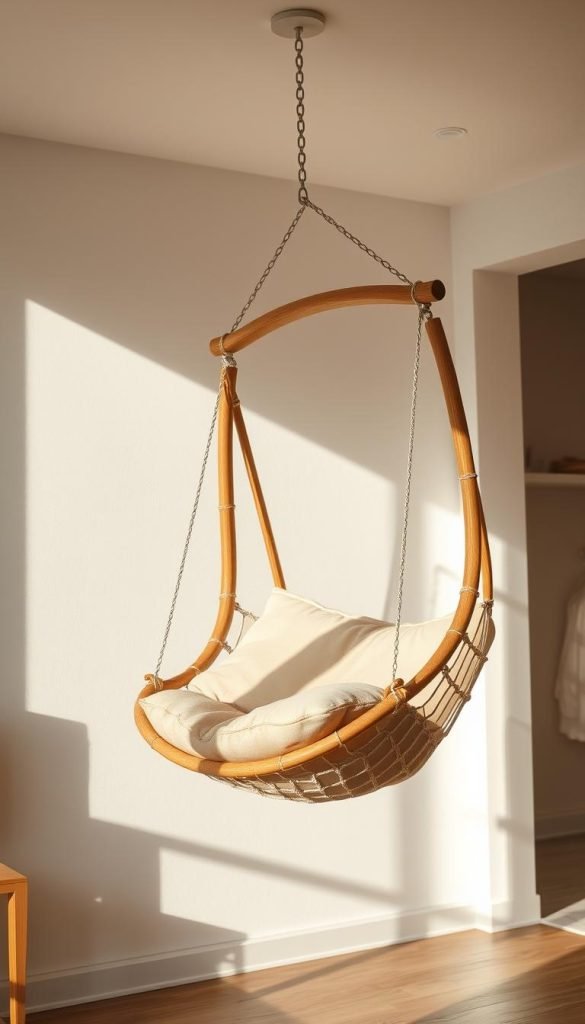
Do not improvise the hardware
Use the suspension hardware specified by the chair or stand manufacturer. Do not replace a supplied connector with an unrated hook, decorative carabiner, eye screw or general-purpose fastener just because it appears strong enough.
If a ceiling installation requires structural anchoring and you cannot positively identify the correct framing and attachment method, use a freestanding model or hire a qualified installer.
Apartment-friendly buying checklist
- Confirm whether the lease permits ceiling or wall attachment.
- Measure the floor footprint and swing clearance.
- Check the manufacturer’s complete-system load rating.
- Confirm that all suspension hardware is included or explicitly specified.
- Check whether the floor surface is suitable for the stand.
- Make sure the chair can be assembled and inspected without blocking exits or walkways.
- Review the maker’s maintenance and replacement guidance for moving parts.
Comfort without compromising stability
Cushions, breathable fabrics and supportive seat shapes can make a swing chair comfortable for reading, but they should come after the structural questions. Avoid adding bulky cushions or accessories if they interfere with the suspension system, balance, or clearance specified by the manufacturer.
Children and active use
Do not assume an adult-rated lounge chair is suitable for children’s play. Follow the product’s age and use restrictions, supervise children around moving furniture, and do not encourage climbing on the stand or suspension components.
A mat may protect flooring or reduce noise, but it does not make an unsafe mounting point safe and should not be treated as fall protection.
Inspection and maintenance
Follow the manufacturer’s inspection schedule. Stop using the chair if you notice loosened fasteners, damaged rope or fabric, bent metal, cracking, unusual movement, or deterioration at a mounting point.
Replace components only with parts approved for the system. If a ceiling attachment shows movement or damage, stop using it until the structure and hardware have been checked.
The simplest safe choice
For most apartments, a complete freestanding swing-chair system is the easiest option because the stand avoids unknown ceiling structure and is reversible when you move. If you choose a ceiling-hung chair, treat the mount as structural work and follow the exact product and building requirements rather than relying on generic DIY hardware advice.
For more small-space planning, see the small living room guide and the Dwelanor Room Guides.