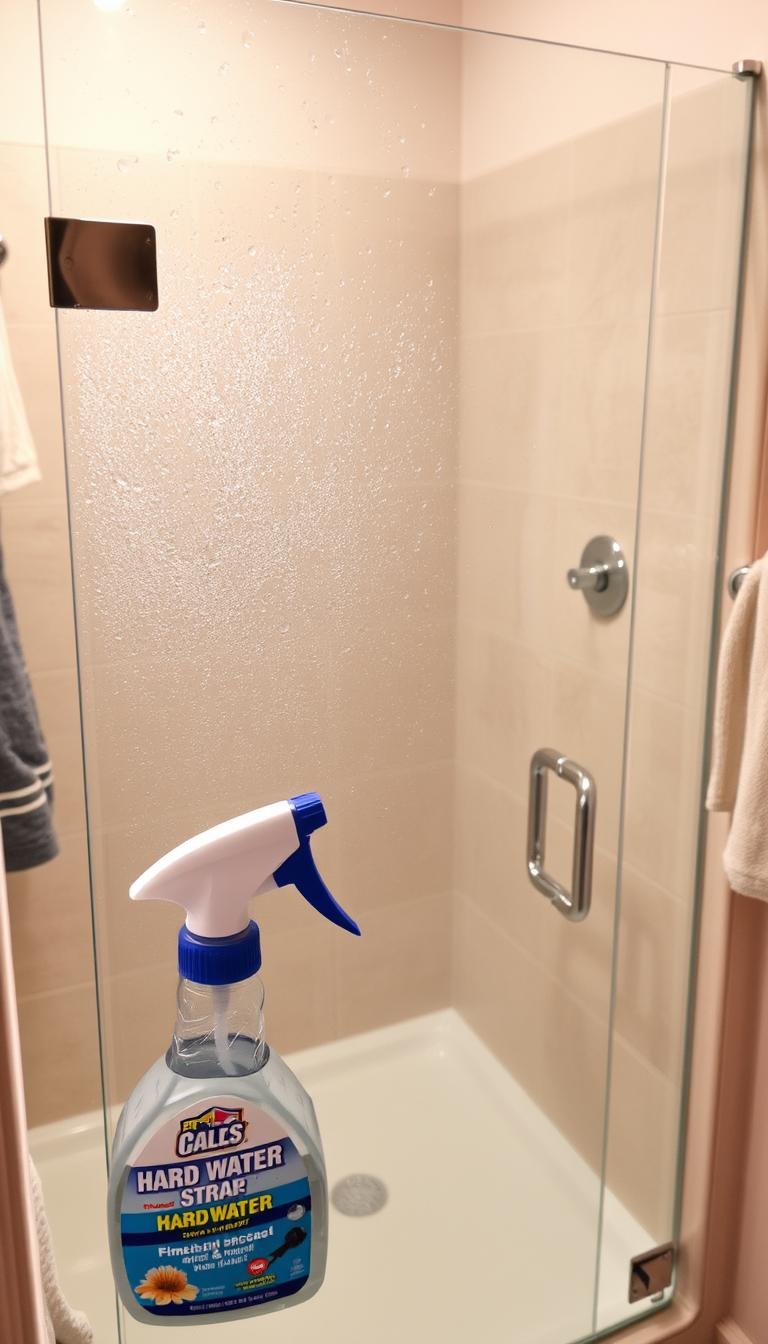
The best way to reduce hard-water spots on a glass shower door is to remove droplets before they dry, then clean the glass with products that are compatible with the glass, coatings, hardware and nearby stone or tile. Hard-water deposits are mainly minerals left behind as water evaporates; soap residue can make the film harder to remove.
The useful relationship is water hardness → mineral deposits → drying → glass/coating type → cleaner compatibility → daily prevention.
Start by identifying what is on the glass
Not every cloudy mark is the same problem.
- Fresh water spots: mineral residue left after droplets dry.
- Limescale/mineral buildup: repeated deposits that have accumulated over time.
- Soap residue: film from body products and soap mixed with water minerals.
- Etching or surface damage: marks that may not disappear with ordinary cleaning because the glass surface itself has changed.
- Coating haze: a protective treatment that has been cleaned or maintained incorrectly.
If you are unsure whether the door has a factory or aftermarket easy-clean coating, check the shower-door paperwork or ask the installer before using stronger cleaners.
Drying the glass is the highest-value habit
After showering, use a clean squeegee or microfiber towel to remove water from the glass. This reduces the amount of mineral-rich water that can evaporate on the surface.
Work from the top down and pay attention to the lower edge, corners and areas near the frame where droplets collect. The goal is simple: less water left behind means less material available to form a visible spot.
DFI, a manufacturer of hydrophobic shower-glass coatings, likewise recommends rinsing treated glass with clean water and removing remaining droplets with a towel or squeegee. See its current glass-care guidance.
Use the shower-door maker’s cleaning instructions first
Universal vinegar, baking-soda and essential-oil recipes are a poor default because shower enclosures combine several materials: glass, sealants, metal finishes, plastic components, tile, grout and sometimes natural stone.
A cleaner that is acceptable for one glass coating may be inappropriate for another finish or for the stone immediately beside it. Start with the door/coating manufacturer’s approved cleaner list and contact time.
If the shower glass is uncoated and the manufacturer permits a mild acidic cleaner for mineral deposits, follow that product’s dilution and rinse instructions rather than assuming a 50/50 vinegar mix is appropriate everywhere.
Avoid abrasive “scrub harder” fixes
Do not use abrasive pads, gritty powders, salt, razors or improvised polishing compounds unless the glass/coating manufacturer specifically approves them. Scratching or damaging a protective treatment turns a cleaning problem into a surface problem.
When buildup is heavy, use a restoration product specifically intended for the glass condition or consult the shower-glass installer. DFI, for example, sells separate restoration products for heavily mineral-stained glass and separate maintenance guidance for coated glass; that distinction matters.
Protect the hardware and seals too
Tracks, hinges, seals and metal finishes can collect the same mineral residue as the glass. Clean them according to their own material instructions rather than soaking the whole enclosure in one chemical solution.
Keep drainage channels clear and inspect seals for wear. Do not use harsh chemicals that may attack plated finishes, rubber components or silicone joints.
Ventilation helps the bathroom dry
Use the bathroom exhaust fan as intended and leave the enclosure open when the layout and manufacturer allow it so moisture can dissipate. Ventilation will not remove minerals from the water, but faster overall drying reduces persistent dampness around tracks, grout and textiles.
Good ventilation is part of the room system alongside the shower door, bath mat, towels and wet-area surfaces.
What about hydrophobic glass coatings?
Hydrophobic or easy-clean coatings change how water behaves on the glass and can make routine cleaning easier. They do not make a door maintenance-free.
Compare:
- whether the glass was factory treated or coated after installation;
- the approved cleaning products;
- maintenance frequency;
- warranty conditions;
- whether restoration or re-treatment is available.
For example, DFI states that its Diamon-Fusion coating is designed to make water and contaminants easier to remove and still recommends routine rinsing and droplet removal. Treat performance claims as specific to that coating, not as proof that every “nano” or water-repellent product works the same way.
When a water softener may help
If mineral deposits appear throughout the home—on fixtures, kettles, faucets and shower glass—the underlying water hardness may be contributing. A properly selected and maintained water-softening system can reduce calcium and magnesium hardness, but it is a whole-home water-treatment decision rather than a shower-door cleaning hack.
Before buying equipment, confirm the water conditions and consider maintenance, plumbing, water use and local requirements.
A practical maintenance routine
| Frequency | Task | Purpose |
|---|---|---|
| After showers when practical | Squeegee or towel-dry glass | Reduce mineral-rich droplets left to evaporate |
| Routine cleaning | Use cleaner approved for the glass/coating | Remove light film without damaging surfaces |
| Periodically | Clean tracks, edges and hardware per material guidance | Prevent concentrated buildup in hidden areas |
| When deposits persist | Use an approved mineral-removal/restoration method | Address established scale rather than scrubbing harder |
Common mistakes that make spotting worse
- Letting every shower dry naturally on the glass.
- Using a one-size-fits-all vinegar or abrasive recipe around coated glass, metal and stone.
- Cleaning the center pane but ignoring tracks and lower edges.
- Assuming a hydrophobic coating means no maintenance is required.
- Repeatedly scrubbing a mark that may actually be etched or damaged glass.
- Mixing cleaning chemicals.
How to tell when cleaning is no longer enough
If the glass remains cloudy after an approved mineral-removal process, the surface may be etched, scratched or otherwise damaged. At that point, stronger household chemistry is not necessarily the answer.
A shower-glass professional can help distinguish removable deposits from damage and advise whether restoration, coating or replacement is appropriate.
Connect the shower door to the rest of the bathroom
A clear shower enclosure is part of a wider wet-area system. The relevant entities include glass, coating, water hardness, tile, grout, sealant, metal hardware, ventilation, bath mat and towel-drying space.
Continue with our shower niche sizing guide, shower niche ideas, faster-drying bath mat guide, and tiny bathroom spa ideas.