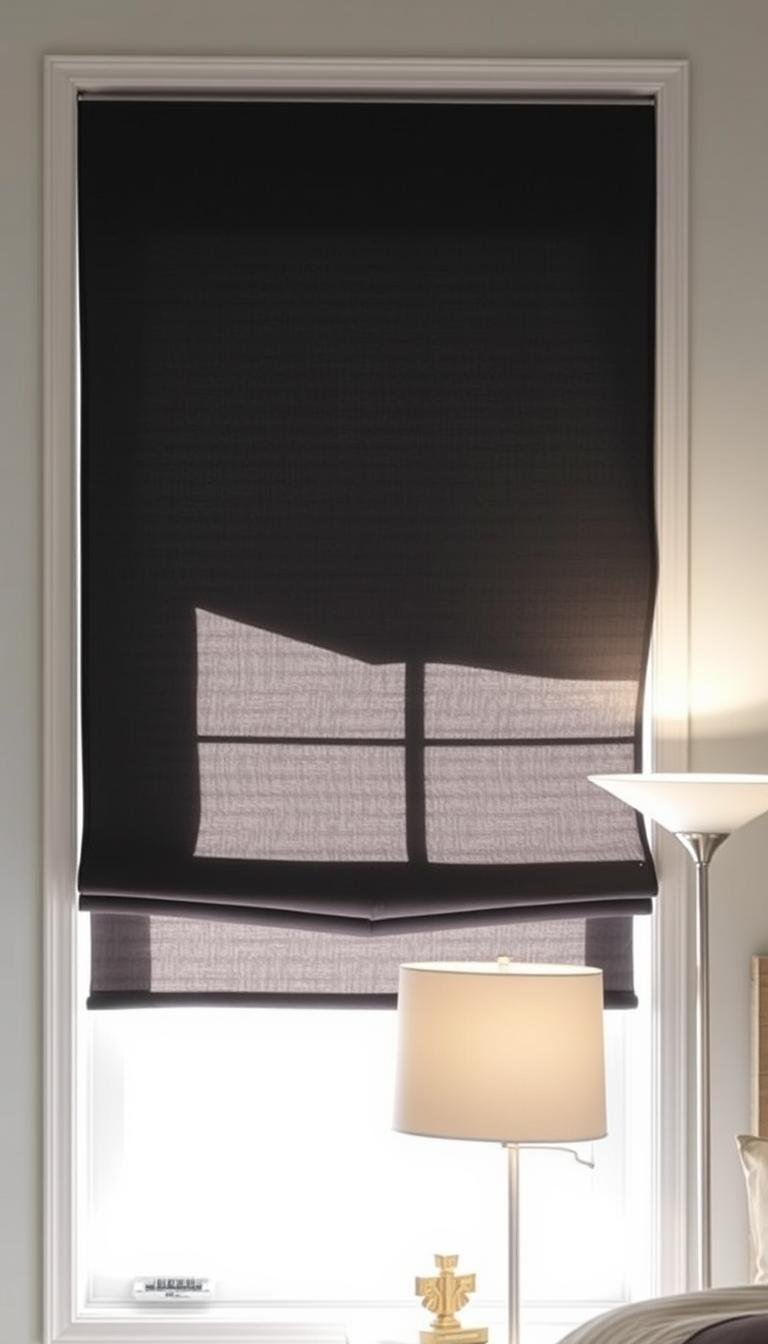
No Roman shade can promise “100% street-light blackout” from the fabric alone. The useful goal is to choose an opaque, cordless shade and install it so perimeter light is controlled as well as the window and room allow.
Key takeaways
- Separate fabric opacity from whole-window blackout performance.
- Cordless or motorized operation avoids accessible operating cords and is generally the preferred direction for homes with children.
- Measure the actual window in several places and follow the shade manufacturer’s sizing instructions.
- Outside mounting, overlap, side channels or layered drapery can reduce perimeter glow where appropriate.
- Do not rely on stale “best product” lists; verify current sizes, hardware, safety information and installation requirements before ordering.
Why “100% blackout” is usually a system question
A blackout lining or opaque shade material can prevent light from passing through the fabric while light still enters at the top, sides or sill. That is why two shades made from similarly opaque material can produce very different room-darkening results.
When evaluating a Roman shade, consider the fabric, headrail, mounting method, overlap and the geometry of the trim together.
Roman, roller or cellular?
Roman shades are useful when you want a softer, textile look. Roller shades provide a simple flat panel. Blackout cellular shades can combine room darkening with an insulating air-pocket structure. None of those categories automatically guarantees a completely dark room.
| Type | Typical strength | Common limitation |
|---|---|---|
| Roman | Decorative fabric appearance | Perimeter gaps depend heavily on fit and construction |
| Roller | Simple, compact panel | Side and top gaps can remain visible |
| Cellular | Insulation plus darkening options | Still depends on frame fit and edge treatment |
Choose the operating system carefully
For bedrooms used by children, check current window-covering safety requirements and the exact manufacturer instructions. Cordless and motorized systems remove the need for an accessible operating loop or pull cord.
If a product uses any accessible cord or chain, do not assume a generic wall cleat makes every setup equivalent to a cordless design. Install and use the product exactly as its manufacturer specifies and keep furniture that children can climb away from the window.
Measure for the actual mount
Inside and outside mounts have different measurement rules. Follow the manufacturer’s order instructions rather than subtracting or adding a universal number yourself; some manufacturers make their own deductions for inside mounts.
For an outside mount, the desired overlap depends on trim, wall space, hardware and how much edge glow you want to reduce. Tape the proposed coverage area on the wall before ordering if the proportions are uncertain.
How to reduce perimeter light
- Use an outside mount when the product and wall layout allow useful overlap.
- Choose a wider covering only within the manufacturer’s mounting and sizing rules.
- Consider side channels or purpose-built light-blocking accessories if they are compatible with the shade.
- Layer curtains over the shade when you need more edge coverage and the room layout supports it.
- Address top and sill gaps as part of the system rather than expecting denser fabric to solve them.
What to compare before buying
Look beyond product names and marketing phrases such as “total blackout.” Check the current specification sheet for:
- cordless or motorized operation;
- blackout lining or stated fabric opacity;
- inside/outside mount requirements;
- minimum window depth and bracket dimensions;
- available width and length;
- care instructions;
- included mounting hardware;
- warranty and return terms, especially for custom sizes.
Installation matters
A shade that is out of level can leave uneven gaps and operate poorly. Use the supplied mounting instructions and appropriate fasteners for the wall or window construction. For large, motorized or otherwise complex systems, professional installation can be worthwhile.
If power is required, follow the electrical and charging instructions for that model. Do not improvise concealed wiring around a window opening.
Color, fabric and room design
Dark fabric is not automatically more opaque than light fabric. Blackout performance comes from the construction or lining, so confirm the product specification rather than judging by color alone.
Texture, fold style and color can then be chosen for the room once the functional requirements are satisfied.
Bottom line
For a sleep-focused room, choose an opaque cordless or motorized shade, measure for the exact mounting system, and treat edge control as part of the blackout plan. If near-total darkness is important, combine the shade with compatible overlap, channels or drapery rather than expecting one fabric panel to eliminate every source of street light.