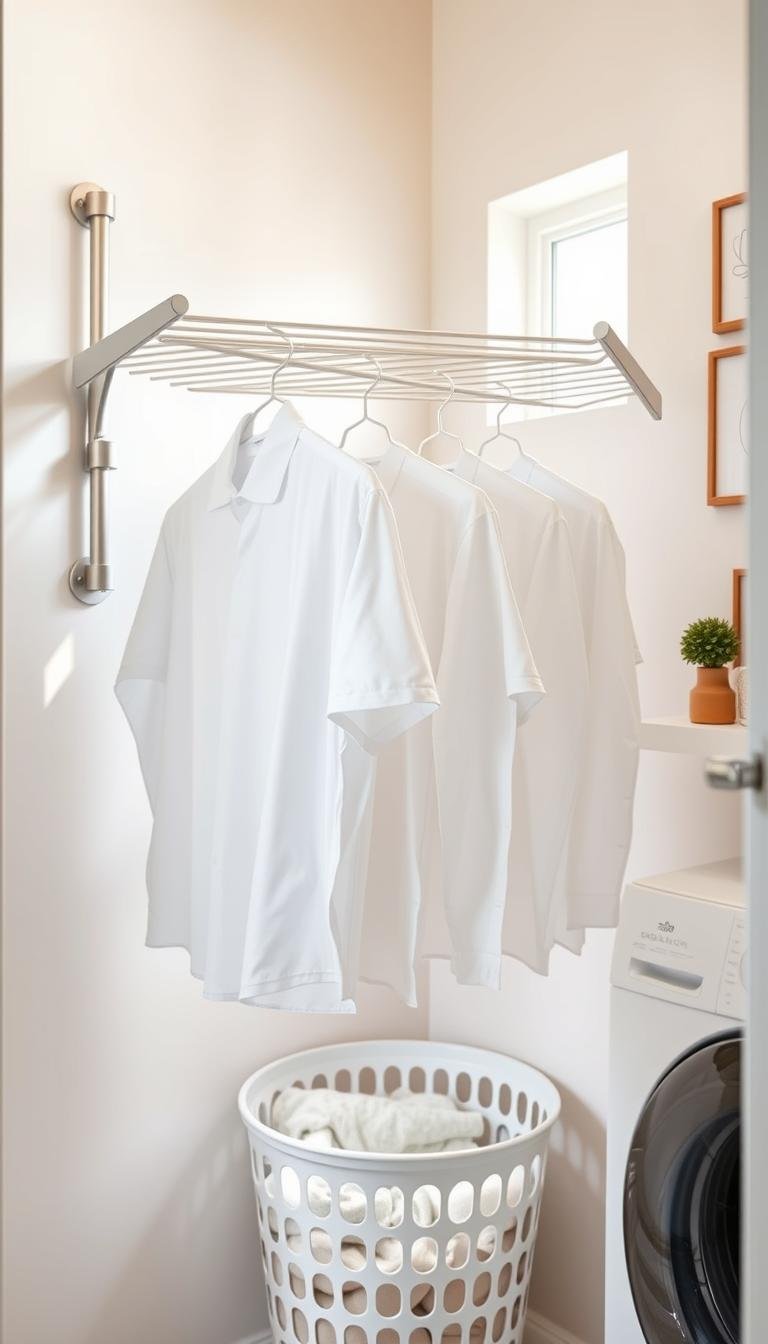
In a tiny laundry room, a freestanding drying rack can consume the exact floor space you need for baskets, doors, and access to the washer. Wall-mounted and over-door racks solve that by moving the drying surface into unused vertical space.
The right model depends on available wall width, how far the rack projects when open, the amount of wet laundry you usually air-dry, and the wall construction supporting it.
This guide compares space-saving drying-rack formats, published dimensions and weight capacities, mounting requirements, materials, and the trade-offs between fixed wall-mounted, accordion, over-door, and specialty drying solutions.
Why wall-mounted drying racks work in small laundry rooms
The advantage is simple: they use vertical space instead of floor space. That matters in laundry closets, narrow utility rooms and shared spaces where a freestanding rack blocks doors, baskets or appliance access.
A fold-flat or retractable rack is especially useful when the room has to serve more than one purpose. The important comparison is not how many bars a product advertises, but whether its open depth, wall width and rated load fit the space and the laundry you actually air-dry.
Measure the room before you compare racks
A drying rack has two footprints: the space it takes when folded and the space it occupies when loaded. Measure both.
Wall width and open projection
Check the usable wall width, then compare the rack’s depth when fully open. Make sure it will not interfere with appliance doors, cabinet doors, room doors, switches, outlets or the path you use to move a laundry basket through the room.
Load and material
Wet towels and denim are much heavier than dry shirts, so use the manufacturer’s published load rating rather than judging capacity by the number of rails. In a humid laundry area, corrosion-resistant finishes and hardware are worth prioritizing.
Mounting requirements
A wall-mounted rack is only as reliable as its attachment to the wall. Follow the manufacturer’s specified fasteners and substrate requirements. If the product requires studs, masonry anchors or a particular type of wall anchor, do not substitute lighter hardware just because it is easier to install.
For rentals or walls that cannot accept permanent mounting, an over-door or freestanding fold-flat format may be a better fit.
Four drying-rack formats worth comparing
The useful choice is between formats, not permanent “best overall” winners. Product lines change; the space problem usually does not.
Fold-flat wall rack
Best when you have a clear wall and want the rack to disappear between loads. Compare folded thickness, open projection, rail spacing and rated load.
Accordion rack
Useful on a narrower wall because it extends outward only when needed. Check how far it projects and whether the mechanism stays clear of doors and appliances.
Over-door rack
A practical no-drill option for renters, provided the door thickness is compatible and the rack does not prevent the door from operating safely. Include the rack and wet-clothing weight when considering the door and hinges.
Flat-dry or accessory rack
Better for sweaters, lingerie and other items that should not hang from a narrow rail. These can complement a main wall rack instead of replacing it.
Future product recommendations on this page should be grouped into these use cases and checked against current manufacturer dimensions, load limits and mounting instructions before publication.
Specialty drying needs
Not everything should hang from a bar. Sweaters and some knitwear are better dried flat, while socks, swimwear and small delicates can be easier to manage on a clip-style accessory rack.
A flat mesh rack, clip rack or small hanging accessory can complement the main wall-mounted rack without consuming permanent floor space. Check garment care labels before deciding whether an item should hang or lie flat.
For unusual laundry-room layouts, modular or custom systems can work around plumbing, doors and appliances, but preserve access to shutoffs, outlets, electrical panels and service clearances.
Plan placement and mounting carefully
Mount the rack where you can load it comfortably without blocking an appliance door, cabinet, walkway or required service access. There is no universal clearance number; use the rack’s fully open dimensions and the actual geometry of the room.
Follow the manufacturer’s mounting instructions exactly. Some products require studs or masonry; others permit specified anchors. The included hardware is not automatically correct for every wall construction.
- Mark the open footprint before drilling.
- Check the published load rating with wet laundry in mind.
- Spread heavy items across the rack rather than concentrating them at one end.
- Recheck fasteners periodically if the manufacturer recommends it.
If you cannot confidently identify the wall construction or choose the required fastener, have the rack installed by someone who can.
Make the rest of the room support the rack
A wall rack works best when baskets, detergent and hangers have places that do not compete with its open footprint. Shallow shelving, an over-door organizer, or a fold-down work surface can help if they fit the room without blocking ventilation or appliance access.
Clean the rack according to its material and finish instructions, and keep the room ventilated enough for wet clothing to release moisture. Inspect hinges, rails and mounting points for looseness or corrosion as part of normal maintenance.
The short version
Choose the rack format that solves the room’s actual constraint. Measure wall width and open projection, check what wet laundry you need to support, and follow the exact mounting requirements for your wall.
| If your main constraint is… | Start by comparing… |
|---|---|
| No spare floor space | Fold-flat or accordion wall racks |
| No drilling allowed | Over-door or freestanding fold-flat options |
| Heavy towels or denim | Higher published load ratings and stronger mounting requirements |
| Sweaters or delicates | Flat-dry or mesh accessory racks |
For more small-laundry planning, see how to make a laundry room more inviting, adding a fold-away ironing board, and the Dwelanor Room Guides.