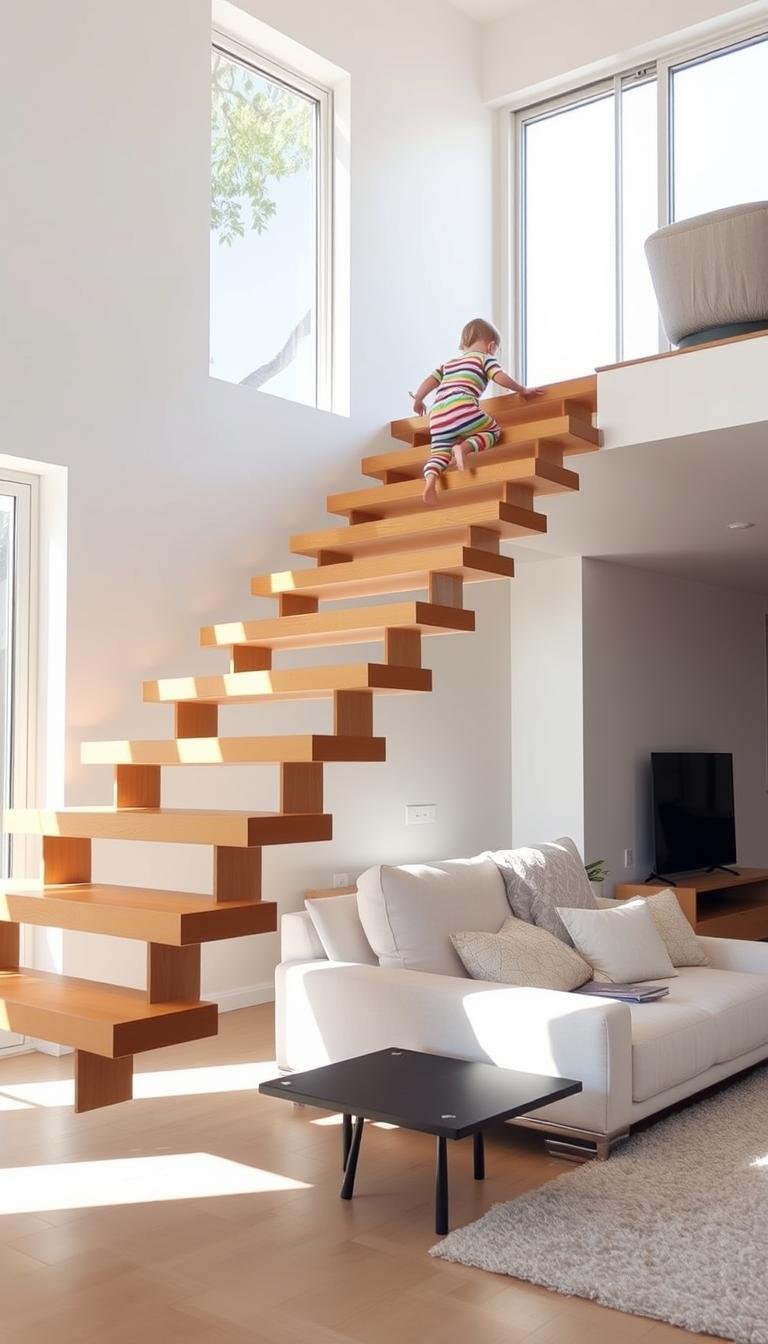
How do I stop my toddler from climbing the floating stairs?
I want a calm, practical plan that keeps everyone safe without turning a beautiful stair into off-limits furniture. I say this as a parent who prefers gentle, consistent steps over constant shouting.
Floating stair systems can meet strict safety rules when built right. Treads often support hundreds of pounds, and some tested systems resist extreme pull forces. The IRC’s four-inch sphere rule also helps keep small children from falling through open gaps.
My short-term fix is a trusted gate and removing easy footholds. For longer-term peace, I’ll consider upgrades like closed risers, tempered glass panels, wider treads, textured finishes, and integrated lighting for better visibility.
For data and certified options, I check product certifications and local code before buying. If you want details on tested systems and code guidance, see this discussion on stair safety and certifications.
Key Takeaways
- Block access with a well-mounted gate at top and bottom.
- Use redirection and routine to teach safe movement.
- Choose child-friendly design features like closed risers and tempered glass.
- Pick slip-resistant treads and consider extra grip strips or lighting.
- Verify ICC/IRC compliance and product testing before upgrades.
Why this matters right now: my toddler, modern floating stairs, and real safety risks
Open, modern steps look great, yet they change how I think about safety in our home. Properly engineered systems can exceed IBC load limits and meet the IRC 4-inch sphere rule. Viewrail’s ICC-tested components — like grade 8 bolts and flow-drilled connections — show strong performance.
But code compliance is not enough. Structural strength does not replace supervision or daily child-proofing. I treat structural features and behavior as separate layers. That helps me plan better protection and reduce risk.
I map where a curious child approaches the stair and note furniture that creates footholds. I also watch times when I feel most distracted. Small hazards include fingers in gaps, slick treads, and poor night visibility.
“Layering engineered design with simple daily routines gives realistic, effective protection.”
I ask caregivers and visitors to follow rules near the stair. Then I focus on practical fixes today while planning calmer long-term upgrades for safety that fits our life.
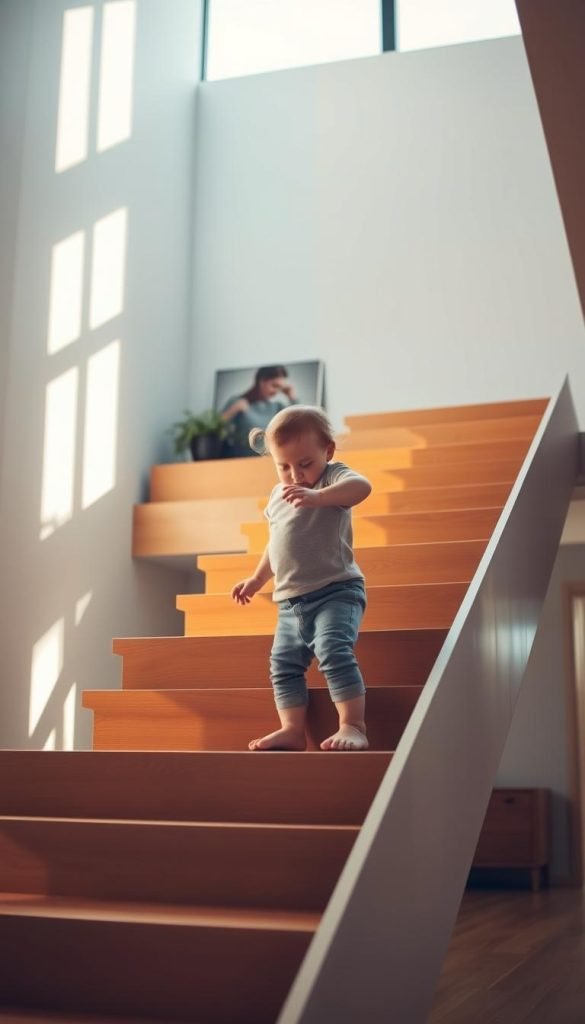
Understand the risks unique to floating staircases before I act
I first separate code claims from everyday reality. Building standards set minimums, but daily life exposes different hazards. I want facts I can use now and next steps I can plan.
Weight capacity versus real-world use
IBC requires a single tread to handle a 300 lb concentrated load. That baseline is useful, yet certified systems can far exceed it. ICC NTA tests on Viewrail show over 2,000 lbs to pull a tread free and 3,000+ lbs to damage it.
Open risers and gap limits
The IRC’s 4-inch sphere rule keeps openings small so bodies or heads can’t pass through. Closed riser choices like FLIGHT Stack or tempered glass rails remove tempting footholds and reduce entrapment.
Slip resistance and visibility
Traction matters. Wire-brushed treads, stainless grip strips, and edge LEDs improve footing and reduce missteps when light is low.
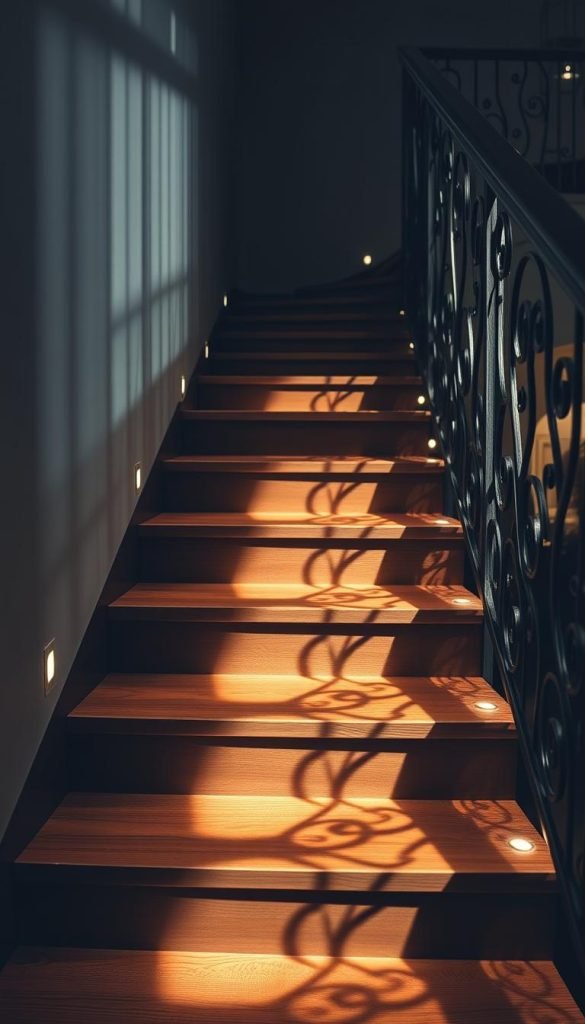
“Layer engineered strength with simple access control and visibility upgrades for real protection.”
| Feature | Code / Test | Practical benefit |
|---|---|---|
| Tread load | IBC 300 lb min; Viewrail 2,000–3,000+ lb tested | Peace of mind for heavy use and impact |
| Opening limits | IRC 4-inch sphere | Prevents fall-through and entrapment |
| Traction & visibility | Wire-brushed treads, grip strips, LEDs | Fewer slips and clearer step edges at night |
| Design options | Closed risers, tempered glass | Blocks gaps while keeping sightlines |
- I separate what codes promise from what daily life demands.
- I evaluate traction, gaps, and clear access control as first priorities.
- I list upgrade options to phase in—closed risers, glass, grip strips, LEDs—so the plan stays realistic.
My first line of defense: smarter baby gate choices that toddlers can’t climb
A smart barrier gives me real time to react and reduces daily worry around an open stair. A fabric stair gate removes horizontal rungs that little hands and feet use as a ladder. That makes climbing far harder while keeping sightlines and style.
Why fabric gates reduce leverage: taut textile removes footholds, resists grip, and rolls away for guests. Many models fit banister-to-wall spans and look less like a “jail” than metal bars.
When taller gates help—and why stacking is risky
Taller single gates can delay a determined climber. Stacking two systems is dangerous because most kits aren’t tested for combined pull forces. That can lead to breakaway, trapping, or collapse.
Mounting matters: secure at posts and banisters
Always anchor a gate to solid posts or newel posts with the recommended hardware. Check fittings where your child tends to grab or bounce. Test push, pull, and shake in multiple directions.
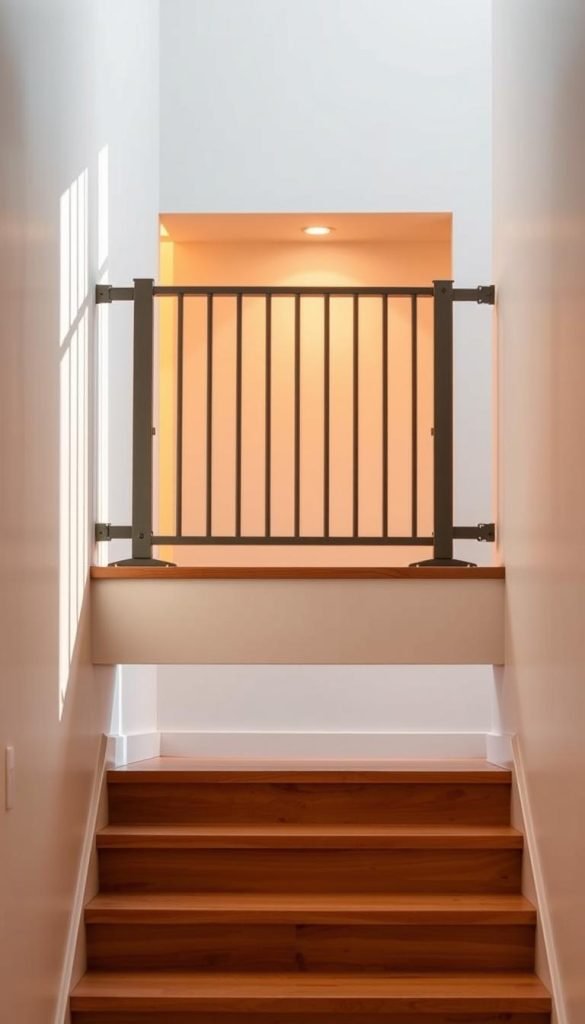
“A taut fabric face and correct mounting give practical protection without remodeling.”
- I choose a barrier that denies footholds and fits my opening.
- I measure spans, use banister-ready products, and avoid makeshift attachments.
- I follow mounting instructions and inspect hardware often.
| Option | Why it helps | Key caution |
|---|---|---|
| Fabric stair gate | Removes rungs, custom fit, rolls up | Use proper hardware; avoid stretchy mounts |
| Tall single gate | Extra height deters climbs | Don’t stack; added leverage risk |
| Bar-style gate | Durable and visible | Horizontal rails can become footholds |
Child-proofing the staircase design without sacrificing style
A few targeted design swaps can keep our stair a showpiece while removing small footholds. I focus on solutions that blend form and function so family life feels calmer and the look stays intentional.
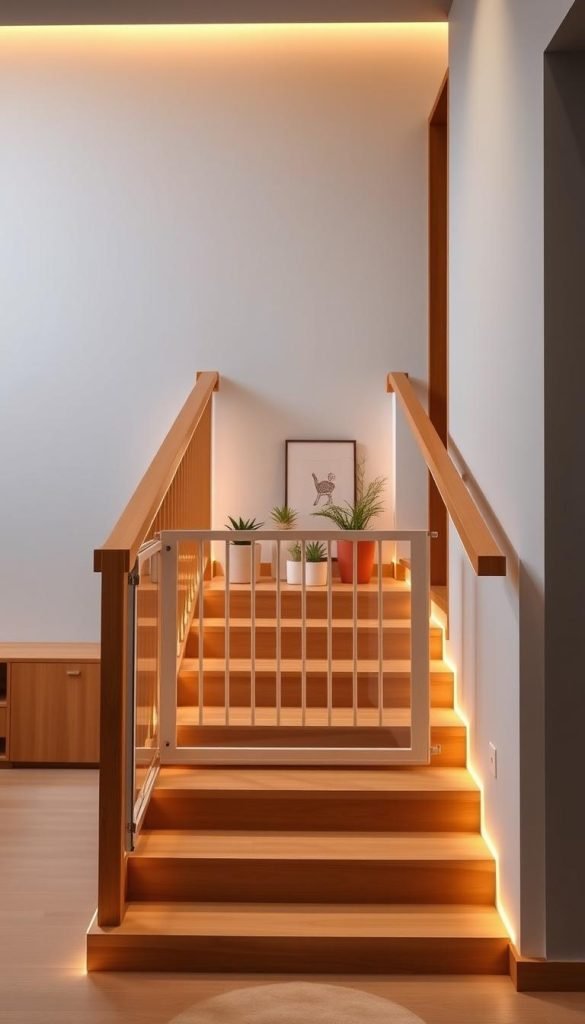
Tempered glass railings to eliminate climbable gaps
Tempered glass preserves sightlines and removes the gaps kids use as ladders. It resists impact and shatters safely, so it keeps the modern feel without compromising safety.
Closed-riser options to block access between steps
Closed risers, like Viewrail’s FLIGHT Stack, prevent hands and feet from slipping between treads. They keep the floating aesthetic while removing tempting openings.
Wider treads and handrails for better footing and balance
Spec wider treads — 12 inches or more — to make each step feel more secure. A well-sized handrail helps little ones and tired adults steady themselves.
LED lighting on steps and rails for safer trips at night
Wire-brushed treads and low-profile stainless grip strips add traction without shouting “industrial.” Integrated LEDs along treads or in the rail clarify edges in low light and cut missteps.
“Upgrade in phases: start with traction and lighting, then add risers or glass as budget allows.”
| Upgrade | Benefit | Design note |
|---|---|---|
| Tempered glass railings | Blocks climbable gaps; resists impact | Keeps open sightlines and modern look |
| Closed risers | Prevents access between steps | Retains floating feel with fewer gaps |
| Wider treads & handrails | Improves balance and comfort | 12″ tread depth recommended |
| Traction & LED lighting | Reduces slips; improves visibility | Wire-brushed finish, low-profile strips, integrated LEDs |
- Choose tested components with third-party or ICC certification for extra peace of mind.
- Coordinate finishes so upgrades look intentional, not piecemeal.
- Think maintenance: tempered glass and quality finishes ease cleaning in a busy home.
How do I stop my toddler from climbing the floating stairs?
A quick, fun distraction often redirects energy away from risky steps and into safe play. Parents report that swapping the stair chase for an engaging task cuts repeat attempts. I use simple cues like “stack blocks” or “catch bubbles” to change focus fast.
Provide clear, safe alternatives at home: couch cushions arranged as an obstacle course, a compact indoor jungle gym, and sturdy boxes let a child practice balance in a supervised way. Tot gym classes also offer supervised equipment for climbing skills without household hazards.

To keep novelty high, I rotate toys and challenges so kids choose the new setup over the stair. Short, upbeat praise—“Great feet on the floor!”—links good choices to attention and builds habit.
- I keep a bag of quick redirects ready: kick a ball, stack blocks, catch bubbles.
- I set up safe climbing stations: cushion islands, a small jungle gym, or boxes of different sizes.
- I schedule active play before high-risk times and consider a tot gym class for supervised practice.
- I make the gate routine and the alternative fun, store setups in sight, and repeat calm, consistent prompts.
Teach skills, not fear: training my child to climb down safely
Teaching calm, repeatable moves builds real confidence. A practiced, feet-first slide builds balance and gives safer options for descending low heights. I start where the risk is small so success feels big.
Feet-first, belly-slide technique for couches, beds, and low steps
Start on soft surfaces. I have the child lie on their belly at the couch edge, then guide their hips so their feet find the floor. I model the move first and make each landing a small celebration.
Practice on stools, low steps, and beds helps the skill transfer to other places. Over time, balance and judgment improve and risky attempts drop. That reduces accidental falls and builds real safety habits.

- I practice short, playful drills several times a day so muscle memory grows with time.
- I add a low step as a bridge between furniture and real stair treads, staying within arm’s reach.
- I use a simple cue like “feet first!” so the child remembers the safe choice.
- I refresh lessons after growth spurts and avoid shame—encouragement beats fear for lasting results.
“Confidence and calm movement reduce panicked motions that lead to falls.”
Tweak my home layout to remove easy “ladders”
I clear the zone around the landing so nothing becomes a ladder toward the top.
Small moves yield big safety wins. After meals I park dining chairs on the table or secure them with non-marking straps so they cannot roll or be pushed into place as a step-up.
I relocate low bookcases to closed rooms or bolt them to studs. I latch cupboards and use simple bungee ties to stop chairs from being dragged to a rail.
Removing side tables near couches and window seats removes easy bridges. I also keep toys and bins out of the path so clutter doesn’t become stepping stones for curious kids.

- I scan the area around the stair for anything that can be pushed, stacked, or climbed.
- I place the safest play zones away from gates so traffic flows away from the landing.
- I set up a cozy reading or play corner to compete with the stair’s novelty.
- I keep rugs flat and non-slip and create a staging area for shoes and bags away from the threshold.
- I review the layout after a week and tweak it based on what my child tries.
“Eliminating launch points lets a gate and rail do their job without constant battle.”
| Action | Why it helps | Quick tip |
|---|---|---|
| Park chairs on table | Removes mobile step-ups | Use non-marking straps for easy daily use |
| Secure or move bookcases | Prevents climbable rungs and tipping | Bolt to studs or relocate to a closed room |
| Pull furniture away from rail | Stops bridges to the landing | Check window seats and side tables first |
| Create distant play zone | Redirects attention and traffic | Rotate toys to keep it interesting |
Stay calm and consistent: supervision, boundaries, and consequences
Consistency trumps drama. When adults use the same words and the same actions, risky experiments fade over time. I watch for higher-risk moments and step in quietly before a problem grows.
Positive phrasing (“feet on the floor”) and predictable follow-through
Parents report success with steady spotting, calm redirection, and simple rules. A short phrase like “feet on the floor” gives children a clear cue without raising the temperature.
I give one reminder, then a predictable action — move to a new activity or carry out a brief, calm consequence. That steady way of responding teaches expectations fast.
Agreeing with other adults keeps mixed messages away. Over time, balance and curiosity shift to safer play, and the stair loses its appeal.

“Consistency is kinder than unpredictability; it builds trust and safer habits.”
- I supervise actively during high-risk time and use a steady voice.
- I avoid power struggles: lift down, redirect, and move on.
- I celebrate safe choices with specific praise to reinforce good behavior.
| Action | Why it helps | Quick tip |
|---|---|---|
| One clear cue | Makes expectations simple | Use the same phrase every adult uses |
| Predictable follow-through | Teaches cause and effect | One reminder, one short consequence |
| Active supervision | Prevents risky attempts | Put the phone away while on duty |
Codes and compliance I should check in the United States
Before any work begins, I check which state or local amendments might alter basic stair rules. Codes set national minimums, but local edits change how an inspector treats a job.
IBC basics: a single tread must resist a 300 lb concentrated load. That is the legal baseline and worth documenting for permits.
IRC basics: openings must pass the 4-inch sphere rule to limit gaps. Closed risers are an easy option when small hands are a concern.
I look for ICC-certified systems. For example, Viewrail’s FLIGHT Mono carries ICC approval and testing shows over 2,000 lbs to pull a tread free and more than 3,000 lbs to damage one.

“Verified components and solid anchoring make code conversations simple and inspections faster.”
- Verify IBC load and IRC opening limits, then check local amendments.
- Prefer ICC-certified systems and request test reports.
- Review hardware: grade 8 bolts, flow-drilled threaded connections, and header/footer anchoring.
- Confirm gate mounting at a post won’t violate railing code or damage structure.
- Keep manuals, certificates, and receipts for inspections or resale.
| Item | Code / Spec | Why it matters |
|---|---|---|
| Tread load | IBC 300 lb min; Viewrail 2,000–3,000+ lb tested | Shows real-world resistance beyond the minimum |
| Opening limits | IRC 4-inch sphere | Prevents small hands and heads reaching through gaps |
| Connections | Grade 8 bolts, thread-locking, flow-drilled | Anchor quality equals long-term safety at posts and rails |
Choose compliant design and options that meet code while matching your style. Licensed pros and proper permits keep the process smooth.
Conclusion
,Simple barriers, engaging alternatives, and steady coaching form a practical plan that keeps children safe while preserving good design.
Short term: block access with well-mounted baby gates that resist climbing, remove furniture ladders, and offer quick redirects so kids choose better options.
Skill work: teach feet-first descent on low steps and celebrate progress; calm routines lower panic and reduce falls over time.
Long term: consider glass rails, closed risers like FLIGHT Stack, wider treads, traction strips, and LEDs. FLIGHT Mono has ICC testing that exceeds code and helps inform choices.
Measure success by quieter days, fewer attempts at the top, and more play in approved zones. With patience and steady steps, our home can be both stylish and safe.